


Quick Answer: What Is Qigong?
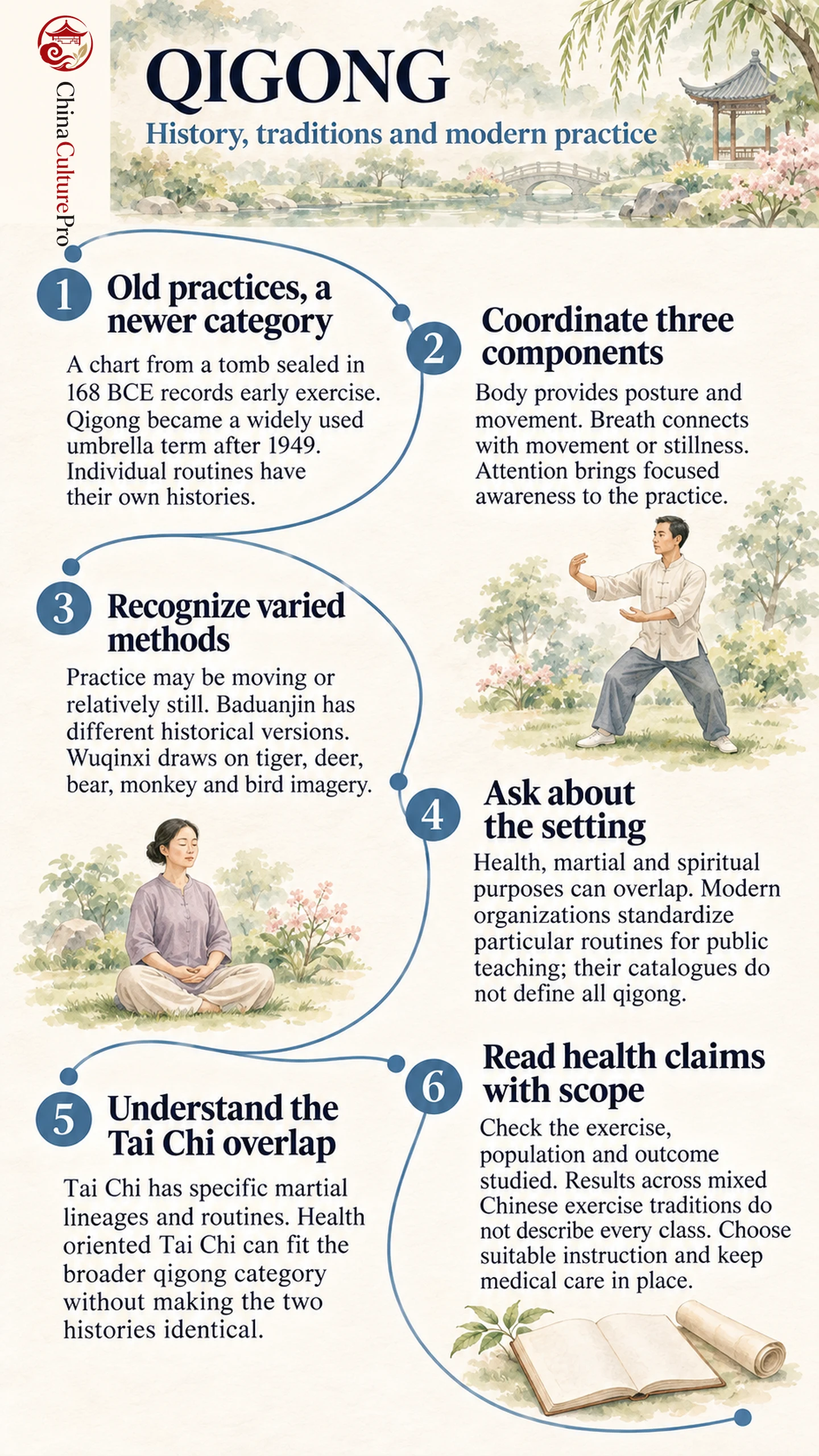
Qigong (气功, qìgōng) is a broad family of Chinese practices coordinating posture or movement, breathing and attention. Different traditions use that combination for physical cultivation, health-oriented exercise, martial training or spiritual development. [2]
- Older practices contributed to the tradition, while “qigong” became a widely used umbrella category in the twentieth century. [4]
- Practice may involve gentle movement or relatively still postures; it is not one universal sequence. [1]
- Health research needs to be read by the particular exercise, population and outcome studied. Results for mixed traditional Chinese exercise cannot automatically describe every qigong class. [8]
Identify the practice’s name, version and teaching purpose to understand what a class offers.
Qigong belongs in several overlapping histories: physical cultivation, medicine, meditation and Chinese martial arts. A quiet exercise class is one modern expression of that varied inheritance. Its cultural vocabulary and historical development help explain what practitioners are doing and how they understand it.
Older Practices and a Modern Umbrella Term
One older term is daoyin (导引, dǎoyǐn), often rendered “guiding and pulling.” The Daoyin tu (导引图, Dǎoyǐntú), an exercise chart associated with the Mawangdui (马王堆, Mǎwángduī) tombs, provides a concrete archaeological reference. Wellcome’s collection record identifies its displayed image as a reconstruction of a chart from Tomb 3, sealed in 168 BCE; the original is held in Hunan. A reconstructed chart and a modern exercise sequence are different objects. [3]
The modern umbrella has a more recent history. Anthropologist David Palmer explains that older body-cultivation practices circulated through medical, religious, scholarly and martial settings before 1949. After that date, qigong became a more general category for bringing varied methods into modern medical, scientific and public discussion. That does not mean the practices themselves all began in 1949. [4]
Palmer also describes the large public enthusiasm for qigong in the 1980s and 1990s. This later social movement is another layer in its history, alongside the much older techniques. Reading history and legend separately helps avoid giving every modern routine the age of the oldest evidence of Chinese exercise. [4]
Body, Breath and Attention
Three coordinated components offer a useful way to recognize practice:
- Body: Posture and movement provide the physical structure of practice. [2]
- Breath: Breathing may be coordinated with movement or attended to during stillness. [2]
- Attention: Focused awareness connects the physical and breathing aspects of practice. [2]
These components are practiced together. A teacher might draw attention to the relationship between movement and breathing, or ask students to notice their posture during a quiet exercise. The visible shape alone does not capture that learning task. [2]
Qi (气, qì) belongs to the tradition’s explanatory vocabulary, commonly translated as vital energy or breath. It helps describe how practitioners interpret cultivation and bodily experience. That cultural meaning should be distinguished from a laboratory claim that a particular healing energy has been measured. [2]
Moving and Still Practice: Two Named Examples
In dynamic practice, body movement is prominent. In meditative or relatively still practice, attention and breathing may be emphasized while a posture is maintained. “Still” therefore does not mean doing nothing, and qigong does not always mean a standing movement sequence. [1]
Baduanjin (八段锦, bāduànjǐn), commonly called the Eight Brocades, is one recognizable example. Historical accounts describe seated and standing versions, while the promoted Health Qigong version draws on standing practice. The name has appeared in different textual and teaching contexts; recognizing it does not establish that every video or class uses an identical sequence. [5]
Wuqinxi (五禽戏, wǔqínxì), the Five Animal Frolics, draws on tiger, deer, bear, monkey and bird imagery. China’s Health Qigong Management Centre explains how the modern sequence adapts material from older texts and traditions. These are human movement practices inspired by animal qualities, rather than literal animal imitation or a fighting-animal spectacle. Modern compilation and older cultural references coexist. [6]
These examples introduce named traditions, not a complete list of qigong systems. Their histories also show why a routine’s title, version and teaching lineage matter.
Traditions and Modern Teaching Settings
Qigong can support different purposes: health-oriented cultivation, martial preparation, meditation or spiritual development. These purposes may overlap. A single division into a few exclusive “types” cannot describe every teacher or lineage. Ask what the particular practice is intended to teach. [2]
Modern organizations select and standardize particular routines to give instructors and learners shared teaching references. China’s Health Qigong Management Centre updated its promoted-practice catalogue in 2026, connecting named routines with community, school and instructor teaching. Such a catalogue describes an organized program, not the outer boundary of everything historically called qigong. [7]
For a learner, useful questions include: What is the routine or method called? Which version is being taught? Does the class emphasize movement, meditation, martial preparation or another purpose? Can the teacher explain suitable adaptations? The context of teacher relationships can help with respectful questions about transmission and practice.
How Qigong Relates to Tai Chi
Tai Chi (太极拳, tàijíquán) has particular martial lineages, routines and partner practices. Qigong is a broader practice category. NCCIH notes that health-oriented Tai Chi can be understood within qigong because it integrates posture, attention and breathing. That functional overlap does not make the terms historically identical. Compare Tai Chi’s traditions and the closer Tai Chi versus qigong guide. [1][9]
Health Research and Its Limits
Research has examined benefits such as physical function, pain, sleep and mental health, but the exercise and population matter. A 2026 umbrella review of traditional Chinese exercises found some high-certainty benefits for particular musculoskeletal outcomes, including physical function in knee osteoarthritis. It combined evidence across several modalities, with Tai Chi prominent. Its results should not be rewritten as proof that every qigong method treats every condition. [8]
NCCIH describes qigong as generally appearing safe, while noting reports of effects such as muscle soreness or headache. Choose instruction appropriate to your abilities and ask about adaptations for an existing condition. Qigong should not delay medical assessment or replace prescribed treatment without discussion with the treating clinician. [1]
The wider history of Chinese medicine explains part of the cultural setting; current research addresses particular health claims. A tradition’s age and a study’s findings answer different questions.
FAQs About Qigong
Is every qigong practice thousands of years old?
No. Older exercise and cultivation traditions are documented, but the modern umbrella category and particular standardized routines have their own histories. An ancient chart cannot date every sequence now taught under the name. [3][4]
Does qigong have to involve standing movement?
No. It includes moving practices and relatively still meditative practices. Posture, breathing and attention can be coordinated without a continuous standing sequence. [1]
Is qigong necessarily religious?
No. Its history includes religious and secular settings. A particular teacher may frame practice spiritually, medically or as physical cultivation. Ask about that setting rather than assuming one belief system applies to all qigong. [4]
Does research prove that qi is a measurable healing energy?
An exercise study can test changes in specified health outcomes. Those results do not, by themselves, demonstrate a traditional energy explanation. Clinical benefit, mechanism and cultural interpretation are separate questions, even when discussed together in Chinese thought and related traditions. [8]
出典
[1] National Center for Complementary and Integrative Health. Qigong: What You Need To Know
[2] National Qigong Association. What Is Qigong?
[3] Wellcome Collection. Daoyin tu: Reconstruction of the Mawangdui Exercise Chart
[4] David A. Palmer. Modernity and Millenialism in China: Qigong and the Birth of Falun Gong
[5] Health Qigong Management Centre. The Historical Sources of Health Qigong Baduanjin
[6] Health Qigong Management Centre. The Historical Sources and Modern Compilation of Wuqinxi
[7] General Administration of Sport of China. Release of the Updated Health Qigong Practice Catalogue
[8] Chen and colleagues. Efficacy and Evidence Certainty of Traditional Chinese Exercises for Musculoskeletal Disorders
[9] UNESCO. Taijiquan