


Quick Answer
Lu Ban (鲁班, Lǔ Bān), also called Gongshu Ban (公输班, Gōngshū Bān) and known in Cantonese as Lo Pan, is a legendary master craftsman honored as a patron of the building trades. In Hong Kong, carpenters, masons and bricklayers are traditionally associated with his temple in Kennedy Town. An early story about Gongshu Ban, a later carpentry manual and a modern festival show how his name came to stand for different kinds of skill and authority.[1][2][3][4]
- The early text: The Mozi (墨子, Mòzǐ) tells of a confrontation over a siege ladder built by Gongshu Ban.[1]
- The trade manual: The Lu Ban Jing (鲁班经, Lǔ Bān Jīng) pairs work on timber houses with the selection of auspicious days and other ritual concerns.[2]
- The living festival: Hong Kong’s heritage inventory records the Lo Pan Festival on the twelfth and thirteenth days of the sixth lunar month.[3]
Stories credit Lu Ban with ingenious inventions. An object label or an old story can tell us what later people associated with him, while the history of a tool requires evidence of its own.[1][5]
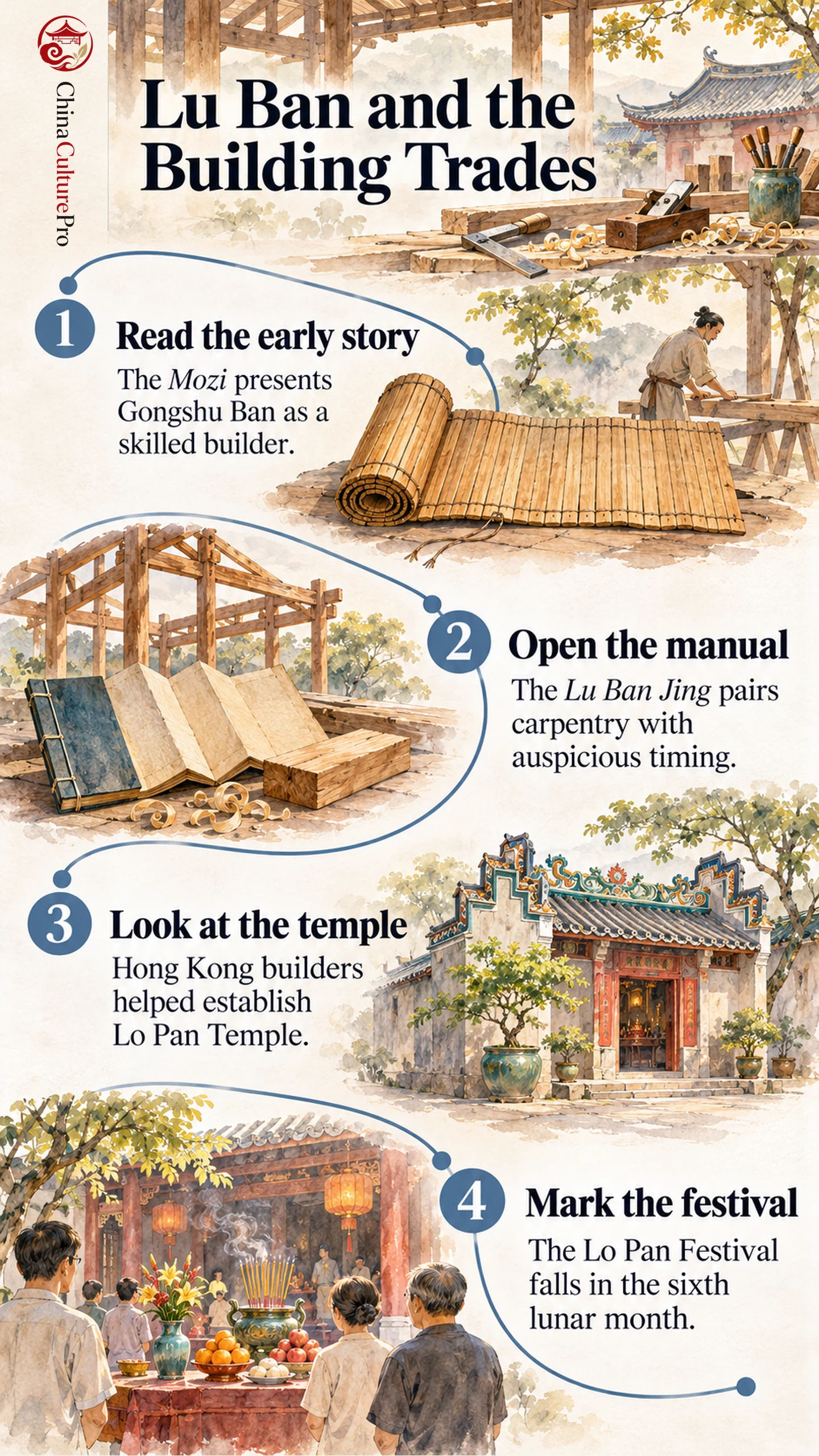
At Lo Pan Temple (鲁班先师庙, Lǔ Bān Xiānshī Miào), the builders left evidence of their own work in stepped gables, decorated ridges and wood carving. A twentieth-century woodblock print shows Lu Ban surrounded by the tools of his trade. Together, the temple and print give a sense of what it meant to honor a god defined by the work he could do.[5][6]
What the Early Story Says About Lu Ban
In the Gong Shu chapter of the Mozi, Gongshu Ban makes a siege ladder for the state of Chu. Mozi travels to oppose a planned attack on the state of Song. The two men demonstrate their approaches before the king, and the episode ends with Chu abandoning the attack. The story gives the craftsman recognizable technical skill while putting the moral choice about using it at the center.[1]
Later imagery gives him a different role. A twentieth-century woodblock print in the University of Michigan Museum of Art puts Lu Ban in the center, above two smaller figures working with wood. Other figures hold tools, including a saw and an axe. The museum identifies the wooden bird and the saw among the inventions attributed to the master. Those associations help explain how an image can celebrate his expertise without being a record of when the tools first appeared.[5]
What Carpenters Read in the Lu Ban Jing
The Lu Ban Jing preserves a late imperial carpentry tradition. Scholar Klaas Ruitenbeek describes a manual whose subjects include the procurement of timber, the choice of a favorable date and the raising of a house frame. For the world described in the manual, building began with decisions about timing and location, well before the frame went up.[2]
The manual’s name invokes a figure associated with mastery of the trade. Ruitenbeek studies a much later text than the Gong Shu story. The distinction matters because stories about the ancient craftsman, written rules for preparing building work and offerings honoring a trade patron answer different historical questions. The manual is particularly revealing about what some later carpenters and clients believed made a construction project auspicious.[1][2]
How Hong Kong Builders Honor Lo Pan
Kennedy Town’s Lo Pan Temple was founded in the 1880s and rebuilt at the same site in 1928. An official heritage assessment associates the temple with the three trades, known in Cantonese as Sam Hong (三行, Sān Háng in Mandarin). Donations came from individuals and companies in construction. The stepped gables and ceramic ridge decorations show what the trades could make as well as whom they honored.[4][6]
The Hong Kong intangible cultural heritage inventory names Kwong Yuet Tong (广悦堂, Guǎngyuè Táng in Mandarin) as organizer of the annual Lo Pan Festival. It records enshrinement, offerings to wandering spirits and celebrations in the sixth lunar month. The workshop and building site connect Lu Ban to a particular community, much as place and occupation shape other practices in <a href="/ja/”https://www.chinaculturepro.com/chinese-folk-religion/”/">Chinese folk religion</a> organized around particular communities.[3]
FAQs About Lu Ban and Craftspeople’s Worship
Is Lo Pan another name for Lu Ban?
Yes. Lo Pan is the Cantonese form used in Hong Kong. Lu Ban is the familiar Mandarin rendering, and Gongshu Ban is the name associated with the early literary figure.[1][4][6]
Was Lu Ban the inventor of the saw?
The saw is among the inventions later attributed to him. For example, it appears alongside other tools in a woodblock print described by the University of Michigan Museum of Art. That print documents the attribution in the twentieth century.[5]
Which trades honor Lu Ban in Hong Kong?
The official heritage assessment of Lo Pan Temple names carpentry, masonry and bricklaying. It also documents support from the wider building industry at the temple’s founding.[4]
出典
[1] Chinese Text Project. Mozi, Gong Shu
[2] Klaas Ruitenbeek. The Lu Ban Jing and house building
[3] Hong Kong Intangible Cultural Heritage Office. ICH Inventory, entry 3.28
[4] Hong Kong Legislative Council. Lo Pan Temple monument declaration, heritage assessment
[5] University of Michigan Museum of Art. Lu Ban, Patron God of Carpenters
[6] Hong Kong Antiquities and Monuments Office. Lo Pan Temple