

Quick Answer: What Is Return by Zhao Mengfu?
Return (歸去來辭, Guīqùlái Cí), also translated as The Return or Returning Home, is a literary work by 陶淵明 (陶淵明, Táo Yuānmíng) copied by Zhao Mengfu (趙孟頫, Zhào Mèngfǔ). This guide focuses on the Yuan-dynasty ink handscroll in Liaoning Province Museum. The text describes departure from official life, arrival home and reflection on time and mortality. Zhao’s calligraphy gives that earlier composition a distinct visual form; he did not compose the original words.[1][2]
An old literary work can acquire a new visual presence each time a calligrapher writes it. This scroll brings together two creative acts separated by centuries: a poet’s account of leaving office and a later writer’s arrangement of those words in ink.
Identify the Calligrapher, Text and Surviving Version
The author of a text and the writer of a particular manuscript need not be the same person. Keep that distinction in view when reading a museum caption.
| 問い | Liaoning version |
|---|---|
| Who composed the literary work? | Tao Yuanming, in 405 |
| Who wrote this calligraphic version? | Zhao Mengfu |
| What is the medium? | Ink on paper |
| What is the format and script? | Handscroll in running script (行書, xíngshū) |
| Where is it preserved? | Liaoning Province Museum |
| What measurements does its exhibition label give? | 24 × 146.2 cm in the 2023 joint exhibition label |
| What date is assigned here? | Yuan dynasty; no exact year is supplied by that label |
The exhibition photograph includes a standing-figure portrait at the right, a narrow written section and part of the main calligraphy. It is a detail of an assembled object, rather than a photograph showing every component at equal scale.[1]
The Preface Explains Why the Speaker Leaves Office
The prose preface begins with a practical problem: the household is poor, farming does not provide enough and children need support. An official appointment offers a possible livelihood. Yet the speaker soon feels the conflict between earning a living in that position and acting in accordance with his own disposition.[2]
The preface then names a family bereavement as the immediate occasion for leaving. It records a brief period in office and dates the composition to the eleventh lunar month of 405. That explanation is more specific than a general story about a poet suddenly deciding that nature is pleasant.[2]
Reading the preface first also changes the emotional weight of the homecoming. The fields and garden answer a difficulty already described. The pleasure of home is connected to work, obligations and the cost of living against one’s own inclinations.
Four Passages Carry the Homecoming beyond a Simple Escape
The main text moves from an urgent decision toward domestic pleasure and, eventually, acceptance of a limited life. These brief English senses explain selected classical passages rather than reproduce a modern published translation.[2]
| Passage | Plain English sense | What it adds |
|---|---|---|
| 田園將蕪胡不歸 | The fields and garden are becoming overgrown; why not go home? | Makes homecoming an action that can no longer be postponed |
| 三徑就荒,松菊猶存 | The paths have grown wild, but pine and chrysanthemums remain | Joins neglect with the persistence of familiar things |
| 雲無心以出岫,鳥倦飛而知還 | Clouds drift from the hills without intention; tired birds know to come back | Places the human homecoming beside movements in nature |
| 感吾生之行休 | I feel that my own life is moving toward its close | Brings mortality into the pleasure of seasonal renewal |
The last movement prevents an entirely carefree reading. Plants and streams enter their season, while the speaker recognizes that his own time is passing. The work does not end by promising endless leisure. It asks how a person might inhabit the life that remains.
For a reader exploring Chinese poetry, this combination is useful: a familiar rural image can carry joy, ethical choice and awareness of death within the same work.
The Writing Turns an Older Text into a New Visual Work
In the published Liaoning detail, the columns extend across a pale sheet with clear intervals between them. The dark characters do not occupy those intervals uniformly. Some forms gather into compact centers; others open out or send a stroke diagonally into neighboring white space.
Compare the black mass within one character with the narrow thread linking two movements. Their difference creates a rhythm that cannot be described simply as neat or flowing. Then look at the small changes in height and inclination from one column to the next.
The broader vocabulary of Chinese calligraphy styles helps identify the script, but close comparison explains what this particular execution does. A calligrapher can preserve the wording of an earlier work while changing how long the eye pauses, where forms gather and how the passage unfolds visually.
The choice of this text also invites reflection on withdrawal from office. Zhao himself served in government, so the relation between literary ideal and official life is part of the work’s later interpretation. The copied words alone do not establish a specific resignation decision or an exact date of writing.[1]
The Liaoning and Shanghai Copies Are Different Objects
Zhao wrote the composition more than once. The Shanghai Museum preserves a version dated 1297, measured at 25.9 × 139.4 cm in the Palace Museum’s exhibition record. Its date and measurements should not be transferred to the Liaoning scroll.[3][4]
When comparing reproductions, read the collection, dimensions and date together. Matching literary text does not make two manuscripts the same physical work.
How to Read the Text and the Brushwork Together
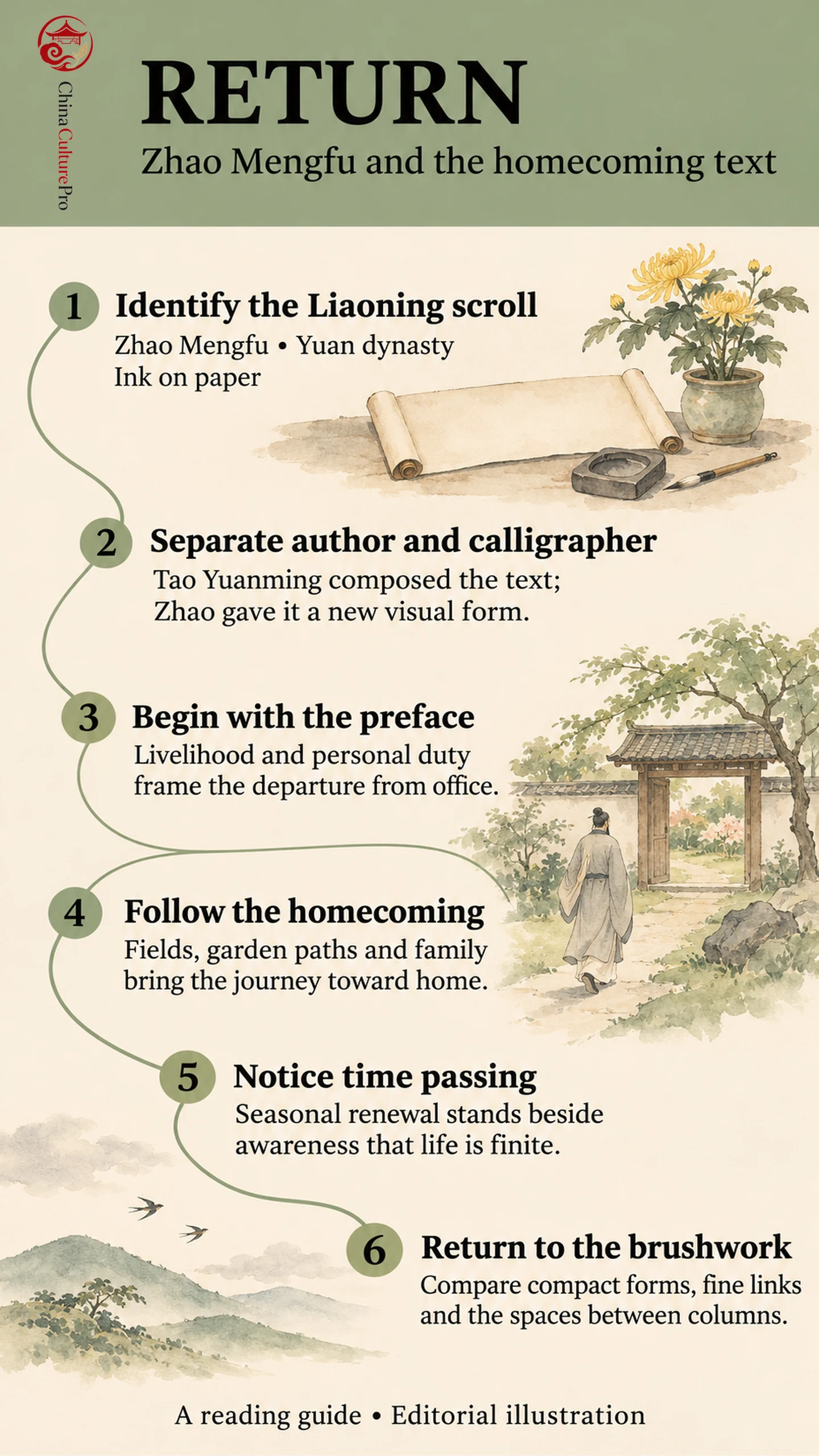
- Identify the version: Check that the caption names the Liaoning collection before using its metadata.
- Read the preface: Notice the livelihood problem and the stated occasion for leaving office.
- Choose a literary landmark: Follow one short passage from the homecoming or the reflection on passing time.
- Compare its surrounding forms: Examine the character spacing and ink shapes, then return to the whole group of columns.
The guide to reading Chinese calligraphy provides further exercises for connecting text, script and viewing distance.
FAQs About Return by Zhao Mengfu
Did Zhao Mengfu write the original literary work?
No. Tao Yuanming composed the text centuries earlier. Zhao produced a calligraphic version of it during the Yuan dynasty.[1][2]
Is Return a landscape painting?
The principal work discussed here is calligraphy. Its words describe gardens, fields, clouds and birds, but verbal landscape imagery is different from a painted landscape.
Does the work describe an entirely carefree retirement?
No. The pleasure of home is set beside financial difficulty, personal obligation and recognition that life is finite. Those tensions are part of its literary movement.[2]
出典
[1] Beijing Fine Art Academy. Landscape within the City: Exhibition of Literati Life and Art
[2] Tao Yuanming. Returning Home with Preface: Classical Chinese Text
[3] Shanghai Museum. Zhao Mengfu’s Running-Script Returning Home Scroll
[4] Palace Museum. Zhao Mengfu’s Artistic Achievement: Returning Home Scroll