


Quick Answer: Who Was Yu Zhiding?
Yu Zhiding (禹之鼎, Yǔ Zhīdǐng; 1647–circa 1716) was an early Qing painter best known for portraits that place recognizable individuals within carefully chosen settings. [1][4]
- Likeness: Facial modeling and flowing robe lines have different visual jobs.
- Setting: Objects and activities help express the sitter’s cultivated identity.
- Authorship: A portrait and its landscape could be painted by different artists.
A convincing likeness does not make every surrounding detail a literal record of the sitter’s everyday life.
A small seated figure can be the center of a long landscape scroll. To understand such a portrait, look beyond the face: the activity, companions and surrounding space help explain how the person is presented.
A Portrait Painter Between Court and Scholar Circles
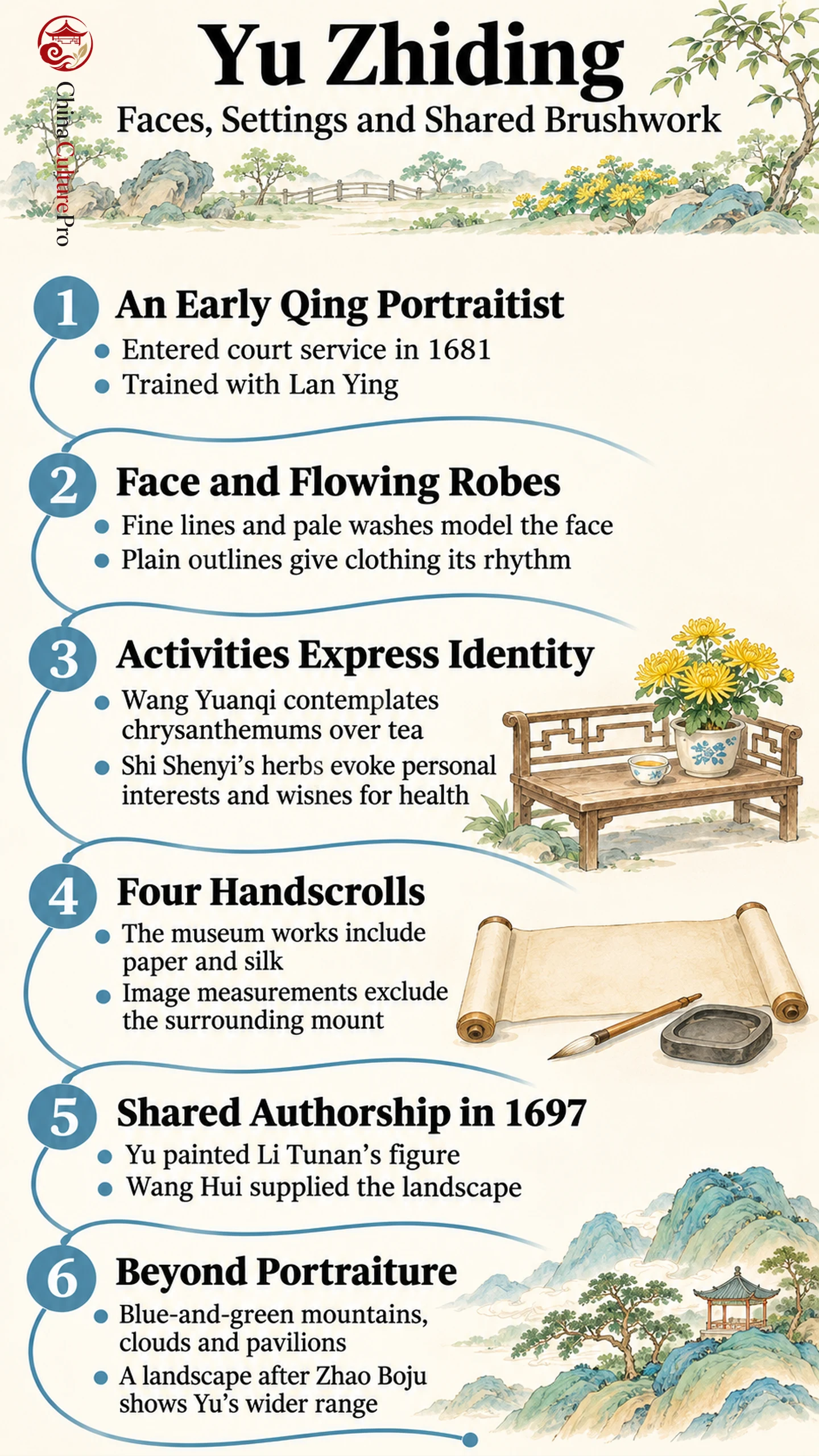
From Jiangdu, now Yangzhou in Jiangsu, Yu trained with Lan Ying and studied earlier painting. He entered court service in 1681 during the Kangxi period. [1]
In this branch of Chinese figure painting, identifying the sitter leads to a further question: which aspects of that person does the composition bring forward?
Reading a Face, a Pose and a Setting
Plain-outline drawing (白描, báimiáo), associated with Li Gonglin, informs the robes in Yu’s Wang Yuanqi portrait. Fine facial lines and pale ink-and-ochre washes establish a different texture. [2]
These painting techniques direct attention between physical presence and the movement of cloth. Follow a sleeve contour, then return to the eyes and mouth; a change in line or wash can make the face feel more concentrated than the surrounding garments.
Wang Yuanqi holds tea while contemplating chrysanthemums, with books and scrolls nearby. [2] Interpretación tea culture and chrysanthemum associations provides context for this cultivated setting.
In Cleansing Medicinal Herbs in the Stream on a Spring Day, the sitter is Shi Shenyi, an official and poet interested in medicine. An attendant washes a fungus, while the sitter rests among bamboo and herb plots. Blossoms and returning swallows indicate spring. The scene may express a friend’s wish for his recovery; it does not document a successful treatment. [4]
This is where medicine’s cultural history enters the portrait. A chosen activity helps distinguish one sitter from another rather than functioning as anonymous decoration.
Four Handscrolls to Compare
Measurements below refer to the painting, excluding the surrounding mount. The comparison keeps materials and collaborators attached to the correct object.
| Work | Collection and medium | Date and image size |
|---|---|---|
| Wang Yuanqi Cultivating Chrysanthemums | Palace Museum, Beijing; ink and color on silk | Qing dynasty; 32.4 × 136.4 cm. [2] |
| Li Tunan Listening to Pines | Palace Museum, Beijing; Yu Zhiding and Wang Hui; ink and color on paper | 1697; 30.8 × 133.3 cm. [3] |
| Cleansing Medicinal Herbs in the Stream on a Spring Day | Cleveland Museum of Art; ink and color on silk | 1703; 36.2 × 132.5 cm. [4] |
| Entertaining in the Studio Xizhai | Shanghai Museum; ink on paper | Qing dynasty; 30.1 × 161.4 cm. [5] |
When Two Painters Shared One Portrait
In Li Tunan Listening to Pines, Yu painted the figure and Wang Hui supplied the landscape. Their contributions belong to one coordinated work. [3]
By contrast, the inscription on Entertaining in the Studio Xizhai identifies its background as following the Northern Song painter Wang Shen. The portrait combines outlining, washes and ink modeling, with subtle facial color and lightly drawn clothing. [5]
An earlier stylistic model and a contemporary collaborator are different kinds of authorship. Inscriptions and seals can help establish those relationships. When a catalogue lists two painters, do not assume that both worked on every figure, tree and building.
Landscapes Beyond Portraiture
Blue-and-green landscape (青绿山水, qīnglǜ shānshuǐ) also belonged to Yu’s repertoire. His After Zhao Boju’s Landscape uses strong blue-green mountains, gold-toned contours, clouds, buildings and small figures to evoke an otherworldly setting. [6]
For a longer view of this landscape tradition, compare the earlier reputations of Li Sixun and Li Zhaodao. An artist renowned for portraits could work across subjects and inherited styles; a single category does not encompass the whole career.
FAQs About Yu Zhiding
Did Yu Zhiding paint only portraits?
No. He also painted landscapes, including a blue-and-green composition after Zhao Boju. [6]
Is a landscape portrait a literal record of a sitter’s home?
That should not be assumed. Shi Shenyi’s spring garden, for example, carries wishes for health as well as references to his interests. [4]
When did Yu Zhiding live?
He was born in 1647 and died around 1716. [1][4]
Fuentes
[1] Palace Museum, Beijing. Yu Zhiding
[2] Palace Museum, Beijing. Wang Yuanqi Cultivating Chrysanthemums
[3] Palace Museum, Beijing. Li Tunan Listening to Pines
[4] Cleveland Museum of Art. Cleansing Medicinal Herbs in the Stream on a Spring Day
[5] Shanghai Museum. Entertaining in the Studio Xizhai
[6] National Palace Museum, Southern Branch. After Zhao Boju’s Landscape