


Quick Answer: What Is the Yu Mouth Organ?
The yu (竽, yú) is an ancient Chinese free-reed mouth organ. Its pipes meet a shared air chamber, a construction familiar from the related sheng (笙, shēng).[3]
- Surviving form: A Western Han burial model preserves bamboo pipes and a wooden chamber.[1]
- Sound evidence: Another Mawangdui (马王堆, Mǎwángduī) find preserves reed components.[3]
- Written memory: A tale in the Han Feizi places yu players at the court of Qi.[5]
Check whether a recording identifies an archaeological reconstruction or a modern mouth organ.
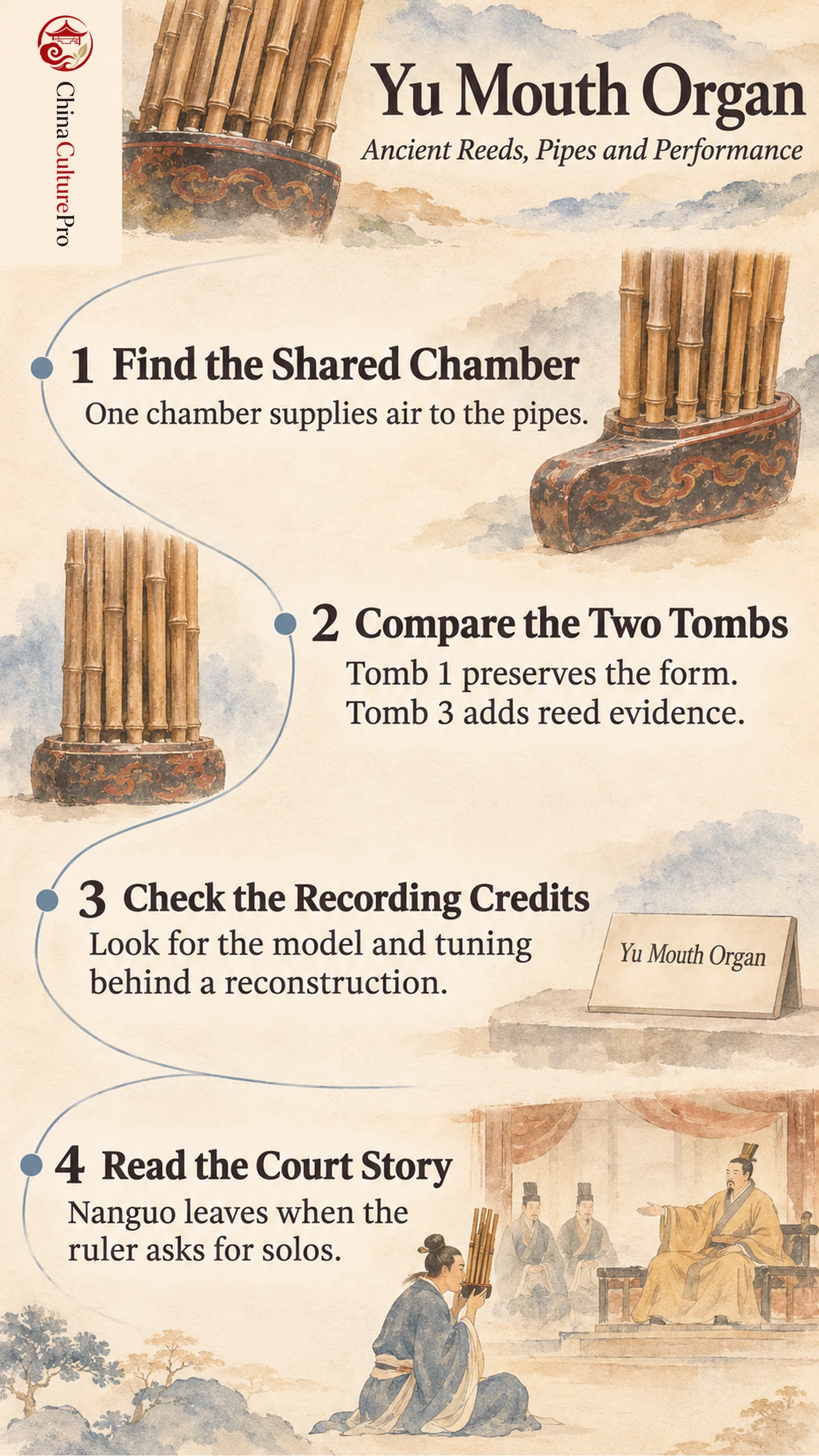
The pipes on an excavated yu can look like a bundle of panpipes. Look down to the wooden piece that joins them. This chamber is where the player would supply air to a working instrument, and it is a good starting point for reading the finds from Mawangdui.
The Wind Chest and Its Pipes
In this mouth organ family, air enters through a common chamber or wind chest. A thin reed tongue vibrates at the base of a sounding pipe. On a traditional sheng, closing a finger hole lets the pipe reinforce that vibration. Closing more than one can produce a combination of pitches.[3]
A player of paixiao panpipes moves the mouth to another pipe to change notes. A mouth organ player keeps the lips at the air inlet and selects pipes with the fingers. The comparison of sheng and yu explains how the names have been used for related instruments.
Two Yu from Mawangdui
Tomb 1 at Mawangdui, in Changsha, yielded a model from the Western Han dynasty. Its 22 bamboo pipes stand in two parallel rows in a wooden chamber. The pipes lack reeds, consistent with its identification as a burial object. In the collection photograph, the narrow pipes meet the much wider chamber near one end.[1][2]
The yu from Tomb 3 preserves a different kind of evidence. Musicologist Alan R. Thrasher describes surviving reeds and a folded pipe in which a passage connects two lengths of bamboo. The burial model preserves the assembly and Tomb 3 adds evidence of how pipes could be made to sound.[3]
How to Listen to a Reconstruction
When a recording credits a reconstruction, look for the tomb number and a note about how the maker chose the tuning. A photograph of the Tomb 1 object gives evidence for the arrangement of the pipes. Its missing reeds limit what can be inferred about the original sound.[2]
The Met’s recorded sheng offers a comparison from the same instrument family. Listen to the way a pitch holds as air continues to feed the reed, then look at which instrument the collection actually identifies.[4]
The Yu in a Court Story
In the Han Feizi, the ruler King Xuan of Qi listens to a large group of yu players. A man called Nanguo takes a place among them. When the next ruler calls for individual performances, he leaves. The change from group to solo playing drives the story and makes it a story about how a crowd can conceal a person’s lack of skill.[5]
The tale is remembered in lan yu chong shu (滥竽充数, làn yú chōng shù), one of the Chinese chengyu that carry an older story into everyday speech. The idiom can describe pretending to have a skill while making up the numbers.[5]
FAQs About the Yu Mouth Organ
How many pipes did a yu have?
The Mawangdui Tomb 1 burial model has 22. That is a count for a specific surviving object.[2]
How did a yu differ from panpipes?
A yu uses reeds and a shared wind chamber. In panpipes, the player blows across the separate ends of the pipes.[3]
Why does the yu appear in a Chinese idiom?
The Han Feizi story about Nanguo turns on his ability to pass as a player in a group. It gives the idiom its sense of pretending to contribute.[5]
Fuentes
[1] Hunan Museum and Royal College of Music. Collection Spotlight Special: Hunan Museum
[2] National Taiwan University teaching resource. Illustrated Objects of the Shang, Zhou, Qin and Han
[3] Alan R. Thrasher, ACMR Reports. The Chinese Sheng: Emblem of the Phoenix
[4] The Metropolitan Museum of Art. Sheng, 89.4.2894
[5] Chinese Text Project. Han Feizi: Inner Storage Explanation Upper