


Quick Answer
Fire has different roles in documented Yi communities. A hearth (火塘, huǒtáng) in an upland Liangshan home can be a place for cooking. Other records describe fire in rites or in a Torch Festival (火把节, Huǒbǎ Jié). The phrase “fire worship” is most useful when a source names the people, place and occasion it describes.[1][2][3][4]
- At home: An account of upland houses describes a fire pit with a trivet or hearthstones.[1]
- In interpretation: A national heritage article reports different proposals for the origins of the Torch Festival.[2]
- In a public event: Chuxiong documents festival performances alongside work to record hearth customs and ritual practices.[4]
A household hearth, a particular rite and a public celebration give fire different functions.[1][2][4]
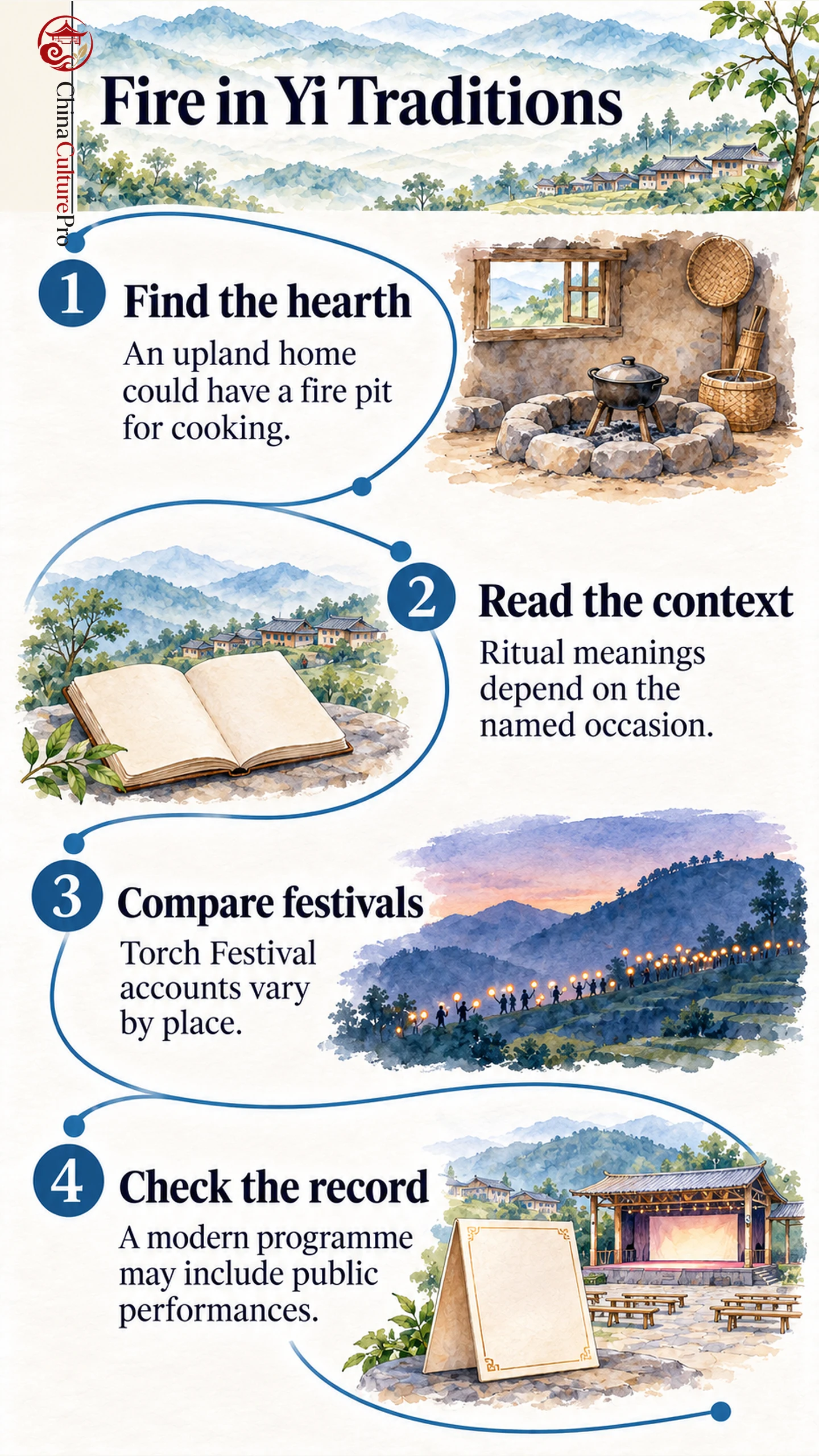
A fire pit in a house leaves evidence in the architecture. A torch procession leaves a record in photographs and programmes. Each points to a different part of Yi life. Reading the source alongside the scene is more informative than using one label for every occasion where fire appears.[1][2][4]
What the Hearth Did in a Household
The introduction to The Nuosu Book of Origins describes traditional upland houses with a fire pit to one side of the main room. It records a three-legged iron trivet or three shaped hearthstones supporting a pot. The smoke and soot described in the account also show how the fire affected the room in daily use.[1]
The same study describes different building forms in lowland areas. The contrast helps explain why one traditional hearth description cannot stand in for every Yi household. Household objects give another view of that setting. The guide to Yi lacquerware explains the documented uses of bowls and other vessels in particular communities.[1]
How Ritual Gives Fire a Context
A record that calls a practice a fire rite should identify the occasion. Chuxiong’s culture bureau describes efforts to document rites involving fire and separately records household hearth customs. A record of a domestic room can describe cooking and household arrangements. A named rite can describe the symbolic role of fire at a particular occasion.[4]
One heritage account reports a scholarly interpretation that links the Torch Festival to hopes of protecting crops from pests. It also reports another interpretation related to an older calendar. The source presents both explanations as interpretations. In Liangshan, the article on Yi bimo ritual specialists gives a separate example of why a named ceremony and local source matter.[1][2]
What Torch Festival Records Explain
The national heritage network describes Torch Festival practices in Liangshan in Sichuan, Chuxiong in Yunnan and Hezhang in Guizhou. It uses the twenty-fourth day of lunar month six in describing those cases. The festival name also appears among several other ethnic communities. The name and date are starting points for checking a particular local account.[2][3]
The activities named in the records vary. The heritage network illustrates a ceremony in Chuxiong and a swing activity in Hezhang. It describes uses of torches and mentions several narratives associated with the festival. Those examples show why the programme matters when identifying an activity in a photograph.[2]
How to Read a Modern Festival Account
The Chuxiong culture bureau’s 2026 report describes both documentation of customs and public presentations. This lets readers identify which statements concern archived practices and which describe an event staged for an audience. Check the date and organiser on a programme to determine its scope.[4]
A caption can also distinguish a household scene, a named ceremonial activity and a public performance. A bright fire or a group carrying torches can establish what is visible. The label or account supplies the location and purpose.[1][2][4]
FAQs About Yi Fire Traditions
Does the Torch Festival Have One Origin Story?
The heritage network records several interpretations, including connections with crops and with an older calendar. Read each account in relation to the community and tradition it names.[2]
Is a Household Hearth the Same as a Festival Torch?
A hearth is a place for fire in a dwelling and can support cooking. Torch Festival records describe torches in collective events. The house and festival accounts document different settings.[1][2]
Fuentes
[1] University of Washington Press. Introduction to The Nuosu Book of Origins
[2] China Intangible Cultural Heritage Network (Red del Patrimonio Cultural Inmaterial de China). Yi Torch Festival examples and interpretations
[3] China Intangible Cultural Heritage Network. Yi Torch Festival inventory entry
[4] Chuxiong municipal culture and tourism bureau. Documenting local fire customs and the Torch Festival