

Quick Answer: What Are Wontons?
Wontons (馄饨, húntun) are filled Chinese dumplings, usually made with wheat-flour wrappers. Their skins, fillings and serving styles change across regions.
- Wrappers: Wheat-based skins can be delicate or more substantial, folded into triangles, joined-corner parcels or loose bundles.
- Fillings: Pork is common, often combined with shrimp or greens. Chicken and vegetable versions also exist.
- Regional styles: Cantonese, Shanghai, Sichuan and Fujian traditions emphasize different textures, ingredients and forms.
- Serving styles: Wontons may arrive in broth, dressed with chili oil or another sauce, or fried until crisp.
Shrimp, chili and soup are not essential to every wonton. The English name identifies a food family, rather than one fixed recipe.
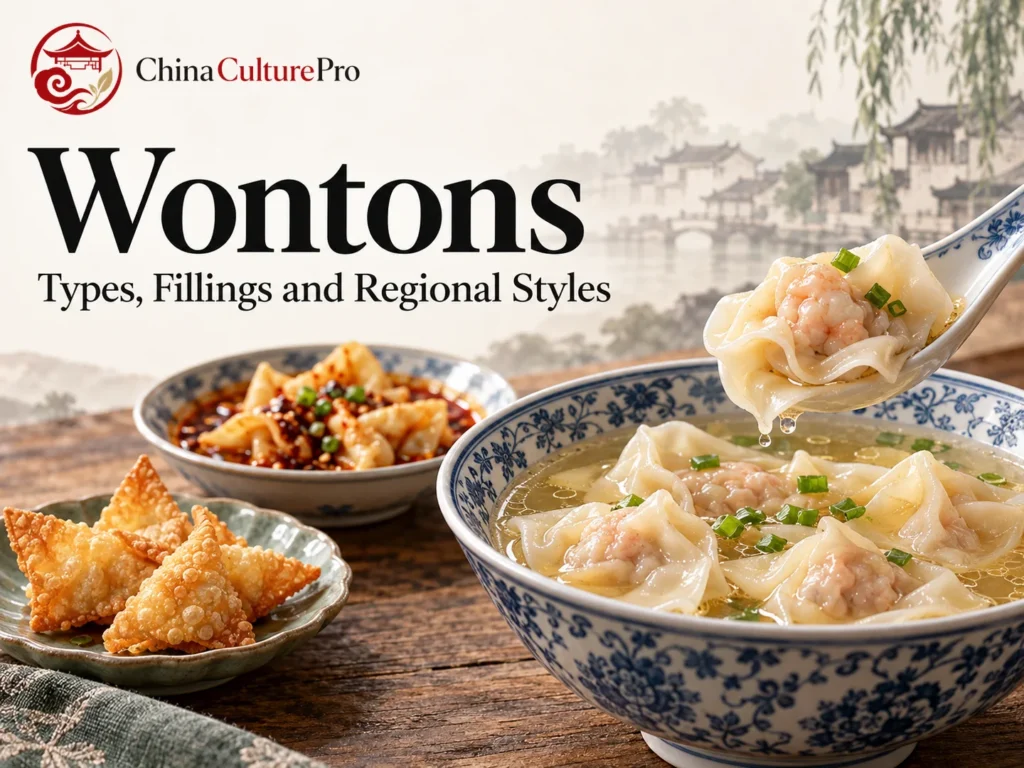
A clear bowl of Cantonese soup, a chili-oil dish and a plate of substantial Shanghai parcels can all appear as “wontons” on an English menu. The name alone tells you little about the filling or the meal’s flavor. Within the broader family of Chinese dumplings, wontons have their own regional names, wrapper textures and serving traditions. Reading those features together makes the differences easier to recognize.
Why Wontons Have Different Chinese Names
The English word wonton is borrowed from Cantonese, rather than being the Mandarin pinyin for 馄饨.[1] Local names remain useful on Chinese menus, even when an English translation groups them together.
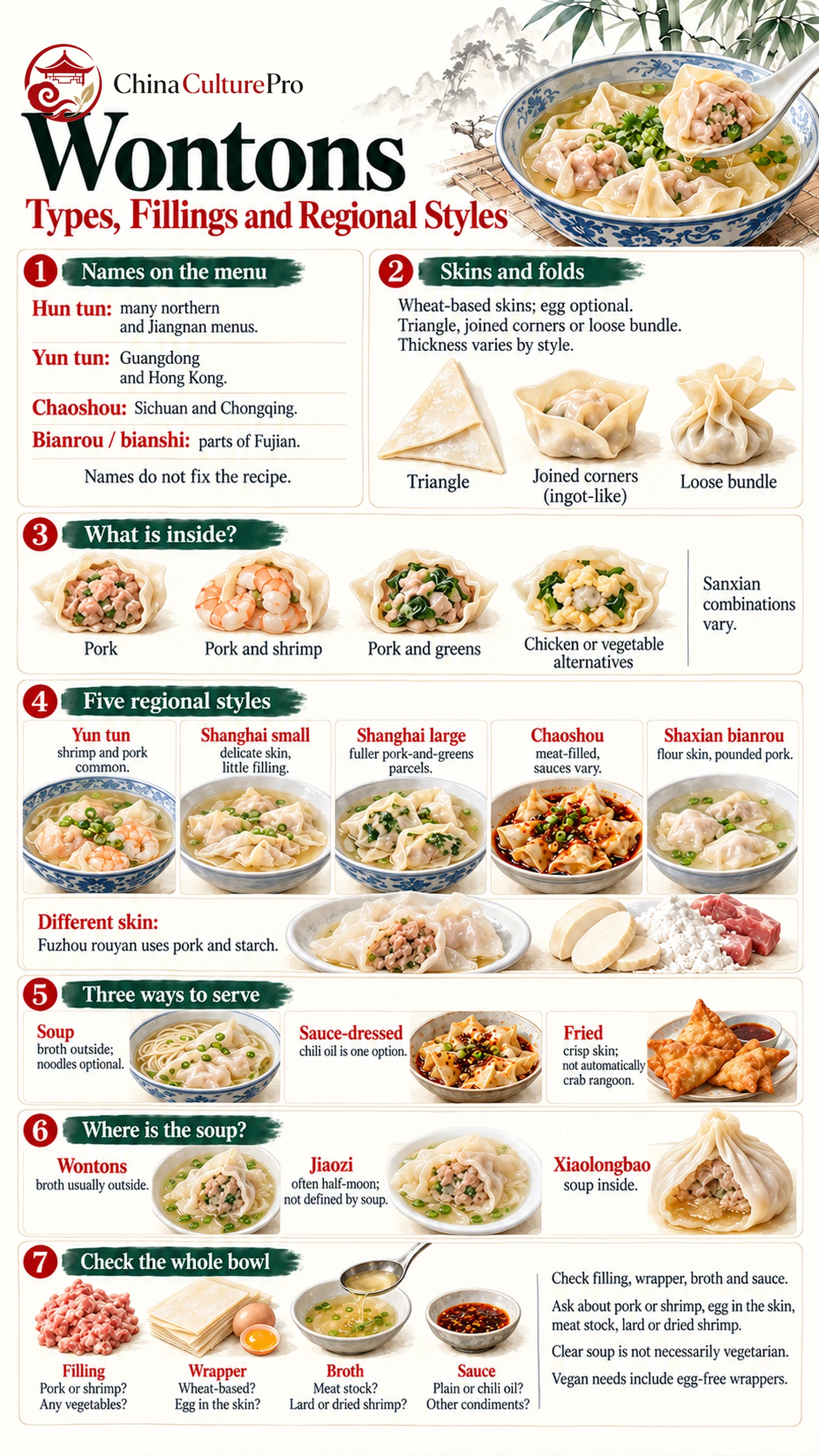
- Hun tun: 馄饨 (húntun) is a common name on northern Chinese and Jiangnan menus. Shanghai’s distinction between larger and smaller versions is one regional use of this broad label.
- Yun tun: 云吞 (yúntūn) is associated with Guangdong and Hong Kong. Here, yúntūn gives the Mandarin reading of the characters; it is not a transcription of their Cantonese pronunciation.
- Chaoshou: 抄手 (chāoshǒu) is the familiar label in Sichuan and Chongqing. It identifies the dumpling, rather than specifying that every serving must be spicy.
- Bianrou and bianshi: 扁肉 (biǎnròu) and 扁食 (biǎnshí) occur in parts of Fujian and other regional usage. Shaxian bianrou is one recognizable example.[7]
These names reflect local speech and food traditions, but they do not define identical recipes within each area. Nor does a literal association between the characters 云吞 and clouds establish the dish’s historical naming origin.
Wrappers, Folds and Common Fillings
Thin Wrappers and Common Folds
A conventional wonton wrapper starts with wheat flour and water, with other ingredients varying by recipe. Egg is optional: commercial egg-free skins exist. Yellow color alone also does not establish whether a wrapper contains egg.[2][3] Thickness affects how much the skin contributes to the bite, but there is no useful nationwide ranking from “thinnest Cantonese” to “thickest Shanghai.”
Three forms help explain the visible differences:
- Triangle: A square skin folds diagonally around the filling, leaving a simple sealed triangular outline.
- Joined corners: Two corners meet after the initial fold, producing an ingot-like or folded-arm form. Variations appear in different regional kitchens.
- Loose bundle: A little filling sits inside a gathered skin. Small wontons (小馄饨, xiǎo húntun) often emphasize these soft folds and a delicate wrapper.[3]
A fuller parcel can have a more defined shape without belonging to a different food family. The Chinese dumpling shapes guide explores that wider relationship between folds and finished forms.
Common Wonton Fillings
Pork is a widely used base, but the ingredient paired with it can change both flavor and texture. Four combinations are useful to recognize:
- Pork: Finely chopped or minced pork produces a tender filling; the balance of lean meat and fat differs by recipe.
- Pork and shrimp: Shrimp adds a springier bite. This combination is familiar in Cantonese cooking, but a shrimp-labeled wonton should not automatically be assumed pork-free.[5]
- Pork and greens: Bok choy or shepherd’s purse brings vegetable flavor to a meat filling. Shanghai’s vegetable-and-pork versions illustrate why a green ingredient does not mean a vegetarian dish.[4]
- Other meat or vegetable fillings: Chicken with mushrooms is one alternative. Meat-free fillings can combine greens, mushrooms, wood ear and bamboo shoots; their accompanying soup is a separate ingredient question.
Sanxian (三鲜, sānxiān), often translated as “three delicacies,” also needs context: pork, shrimp and chicken is one version, rather than a national formula.[3] The wider guide to Chinese dumpling fillings covers combinations beyond wontons.
Regional Wonton Styles to Recognize
The following five examples show how size, filling and wrapper texture work together. They are representative styles, not an exhaustive map of Chinese wontons. A restaurant outside the associated region may prepare any of them, and a familiar label can cover more than one household or shop recipe.
| Name and regional context | Wrapper and filling | Claves de identificación |
|---|---|---|
| Yun tun in Cantonese cuisine, including Guangdong and Hong Kong | Thin skins often enclose shrimp combined with pork. Pieces of shrimp can give a distinct firm, springy bite within the softer filling. | Delicate outer folds and a seafood emphasis are familiar features. Some preparations also use dried fish in the filling or broth; the visible shrimp is not necessarily the only animal ingredient.[5] |
| Small wontons in Shanghai cuisine and surrounding Jiangnan traditions | Very thin skins surround a small amount of meat. The wrapper gathers loosely instead of enclosing a large, densely packed center. | Soft, trailing folds are central to the texture. This is a different balance of skin and filling from a substantial vegetable-and-pork parcel, rather than simply a smaller portion of the same recipe.[3] |
| Large wontons (大馄饨, dà húntun), especially Shanghai and Jiangnan | Fuller parcels commonly combine pork with greens such as shepherd’s purse or bok choy. The skin must hold the more generous filling. | A substantial filled center and a more defined folded shape. Leafy vegetables are part of the filling, while broth and toppings may contribute further meat, egg or other ingredients.[4] |
| Chaoshou in Sichuan cuisine and Chongqing cooking | Folded meat-filled parcels, commonly pork, with other versions including shrimp or beef combinations. Joined corners are one familiar form. | The regional name alone does not identify the sauce. Both clear-broth and chili-oil versions occur, so the seasoning words on the menu matter.[6] |
| Shaxian bianrou in Fujian cuisine | A thin flour-based wrapper encloses finely pounded pork. Working the meat into a smooth filling gives it a different texture from a coarsely chopped mixture. | Small, tender parcels commonly served in broth. The defining material distinction is flour skin around worked pork, rather than a wrapper made from meat.[7] |
Fuzhou’s rouyan (肉燕, ròuyàn) requires a separate distinction. Its traditional yanpi (燕皮, yànpí) wrapper is made by working lean pork with sweet-potato starch into a thin sheet.[8] It can resemble a flour-wrapped parcel, but the skin itself contains meat. Similar appearance and overlapping everyday names should not erase that material difference.
Soup, Chili Oil and Fried Wontons
The same kind of filled parcel can take on a different character through the way it is served. These three formats explain more than a general “spicy” or “not spicy” label:
- In soup: Cooked wontons sit in broth with possible additions such as greens, seaweed, egg strips or dried shrimp. Clear describes appearance, not a vegetarian recipe: meat stock, lard or seafood may be present.[4][5] Even a light soup made with water and dried shrimp contains an animal ingredient. Wonton noodles (云吞面, yúntūn miàn) add noodles to the bowl; noodle-making traditions vary, so bamboo-pole-worked noodles are one style rather than a requirement of the name.
- Dressed with sauce: Red-oil wontons (红油抄手, hóngyóu chāoshǒu) combine cooked parcels with chili-oil seasoning. Soy sauce, vinegar, sweetness or sesame paste may contribute, depending on the preparation.[6] Some versions are relatively dry and others include broth. Chili heat and numbing Sichuan pepper are separate flavor elements, so “red oil” alone does not promise a fixed level of either.
- Fried: The wrapper becomes golden and crisp, with the filling enclosed inside. Fried wontons may be eaten with a dipping sauce and contrast with the soft skins of boiled versions. A fried wonton is not automatically crab rangoon, and cream cheese is not a defining filling for the broader wonton family.
Wontons, Jiaozi and Soup Dumplings Compared
Dumpling is a broad English category, not a single Chinese dish. Wontons and the two foods below overlap in ingredients, while their usual structures and serving traditions differ.
| Alimento | Common wrapper and form | Cooking or serving format | Where the soup is |
|---|---|---|---|
| Wontons | Often square wheat skins, with loose, triangular or joined-corner folds; size and thickness vary. | Boiled in soup, sauce-dressed or fried. | In soup versions, most broth surrounds the parcels. The filling may still be juicy. |
| Jiaozi (饺子, jiǎozi) | Often round wheat skins folded into a half-moon, with a sealed or pleated edge. | Boiled, steamed or pan-fried; some are served in soup. | A juicy filling is possible, but a separate pocket of soup is not the defining feature. |
| Xiaolongbao (小笼包, xiǎolóngbāo), referring here to soup-filled versions | Thin wheat skins gathered and sealed at the top. | Steamed, commonly in a small basket. | Soup is enclosed inside the skin; gelatin-rich stock in the filling melts during steaming. |
The main distinction is structure and preparation, rather than simply whether a bite releases liquid. Wontons vs dumplings explores the wrapper and cooking comparison; soup dumplings vs wontons focuses on the location of the broth.
Reading Wonton Menus and Checking Ingredients
Consider 荠菜鲜肉大馄饨 (jìcài xiānròu dà húntun): “large wontons with shepherd’s purse and fresh pork.” The first part identifies a vegetable-and-meat combination; the last part identifies the regional size category. By contrast, “shrimp wontons” highlights shrimp without necessarily listing every ingredient mixed into the filling.
Neither name tells you whether egg was used in the skin, meat stock was poured into the bowl, or dried shrimp was added at serving. Three questions help check the actual dish:
- Filling: What exactly is in the filling? Does it contain pork or shrimp? — 馅料里具体有什么?有猪肉或虾吗?
- Wrapper: Does the wrapper contain egg? — 馄饨皮里加鸡蛋了吗?
- Soup and sauce: Are there animal ingredients in the broth or sauce, such as meat stock, lard or dried shrimp? — 汤底或酱料里有肉汤、猪油、虾皮等动物来源的原料吗?
For vegan requirements, check egg as well as meat and other animal ingredients. Some vegetarian diets include egg, so “vegetarian” and “vegan” should not be treated as identical requests. The Chinese vegetarian food guide covers broader choices; Chinese food names explains other useful menu terms.
FAQs About Wontons
Are Wontons a Type of Dumpling?
Yes. Wontons belong to the broad English dumpling category. On Chinese menus, however, wontons and jiaozi are distinct foods. Calling both dumplings does not make their usual wrappers, folding styles and serving traditions identical.
Do All Wontons Contain Pork?
No. Pork is common, but chicken, seafood and vegetable fillings also exist. A name emphasizing shrimp or greens does not confirm that pork is absent. Ask about the complete filling when that distinction matters.
Does Wonton Soup Always Include Noodles?
No. Wonton soup can consist of wontons in broth without noodles. A wonton noodle dish combines the two. Check the menu wording rather than assuming that every bowl of wonton soup is also a noodle meal.
Are Wontons the Same as Soup Dumplings?
No. Soup-filled xiaolongbao enclose broth inside a sealed wrapper. Wontons are often served in broth surrounding the parcels. Their fillings can still be juicy, so the presence of moisture alone is not a reliable distinction.
Can Wontons Be Vegetarian?
Yes, when the wrapper, filling, broth and sauce all meet the diner’s requirements. Vegan diners should explicitly check for egg as well as meat and other animal ingredients. A vegetable in the name does not establish the whole bowl’s composition.
Fuentes
[1] The American Heritage Dictionary. Wonton
[2] Nasoya. Wonton Wraps
[3] Kaitlin Leung, The Woks of Life. How to Make Wontons: Full Guide
[4] Shanghai Municipal Government. Pork and vegetable wontons
[5] Hong Kong Tourism Board. 英記巷仔雲吞麵
[6] Ministry of Commerce, Time-honored Brands Digital Museum. 吴抄手
[7] Fujian Provincial Department of Commerce. 三明风味—小吃菜谱—沙县扁肉
[8] Fuzhou Evening News. 同利肉燕走进“一碗福州·我来了”直播间