


Quick Answer: Who Was Wei Zheng?
Wei Zheng (魏徵, Wèi Zhēng; 580–643) was a statesman and historian best known for advising Emperor Taizong (唐太宗, Táng Tàizōng). His reputation rests on sustained criticism of the ruler’s decisions, participation in historical compilation and the image of a minister who helped a monarch recognize his own errors.[1][2]
- Career: He served the emperor after previously supporting a rival prince.
- Advice: He challenged expenditure, burdens on communities and failures to listen.
- Legacy: Recorded exchanges and memorials shaped later ideals of good government.[1][2]
The celebrated relationship included disagreement and changing favor; later fictional appearances belong to a separate tradition.
The familiar picture of a fearless minister correcting a receptive emperor leaves important questions unanswered. What gave Wei Zheng access, what did he ask the ruler to change, and who preserved their conversations? His career connects those questions to the politics of the early Tang.
A Former Opponent in Taizong’s Government
The collapse of the Sui dynasty brought Wei Zheng into successive political households. He served the rebel leader Li Mi (李密, Lǐ Mì), entered Tang service after Li’s defeat and was subsequently captured by Dou Jiande (窦建德, Dòu Jiàndé). After Dou’s fall, he returned to the Tang court.[1][2]
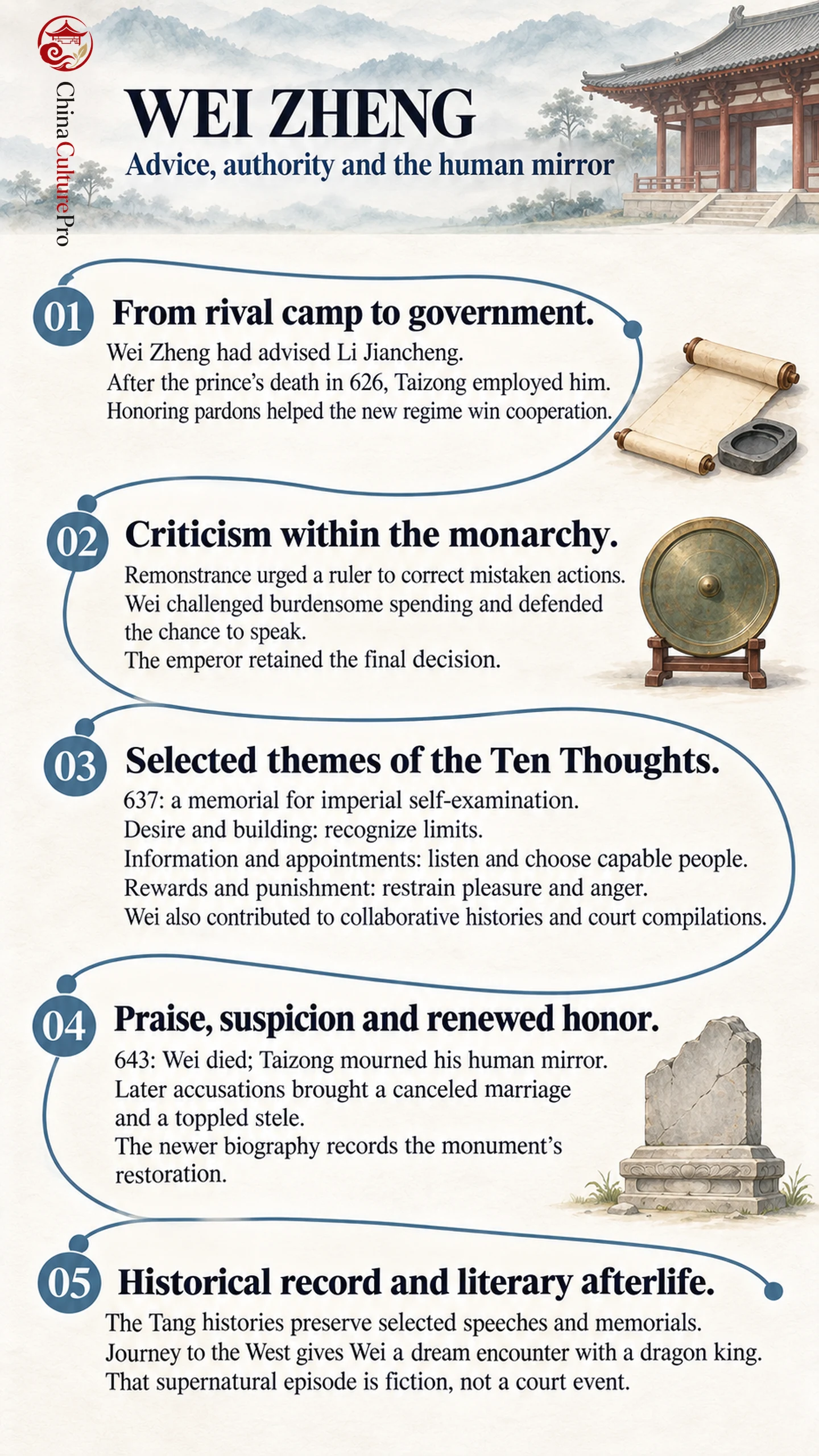
He then advised the crown prince Li Jiancheng (李建成, Lǐ Jiànchéng), whose younger brother Li Shimin (李世民, Lǐ Shìmín) was his principal rival. Li Shimin killed the crown prince in the Xuanwu Gate Incident (玄武门之变, Xuánwǔmén zhī Biàn) of 626 and became Emperor Taizong. Wei Zheng’s earlier allegiance therefore placed him on the losing side.[1][2]
Taizong nevertheless brought him into government. Sent to reassure former supporters of the defeated princes, Wei Zheng insisted that promised pardons be honored when he encountered prisoners being sent toward the capital. Their release put the announced pardon into practice and helped secure cooperation after the violent transfer of power.[1]
What Remonstrance Meant at Court
Remonstrance (谏, jiàn) was advice urging a ruler to correct a mistaken action or policy. Wei Zheng’s position gave such criticism an official place within the Tang monarchy. It did not create a separate authority capable of overruling the emperor.[1][2]
One dispute concerned welcoming western rulers and envoys. Wei Zheng argued that frontier communities still recovering from war would struggle to supply a greatly enlarged procession. Commercial travelers could benefit local people; maintaining official guests imposed different obligations. The biographies describe Taizong recalling the invitation. The issue was the cost of hospitality, rather than hostility to every foreign arrival.[1][2]
He also defended the opportunity to submit criticism when the emperor complained that memorials were numerous or ill-informed. A mistaken suggestion need not be punished merely because it failed to persuade. That argument protected the flow of information to the ruler, while leaving the final decision with him.[1][2]
In a distinction drawn from Confucian moral examples, Wei Zheng preferred a minister whose advice improved government to one remembered only for dying loyally under a disastrous ruler. The desired outcome was correction that worked, rather than the personal glory of martyrdom.[1][2]
The Ten Thoughts and the Work of Compilation
The Memorial of Ten Thoughts (谏太宗十思疏, Jiàn Tàizōng Shí Sī Shū), presented in 637, turns imperial self-examination into a sequence of restraints. Its opening compares political security to a tree requiring sound roots and a stream requiring a deep source. These images connect lasting authority with ethical conduct.[1][4]
| Selected theme | What the ruler should examine |
|---|---|
| Desire and building | Recognize limits on acquisition and construction so that personal enjoyment does not exhaust the people. |
| Information and appointments | Listen receptively, resist misleading favorites and choose people for their ability. |
| Rewards and punishment | Prevent pleasure from producing undeserved rewards and anger from producing excessive punishment. |
The memorial also asks the ruler to sustain vigilance after success and delegate work to capable officials. Self-restraint was paired with the effective use of other people’s abilities.[1]
Wei Zheng’s work extended to organizing texts. He supervised revisions of dynastic histories and contributed introductory or evaluative writing, including material for the Book of Sui (隋书, Suí Shū). Other scholars drafted substantial parts of those collaborative projects; calling him an editor does not make him their sole author.[1]
The Essentials for Bringing about Order from Assembled Texts (群书治要, Qúnshū Zhìyào), associated with Wei Zheng and fellow compilers, assembled passages from older classics, histories and philosophical writings for imperial instruction.[6] Commissioned in the 620s, this anthology used earlier texts to address the ethical and political demands of rulership.[3]
The Lost Mirror and Changing Imperial Favor
Wei Zheng died in 643 and was buried near Taizong’s Zhaoling (昭陵, Zhāolíng) mausoleum. The emperor’s recorded lament compares three kinds of reflection: bronze helps correct appearance, earlier history reveals political change, and another person exposes one’s mistakes. Wei Zheng’s death meant losing the third kind of mirror.[1][2]
The honors did not remain undisturbed. After officials he had recommended fell from favor or became implicated in rebellion, accusations cast his recommendations as factional. His practice of showing records of his advice to a court historian also angered Taizong. The emperor canceled the proposed marriage between Wei Zheng’s son and an imperial princess.[1][2]
The later biography adds that his commemorative stele was toppled. It then describes Taizong regretting his absence after the expedition to Liaodong and restoring the monument. The sequence complicates the ideal of perfect mutual trust: imperial praise, suspicion and renewed honor could follow one another even after the minister could no longer answer.[2]
Reading the Histories and the Later Legend
The Old Book of Tang (旧唐书, Jiù Táng Shū) and New Book of Tang (新唐书, Xīn Táng Shū) preserve extensive speeches and memorials. Compiled after the Tang period, they arrange the exchanges into accounts of character and government. Their polished dialogue should be read as transmitted historical narrative, not a modern verbatim recording.[1][2]
A memorial placed in 639 in the newer biography contrasts Taizong’s earlier restraint with later hunting, building and distrust of officials. This criticism records the demands he made on the emperor and helped shape the later image of their relationship.[1][2]
In Journey to the West (西游记, Xīyóu Jì), Wei Zheng instead acts within a supernatural court. Chapter 10 depicts him executing the Jing River Dragon King (泾河龙王, Jīnghé Lóngwáng) in a dream while his waking body remains before the emperor. That episode is evidence of his literary afterlife, not of a dragon execution in seventh-century government.[5]
FAQs About Wei Zheng
Was Wei Zheng also a historian?
Yes. He supervised collaborative dynastic histories and supplied evaluative writing. His work on the Book of Sui formed part of a larger scholarly project.[1][2]
Which emperor did Wei Zheng advise?
He is chiefly associated with Tang Taizong, although his career began under other leaders during the civil wars surrounding the Tang’s foundation.[1][2]
Was Wei Zheng executed for criticizing the emperor?
No. He died after an illness in 643. The later damage to his reputation and monument occurred after his death.[1][2]
Did Wei Zheng really kill a dragon?
The dream execution belongs to Journey to the West. It is a fictional transformation of a historical minister, not a documented event.[5]
Fuentes
[1] Liu Xu and other compilers. Old Book of Tang, Chapter 71: Wei Zheng
[2] Ouyang Xiu, Song Qi and other compilers. New Book of Tang, Chapter 97: Wei Zheng
[3] Michigan Publishing Services / Lever Press. Ordering Tang China: Publisher’s Description
[4] National Dr. Sun Yat-sen Memorial Hall. Memorial of Ten Thoughts: Collection Record C21_1_01_3
[5] Journey to the West, traditionally attributed to Wu Cheng’en. Journey to the West, Chapter 10
[6] Wei Zheng and fellow compilers. Essentials for Bringing about Order from Assembled Texts: Front Matter