
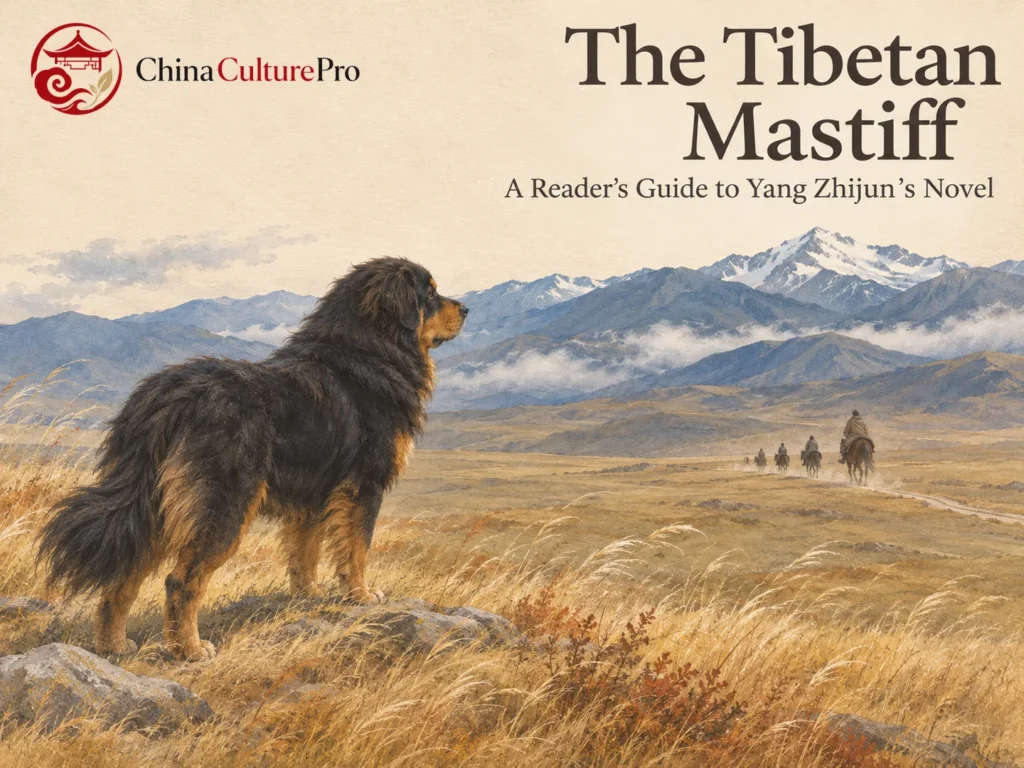

Quick Answer: What Is The Tibetan Mastiff Novel?
The Tibetan Mastiff (藏獒, Zàng’áo) is a novel by Yang Zhijun (杨志军, Yáng Zhìjūn) set on the Tibetan Plateau in the early years of the People’s Republic of China. A mastiff named Gangri Senge (冈日森格, Gāngrì Sēngé) and the people he guards become caught in a dispute between grassland communities.[1][3][10]
- The first Chinese book: People’s Literature Publishing House issued it in Beijing in 2005.[2]
- Where to start: The preface explains how Yang drew the dogs’ names from his family’s memories. Chapter eight places Gangri Senge and seven children together.[3][4]
- What to watch: A dog and a person can move together while interpreting the same journey in very different ways.[5]
- The screen version: The animated film The Tibetan Dog adapts Yang’s work around a boy named Tenjin and a golden dog.[6][8]
This guide follows scenes and narrative choices in the first novel. It keeps the later outcomes for readers and treats the mastiffs as literary characters.
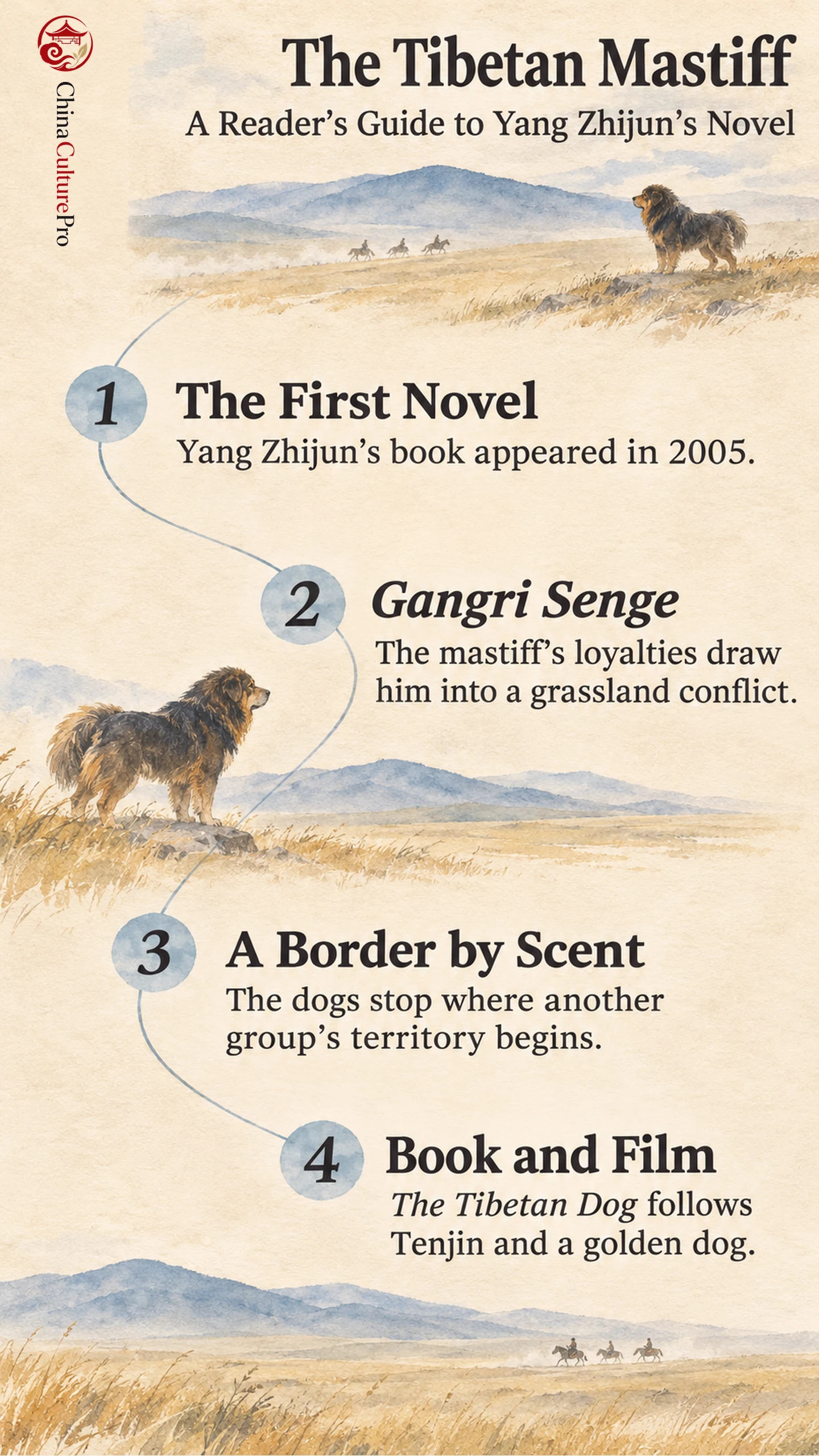
A group of mastiffs follows a man on horseback until they come to the edge of unfamiliar ground. The father interprets their escort as part of their duty and their regard for the horse he rides. The lead mastiff has another reason to stay near him. He hopes the man will lead him to Gangri Senge.[5]
That disagreement is one reason to slow down in a story full of chases and encounters. Yang lets the reader know something the man does not. The dogs have their own alliances and responsibilities, and the action depends on them.
Gangri Senge and the People He Guards
The first book puts Gangri Senge in a landscape where a dog’s allegiance to particular people can bring him into conflict with dogs that guard another community. The chapter titles in the Taiwan anniversary edition introduce Xijiegu (西结古, Xījiégǔ) and later name Gangri Senge alongside seven orphans.[3]
Read the preface before trying to place every name. Yang remembers his father’s relationships with dogs on the grassland. He explains that the family passed some of the old dogs’ names to puppies and that he later reused them for his fictional characters.[4] The preface explains how the names entered the novel. The later chapters give those names fictional lives.
The China Writers Association presents the first novel as a story about a mastiff’s part in a conflict between two grassland communities.[1] Watch whose safety is at stake when the conflict first becomes visible. The seven children give Gangri Senge someone to protect and the reader a reason to care about which dogs control the ground.
Why the Border Scene Matters
In chapter twelve, the mastiffs stop after picking up scents left by the dogs of another grassland. The narration gives their rule as a responsibility to guard their own ground and avoid entering someone else’s, except when their owners take them there.[5]
The riders can keep going. The dogs stop at a border that is visible to the reader through scent alone. A person can continue on horseback. For the dogs, crossing would require the presence of their owner. The man they are following is a guest. The chapter ties those decisions to smell, movement and the people the dogs know.
The pursuit has the forward movement of an adventure. If you come from Chinese wuxia fiction, the attention to duties and allegiances may feel familiar. The distinctive feature here is that an animal can make the decision that gives the scene its shape.
What the Dogs’ Point of View Adds
The dogs register scents and motions that people overlook. Yang also gives them motives the reader can understand as loyalty, rivalry and obligation. Literary scholar Sun Dexi discusses this personification as central to the series.[7] The two aspects work together. Scent tells a dog that it has reached someone else’s ground. The meaning attached to that border gives the decision a place in the story.
In an interview, Yang discussed how the trilogy was read alongside Jiang Rong’s Wolf Totem (狼图腾, Láng Túténg). He differentiated his admiration for that book from his concern about readers who made the idea of wolfish competition into a model for human conduct.[6]
The contrast is worth bringing back to the characters instead of reading it as a claim about actual wolves or dogs. When a dog stays near someone, ask who benefits and what the dog thinks it owes that person. An overview of Tibetan culture gives separate context for readers who want to move from a fictional setting to broader cultural subjects. The novel also belongs to a wider tradition of regional storytelling in modern Chinese literature.
How to Find the First Book and Recognize the Film
Search 藏獒 by 杨志军 or use the traditional forms 藏獒 and 楊志軍. Guangxi University records the 2005 People’s Literature Publishing House edition under ISBN 7-02-005278-9. The same book is also indexed under 9787020052783.[2][10] An anniversary edition listed in Taiwan explicitly identifies its first volume.[3]
Yang wrote two further books in the trilogy. The later novel Tibetan Mastiffs Are Not Dogs (藏獒不是狗, Zàng’áo Bú Shì Gǒu) appeared after the trilogy and takes up a different story involving the animals’ treatment as luxury pets.[1][9]
Check the complete title if you want the first book.
The animated adaptation The Tibetan Dog credits Yang with the original story and Masayuki Kojima as director. The Japanese Film Database lists the film under 2011 and gives its Japanese release as January 2012.[8] Start with the novel’s preface and chapter headings if your interest is Yang’s use of family memory within Chinese literature.
FAQs About The Tibetan Mastiff Novel
Is The Tibetan Mastiff the first book in a trilogy?
Yes. Yang’s first book appeared in 2005, and the China Writers Association lists the two numbered follow-ups separately.[1][2]
Is The Tibetan Dog the same as the novel?
It is an animated adaptation. Its story follows Tenjin, who goes to live with his father and meets a golden dog. Yang’s novel follows Gangri Senge and the conflict on the grassland.[1][8][10]
Is the novel a true account of Tibetan mastiffs?
The book is fiction. Yang explains in the preface that he drew on family memories and borrowed dogs’ names for his characters. The narration gives the dogs imagined thoughts and motives.[4][7]
Fuentes
[1] China Writers Association. Yang Zhijun and His Works
[2] Guangxi University Library. Zang Ao, People’s Literature Publishing House Edition
[3] Kingstone Books. Zang Ao, Anniversary Edition, Volume One
[4] Yang Zhijun. Father’s Mastiffs, Preface to Zang Ao
[5] Yang Zhijun. Zang Ao, Chapter Twelve
[6] China Writers Association. An Interview With Yang Zhijun
[7] Sun Dexi. Civilizational Memory in Yang Zhijun’s Tibetan Mastiff Novels
[8] Japanese Film Database. The Tibetan Dog
[9] China Culture Daily via China Writers Association. Yang Zhijun Writes Again About the Mastiff
[10] Google Books. Zang Ao, Volume One