


Quick Answer: Who Was Sun Ce?
Sun Ce (孙策, Sūn Cè, 175–200) was a military leader at the end of the Eastern Han. He built a territorial base in Jiangdong (江东, Jiāngdōng), south of the lower Yangtze, before handing leadership to his younger brother Sun Quan (孙权, Sūn Quán).[1][2][3]
- Rise: A campaign launched under a patron became the basis of independent power.
- Legacy: Sun Quan inherited troops and territory that helped make Eastern Wu (东吴, Dōng Wú) possible.
- Evidence: The early biography records a fatal attack. Later accounts give the death different meanings.
The transfer of leadership in 200 came decades before the imperial founding of Wu.
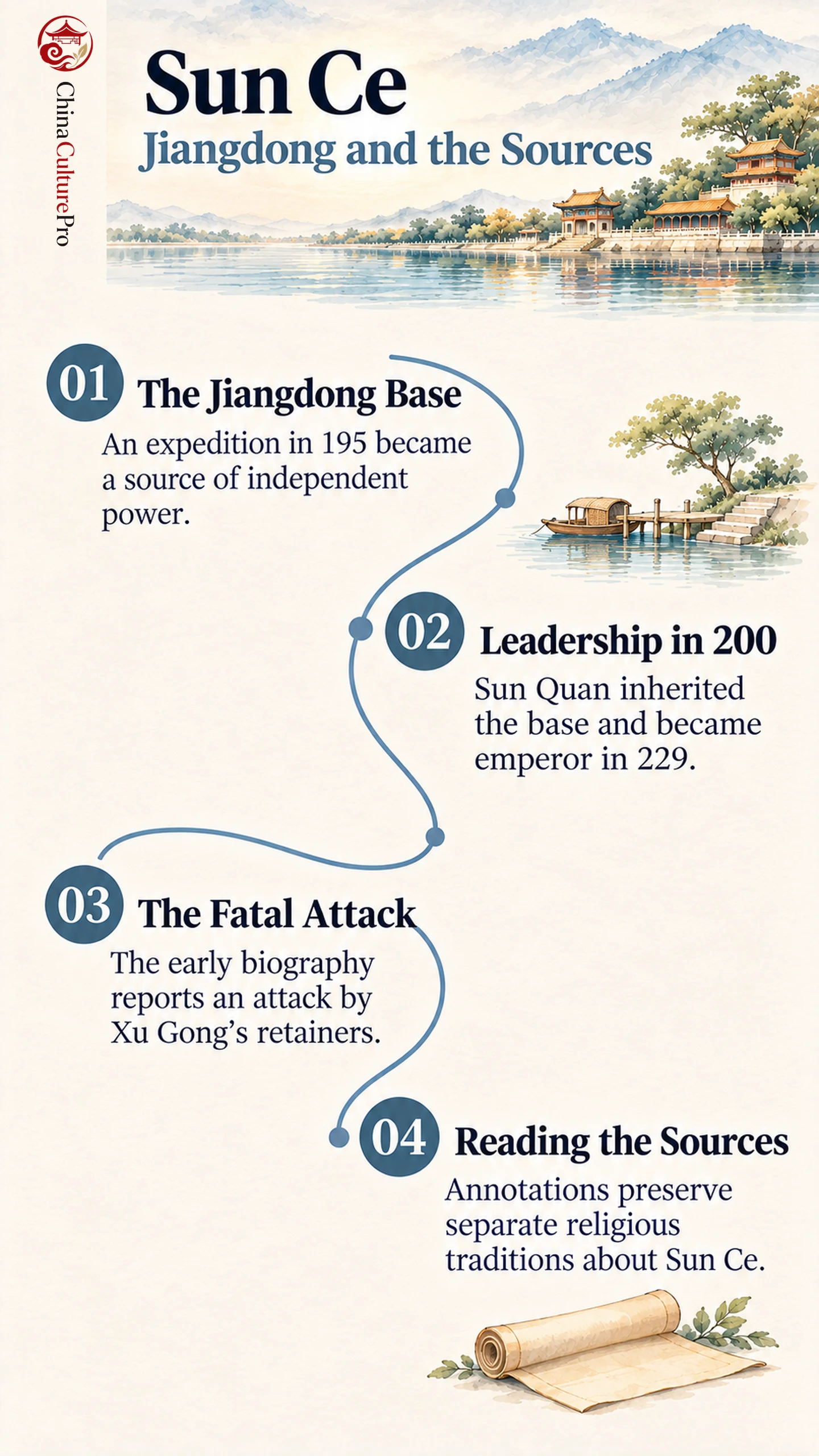
Sun Ce left his brother something more durable than a victorious army. His campaigns placed territory, officials and local alliances under the Sun family’s authority. That regional base helps explain how a state emerged south of the Yangtze after the Han collapsed.
How a Subordinate Built a Base in Jiangdong
Sun Ce entered the service of Yuan Shu (袁术, Yuán Shù), the former patron of his father Sun Jian (孙坚, Sūn Jiān). In 195 he secured backing for an expedition south of the lower Yangtze. A commission from a stronger patron gave him a way to raise and lead forces. Acquiring territory then gave him a source of authority that did not depend entirely on that patron.[1][3]
His armies contended with officials such as Liu Yao and with locally entrenched forces. Sun Ce gained control of Danyang, Wu and Kuaiji commanderies. The early biography describes replacing officials and assigning key posts as the campaign moved forward. Sun Ce assumed the Kuaiji administrator’s post himself. He placed associates in other commanderies, making each appointment a claim to govern a district after its capture.[1][3]
The relationship with Yuan Shu broke down after Yuan claimed the imperial title in 197. Sun Ce acted independently and pushed his power west from his lower-Yangtze base. The conflict belongs to the late Han setting that preceded the formal Three Kingdoms period. To follow it on a map, distinguish the territory held by the Sun family from the later boundaries of Wu.[3]
What Sun Quan Inherited in 200
In 200, Sun Ce’s death left a fragile settlement in the hands of Sun Quan. His brother inherited troops, officials and established positions south of the river. The narrative of Sun Quan’s accession also identifies senior advisers who helped him take charge. To retain that base, Sun Quan had to win the confidence of people whose allegiance had been organized around his brother.[1][2]
The historians make the succession visible at two different points. Sun Ce’s biography ends with the transfer of authority to his brother. Sun Quan’s biography follows the work of taking charge after that death. Reading the two together puts both the decision and its implementation in view.[1][2]
The later imperial accession in 229 belongs to Sun Quan. Sun Ce’s role in founding Wu was to build the territorial and military base. His brother made it the seat of an imperial state decades later.[2][3]
The Attack and the Gan Ji Traditions
The main biography reports that retainers of Xu Gong (许贡, Xǔ Gòng), a former administrator of Wu Commandery, attacked Sun Ce in 200. The attack was fatal. The biography places it while Cao Cao and Yuan Shao were facing one another and says Sun Ce intended to move against the seat of the Han emperor. The planned expedition never took place.[1]
Pei Songzhi’s annotations preserve accounts about a religious figure called Yu Ji (于吉, Yú Jí) in the transmitted Chinese text. The modern historian Rafe de Crespigny refers to him as Gan Ji. One tells of a popular religious figure whom Sun Ce had executed. Another places the conflict aboard boats and includes a rainmaking episode. Pei points out problems of chronology and says the accounts differ. Their inclusion shows that competing versions circulated.[1][3]
The later Romance of the Three Kingdoms tradition made the religious episode part of Sun Ce’s literary image. Read it as a story about the commander and his reputation. The biographical account of an attack by Xu Gong’s retainers answers a different question.[1][3]
How to Read Sun Ce in the Sources
A useful first step is to open chapter 46 and identify the paragraph where the historian reports the attack. Then follow each title given in the annotation and note whether Pei is quoting it, comparing it or challenging it. A modern page that reproduces the whole chapter can make all those layers look equally early.[1]
For the longer political story, follow the transition across chapters 46 and 47. Sun Ce’s career explains why the Sun family held territory at the end of the Han. Sun Quan’s career explains how that inheritance was maintained and transformed. The founding of Wu becomes a sequence of decisions rather than one event with a single date.[1][2][3]
FAQs About Sun Ce
Was Sun Ce the first emperor of Eastern Wu?
Sun Quan became emperor of Wu in 229. Sun Ce had laid much of the regional military and political groundwork before his death in 200.
How were Sun Jian, Sun Ce and Sun Quan related?
Sun Jian was their father. Sun Ce was the elder brother who built up the Jiangdong base. Sun Quan succeeded him and later ruled as emperor of Wu.
What does Jiangdong mean in Sun Ce’s biography?
In this setting it refers broadly to the region south of the lower Yangtze where Sun Ce built his base. The term’s historical scope need not correspond to a single modern province.
Fuentes
[1] Chen Shou with Pei Songzhi’s annotations, Records of the Three Kingdoms, chapter 46. Biographies of Sun Jian and Sun Ce
[2] Chen Shou, Records of the Three Kingdoms, chapter 47. Biography of Sun Quan
[3] Rafe de Crespigny, Australian National University. Generals of the South, chapter 3: The Young Gentleman Sun Ce