
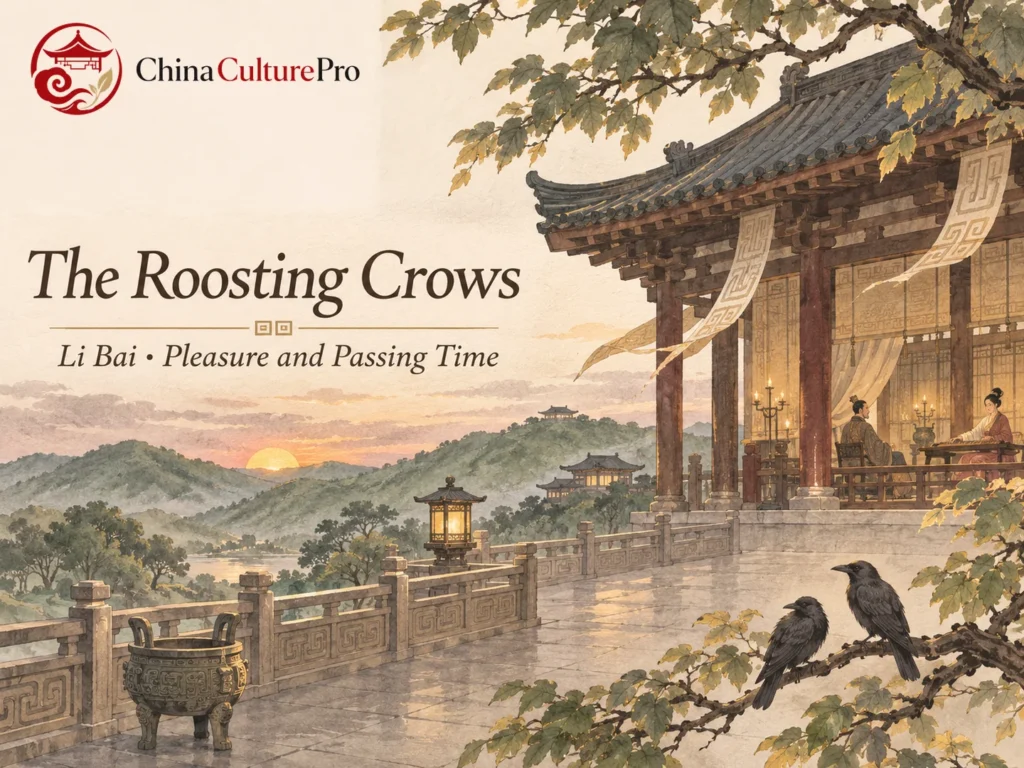

Quick Answer: What Is Song of the Roosting Crows About?
Song of the Roosting Crows (烏棲曲, Wū Qī Qǔ) by Li Bai (李白, Lǐ Bái) imagines a night of pleasure in an ancient royal palace, while changes in the sky and a water clock make passing time unavoidable.
- Scene: The king of Wu (吳王, Wú Wáng) and Xi Shi (西施, Xī Shī) belong to an older historical and legendary setting.
- Movement: Roosting crows, the setting sun, a draining clock, a sinking moon and dawn carry the night forward.
- Tension: The pleasure continues, but readers familiar with Wu’s fall can sense a future the scene never directly narrates.
The complete poem has seven lines of seven characters, or 49 characters. Its inherited song title and palace scene should not be confused with a literal report of Li Bai attending the feast.[1][2][3]

Crows settle as an evening begins; a water clock keeps running while the palace entertainment continues. By the time the moon sinks and the east brightens, pleasure has lasted through the night. The poem leaves its revelers at that threshold rather than recounting what follows.
The Complete Poem and an English Sense Translation
This is the whole poem, with an original sense translation. It follows the received 欲, 銀箭金壺 and 樂 readings. The transmitted text records alternatives at those points.[1]
| Chinese text | English sense translation |
|---|---|
| 姑蘇臺上烏棲時, | When crows settle on Gusu Terrace (姑蘇臺, Gūsū Tái), |
| 吳王宮裏醉西施。 | in the Wu king’s palace, Xi Shi is drunk. |
| 吳歌楚舞歡未畢, | songs of Wu (吳, Wú) and dances of Chu (楚, Chǔ)—the pleasure is not yet over. |
| 青山欲銜半邊日。 | Green hills are about to hold half the sun in their mouths. |
| 銀箭金壺漏水多, | Much water has run through the gold vessel with its silver indicator. |
| 起看秋月墜江波, | They rise to watch the autumn moon sink toward the river’s waves. |
| 東方漸高奈樂何? | The east grows bright—what will become of their pleasure? |
The “silver indicator” and “gold vessel” evoke a water clock, also called a clepsydra. The indicator belongs to timekeeping; it is not an arrow fired into a drinking pot. The English supplies “they” where the Chinese leaves the watchers’ subject unstated.[1][3]
An Ancient Palace Seen Through a Tang Poem
The king is conventionally identified as King Fuchai (夫差, Fūchāi). The familiar story links his pleasure with Xi Shi to the eventual defeat of Wu by Yue (越, Yuè). That background makes the scene troubling without turning every legendary detail into established biography.[2][3]
The Li Bai guide gives the poet’s wider context. Here he makes an earlier palace briefly present through selected sights and sounds. He does not introduce a traveler surveying its ruins or tell us he personally watched the royal couple.
The title belongs to an inherited song tradition. Its roosting crows establish a moment in the day; the poem gives them no speech announcing a curse or predicting a particular death.[1][3]
How the Night Passes Around the Revelers
The crows begin settling as the hills take the sun from view. Inside, music and dancing have not finished. The difference between those movements gives the opening its pressure: the outside world approaches night while the entertainment continues.[1]
The clock then makes elapsed time concrete. Water has run, although the poem gives no numbered hour or measured duration. The next view is already the sinking autumn moon. A few images have carried the reader across a long interval without describing every performance or cup.
Notice how the sun and moon both move toward disappearance. The mountains seem to hold the sun in their mouths; the moon descends toward the waves. These are poetic perspectives on the sky, not claims that hills or river water physically consume celestial bodies.[1]
What the Unpaired Final Line Leaves Open
Three pairs of lines are followed by one last line. That extra line prevents the poem from closing with the moon’s descent: dawn must still enter, and the question about pleasure remains.[1]
The question can hold the revelers’ reluctance to let the night end. At the same time, knowledge of Wu’s defeat lends it a darker force. The reader can feel the fragility of enjoyment without being shown a siege, punishment or ruined palace.[2]
The poem’s restraint matters. It lets time and the question unsettle the scene instead of appending a speech about how the kingdom fell. The pleasure remains present while the passing night makes it uneasy.
How to Read the Poem’s Passing Time
- Locate the evening: Begin with roosting crows and the hills taking the sun from view.
- Watch the clock: Let the running water register time while the entertainment continues.
- Follow the moon: Notice the leap from sunset to a moon descending toward the river.
- Leave the question open: Hear both the wish for continuing pleasure and its vulnerability as dawn arrives.
FAQs About Song of the Roosting Crows
Are the crows announcing a supernatural omen?
The text shows them settling at evening. It does not give them a prophecy; the darker historical resonance comes from the scene and its familiar background.[1][2]
Does the poem show the destruction of Wu?
No. It ends with the brightening east and a question about pleasure. The later defeat belongs to the background readers bring to the scene.[1][2]
Why does the poem have seven lines?
The received text ends with a single line after three pairs. That shape gives the last question its own space rather than supplying a balancing eighth line.[1]
Fuentes
[1] Li Bai; Chinese Wikisource. Wu Qi Qu
[2] Stephen Owen; Harvard University author archive. The Great Age of Chinese Poetry: The High T’ang, Discussion of Wu Qi Qu
[3] Tang Poetry Close Reading course, hosted on Chaoxing. Wu Qi Qu: Text and Notes