


Quick Answer: Who Was Li Bai?
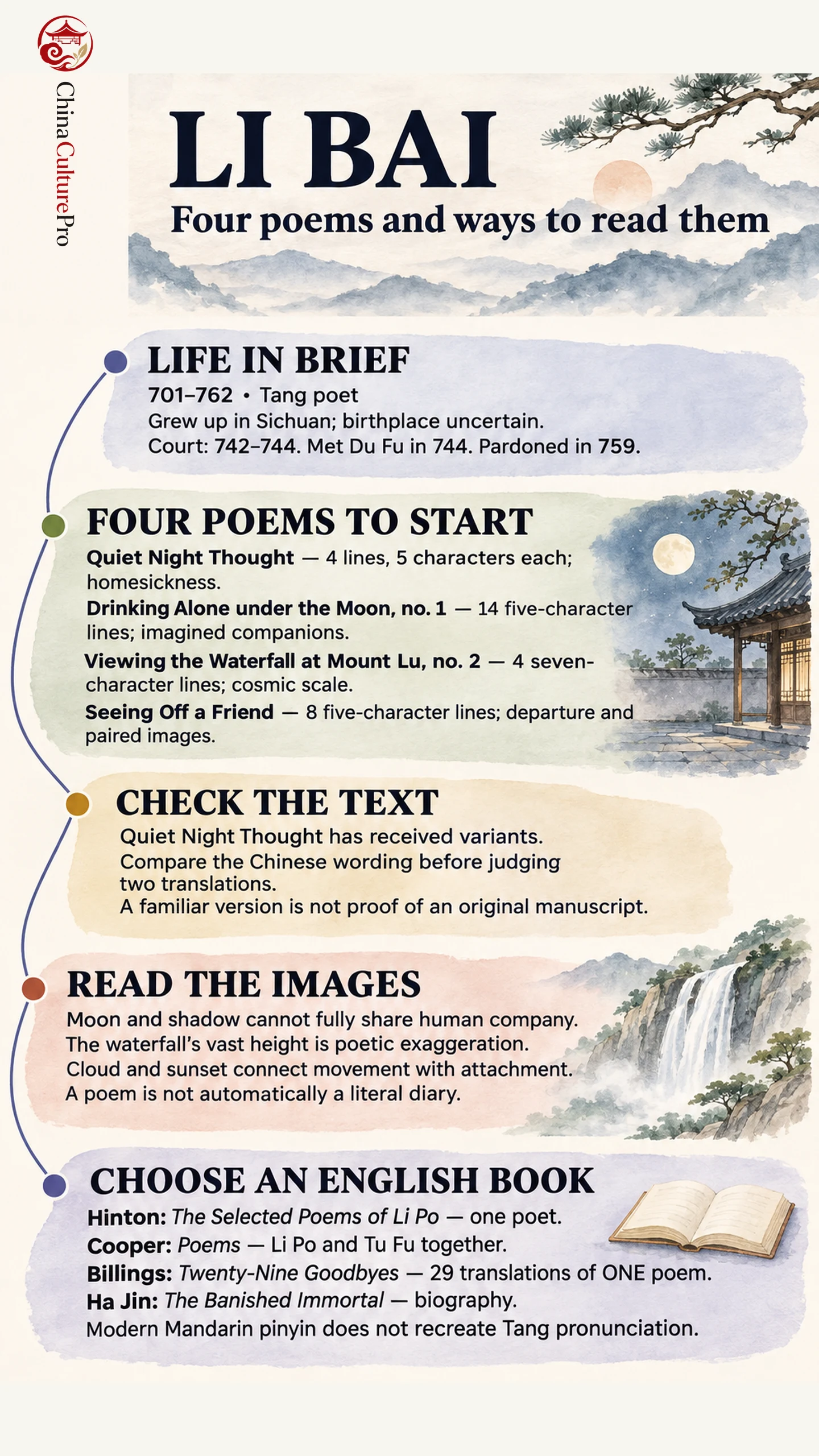
Li Bai (李白, Lǐ Bái; 701–762), also called Li Po in English, was a major poet of the Tang (唐, Táng) dynasty. His poetry brings together travel, friendship, longing and extraordinary imaginative leaps.[1]
- Start with a short poem: A twenty-character poem turns a glimpse of moonlight into homesickness.
- Read beyond the familiar image: Alongside moonlight and wine, his poems explore parting, ambition and the wish for companionship.
- Choose the right book: A poetry selection, a two-poet anthology, a translation study and a biography serve different reading interests.
The speaker in a poem is not automatically a reliable witness to every event in the poet’s life.
Li Bai can seem immediately approachable: a moon, a mountain or a friend leaving town needs little explanation. Yet a few plain images can carry shifts in scale, feeling and viewpoint that an English paraphrase smooths away. Begin with the poem’s movement, then use biography and notes to deepen the reading. Our broader guide to Chinese poetry places him among other periods and forms.
A Life of Travel, Court Service and Upheaval
Li Bai grew up in what is now Sichuan and travelled down the Yangzi Valley in the mid-720s. His precise birthplace remains uncertain; upbringing and birthplace should not be treated as the same fact.[11] In 742 he was summoned to court and given a position in the Hanlin Academy (翰林院, Hànlín Yuàn). That brief court connection ended in 744. The Tang dynasty supplied both the cultural opportunities and political pressures behind this career.[1]
In 744 he met Du Fu (杜甫, Dù Fǔ), another major poet and a lasting friend. Later, Li Bai’s association with Prince Yong during the rebellion that began in 755 brought political trouble and exile. He received a pardon in 759 and died in 762. These events matter because his life included pursuit of recognition and exposure to conflict, alongside travel and friendship.[2]
Interpretación Du Fu beside Li Bai offers a comparison between two writers who knew each other. Avoid turning them into a rigid pair of opposites: imaginative freedom does not exclude careful construction, and poems about a private occasion can still engage a wider social world.
Four Li Bai Poems to Read First
These four poems offer different lengths and emotional situations. Their English titles vary between translators; the Chinese title helps identify the work.
| Poem | What happens, and what to notice |
|---|---|
| Quiet Night Thought (静夜思, Jìng Yè Sī) | Four five-character lines connect a night scene with homesickness. Read for the speaker’s changes in attention.[3] |
| Drinking Alone under the Moon (月下独酌, Yuè Xià Dú Zhuó), no. 1 | Fourteen five-character lines imagine the moon and the speaker’s shadow as drinking companions. The poem recognizes that these companions cannot really share a human encounter.[4] |
| Viewing the Waterfall at Mount Lu (望庐山瀑布, Wàng Lúshān Pùbù), no. 2 | Four seven-character lines transform a waterfall into a cosmic spectacle. Distance, apparent suspension and the imagined fall of the Milky Way expand an observed scene.[5] |
| Seeing Off a Friend (送友人, Sòng Yǒurén) | Eight five-character lines frame a departure with landscape, clouds, sunset and the cries of separating horses. Watch how setting and feeling develop together.[6] |
Here is the familiar version of Quiet Night Thought displayed in the Three Hundred Tang Poems (唐诗三百首, Táng Shī Sānbǎi Shǒu) section of the cited text, with simplified characters:[3]
床前明月光,疑是地上霜。举头望明月,低头思故乡。
An English sense-gloss, written here rather than borrowed from a published translation, is: Moonlight before the bed looks like frost on the ground; the speaker raises the head to the bright moon, then lowers it in thoughts of home. The twenty characters make four lines of five characters, despite the continuous display above.
The same source also records another version with 看月光, “look at moonlight,” in the first line and 望山月, “gaze at the mountain moon,” in the third. A translation based on those readings may legitimately differ from one based on 明月光 and 望明月. Neither this comparison nor a familiar schoolroom wording establishes the poet’s original manuscript.[3]
Read the moon poems for two different situations: memory of an absent home and the invention of present companions. Our guide to Chinese moon poetry explores the image across authors; the guide to friendship and farewell poems develops the social occasion behind a departure.
What to Notice in His Poetry
The waterfall poem offers a clear example of hyperbole. Its immense stated height and the image of the Milky Way falling from the sky convey wonder, not a measured description of the falls. The leap works because the opening supplies something visible: sunlight, mist and a distant cascade. Read the cosmic ending against that physical scene.[5]
In Drinking Alone under the Moon, the speaker creates a party of three from one person, the moon and a shadow. The invention does not remove solitude: the moon cannot drink, and the shadow merely follows. Companionship is both desired and shown to be incomplete. Wine belongs to this imaginative scene; the passage is not a factual drinking diary.[4]
Seeing Off a Friend uses paired images rather than a spectacular leap in scale. Drifting cloud and setting sun connect with the traveller’s movement and the remaining friend’s attachment. This eight-line form is lüshi (律诗, lǜshī), regulated verse. A reading of Chinese regulated verse explains how parallel structures and tonal patterns contribute to its construction.[6][9]
These examples suggest three useful questions: What changes between the opening and ending? Which images answer or transform one another? Where does the poem exceed what an observer could literally see? Broader readings of nature poetry and literary allusions help when landscape or an unfamiliar reference needs more context.
Cultural Legacy and English Reading Choices
Li Bai’s poems remain part of Chinese cultural memory through school learning and recitation. His reception also extends beyond China: English-language modernist poetry encountered his work through Ezra Pound’s translations. These are different kinds of afterlife—repeated familiarity with particular lines and the transformation of poetry in another language.[7][10]
Choose an English book by what you want to do next:
- Read a range of his poetry: The Selected Poems of Li Po, translated by David Hinton, is a single-poet selection.[7]
- Read two contemporaries together: Poems, by Li Po and Tu Fu, has translations, an introduction and notes by Arthur Cooper.[8]
- Compare how translation works: Timothy Billings’s Twenty-Nine Goodbyes: An Introduction to Chinese Poetry examines twenty-nine translations of Seeing Off a Friend. It studies one poem through many versions, rather than presenting twenty-nine different Li Bai poems.[9]
- Follow the life story: Ha Jin’s The Banished Immortal is a biography. Choose it for historical and literary narrative rather than as a replacement for a poetry collection.[10]
For close reading, look for Chinese alongside English and enough notes to explain references without overwhelming the poem. Chinese characters make line length visible even before you can read fluently. Pinyin (拼音, pīnyīn) can help connect characters to modern Mandarin pronunciation; it does not reproduce eighth-century speech. Our pinyin guide explains that notation. From there, Tang poetry opens a wider field of voices and occasions.
FAQs About Li Bai
Are Li Bai and Li Po the same poet?
Yes. Li Po, Li Bo and Li Bai are English spellings associated with the poet whose name is written 李白. A book using Li Po is not necessarily about a different writer.[2]
Is Li Bai easy to read without Chinese?
You can begin in English, particularly with short poems about a recognizable situation. A bilingual edition and explanatory notes help reveal features that translation may rearrange or leave implicit. Comparing versions can make those choices visible.[9]
Were all Li Bai poems written in four lines?
No. The four examples here include four-, eight- and fourteen-line poems. Familiar short poems provide an entry point, not a complete picture of his range.[3][4][5][6]
Do we know exactly how Li Bai died?
His death is dated to 762, but its precise circumstances remain uncertain. A detailed account should distinguish evidence from later storytelling rather than treating a memorable anecdote as a confirmed cause.[2][10]
Fuentes
[1] Chinese University of Hong Kong, Research Centre for Translation. Li Bai
[2] Academy of American Poets. Li Bai
[3] Li Bai, Chinese primary text via Wikisource. Quiet Night Thought: received versions
[4] Li Bai, Chinese primary text via Wikisource. Drinking Alone under the Moon, first poem
[5] Li Bai, Chinese primary text via Chinese Text Project. Viewing the Waterfall at Mount Lu: two poems
[6] Li Bai, Chinese primary text via Chinese Text Project. Quan Tang Shi, volume 177: Seeing Off a Friend
[7] New Directions. The Selected Poems of Li Po
[8] Penguin Random House. Poems by Li Po and Tu Fu
[9] Fordham University Press. Twenty-Nine Goodbyes: An Introduction to Chinese Poetry
[10] Penguin Random House. The Banished Immortal by Ha Jin
[11] The Poetry Foundation. Li Bai