
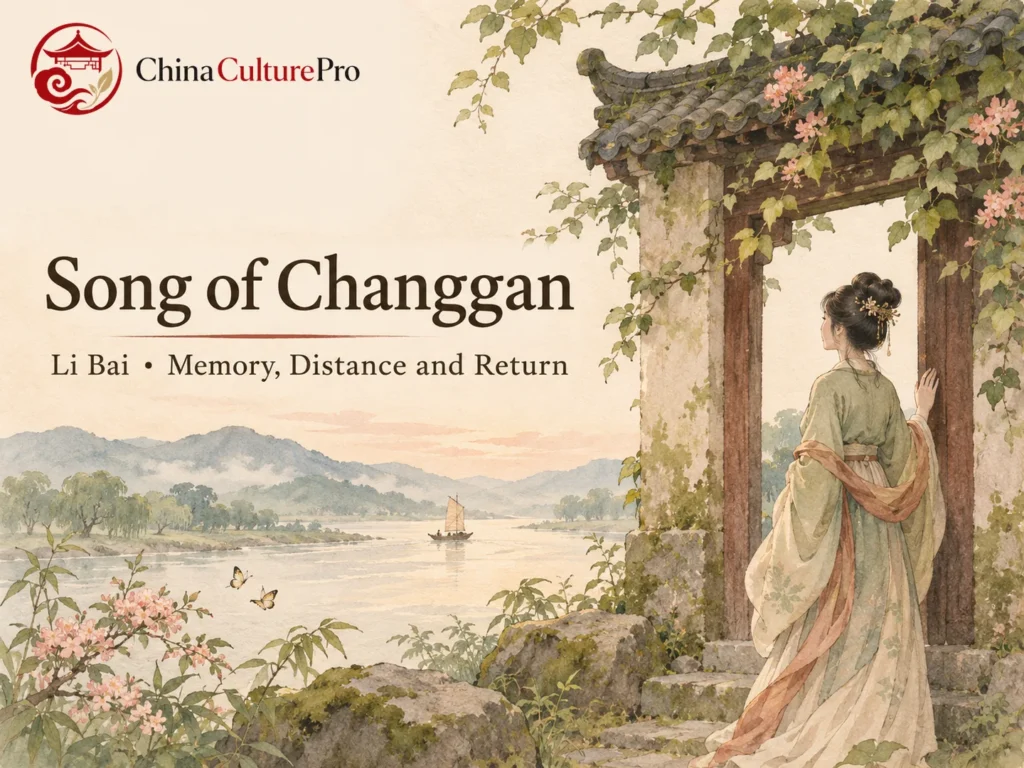

Quick Answer: What Is Song of Changgan About?
Song of Changgan (長干行, Chánggān Xíng) by Li Bai (李白, Lǐ Bái) follows a woman’s relationship from childhood companionship through marriage to separation and the hope of reunion.
- Memory: Shared games and the ages fourteen, fifteen and sixteen organize her account of growing attachment.
- Absence: Dangerous waters, moss and paired butterflies make distance and passing time tangible.
- Ending: She asks for advance news so she can travel out to meet her husband.
This page covers the complete first poem of the two collected under this title in Li Bai’s corpus: thirty five-character lines, or 150 characters. It is a yuefu (樂府, yuèfǔ) poem in an inherited song tradition, with an adopted female voice rather than a documented autobiographical letter.[1][2]

A wife remembers the games of childhood, the shyness of marriage and the confidence that followed. Her husband is now away. The place where they once played has become a place of waiting, but her final words imagine moving toward him.
The Complete First Poem and an English Sense Translation
All fifteen couplets appear below. The English is an original sense translation. The Chinese follows the received 遲 / 綠 / 胡蝶來 readings; editions also have variants such as 舊, 蒼 and 胡蝶黃.[1]
| Chinese text | English sense translation |
|---|---|
| 妾髮初覆額,折花門前劇。 | When my hair had just reached my forehead, I picked flowers and played before the gate. |
| 郎騎竹馬來,遶牀弄青梅。 | You came riding a bamboo horse, circling the well-rail and playing with green plums. |
| 同居長干里,兩小無嫌猜。 | We lived in Changgan (長干, Chánggān), two children without suspicion or reserve. |
| 十四為君婦,羞顏未嘗開。 | At fourteen I became your wife; my shy face had not yet opened into a smile. |
| 低頭向暗壁,千喚不一回。 | I lowered my head toward the dark wall; though called a thousand times, I never turned. |
| 十五始展眉,願同塵與灰。 | At fifteen my brows began to relax; I wished us together as dust and ash. |
| 常存抱柱信,豈上望夫臺。 | I held to pillar-clasping faith: why would I climb a terrace to watch for my husband? |
| 十六君遠行,瞿塘灩澦堆。 | At sixteen you went far away, toward Qutang (瞿塘, Qútáng) and Yanyu Rock (灩澦堆, Yànyù Duī). |
| 五月不可觸,猿聲天上哀。 | In the fifth month that rock must not be struck; gibbon cries lament high above. |
| 門前遲行跡,一一生綠苔。 | The old traces of your steps before the gate have each grown green with moss. |
| 苔深不能掃,落葉秋風早。 | The moss lies too deep to sweep away; falling leaves arrive with an early autumn wind. |
| 八月胡蝶來,雙飛西園草。 | In the eighth month butterflies come, flying in pairs over the western garden’s grass. |
| 感此傷妾心,坐愁紅顏老。 | These sights wound my heart; through sorrow I fear my youthful beauty fading. |
| 早晚下三巴,預將書報家。 | Whenever you come down from the Three Ba districts (三巴, Sān Bā), send word home beforehand. |
| 相迎不道遠,直至長風沙。 | I will come to meet you, disregarding distance, all the way to Changfengsha (長風沙, Chángfēngshā). |
The well-rail follows a teaching gloss of 牀. The months are traditional-calendar months, not fixed equivalents of May and August. The dangerous rock belongs to the poem’s historical river journey, rather than a present-day navigation warning.[2]
Childhood Familiarity and the Wife’s Changing Voice
The opening places both children in one neighborhood. Picking flowers, a pretend bamboo mount and green plums establish familiar play before marriage enters the narrative. The bamboo horse is a toy or a stick ridden as a horse, not a real animal made from bamboo.[3]
Two later idioms preserve this opening: qingmei zhuma (青梅竹馬, qīngméi zhúmǎ), literally “green plums and bamboo horse,” for companions known since childhood; and liangxiao wucai (兩小無猜, liǎngxiǎo wúcāi), the unguarded innocence of two children.[3][4]
The age sequence changes the manner of address. At fourteen, the wife cannot turn toward repeated calls; at fifteen, she can express complete attachment; at sixteen, she must speak across distance. These changes belong to the wife’s account rather than the author’s biography. The Li Bai guide places this adopted voice within his wider work.
Promises and the Dangerous River
“Pillar-clasping faith” invokes the tale of a man who kept an appointment beneath a bridge and stayed as the water rose, dying while holding a pillar. Here the allusion intensifies the language of trust; it does not predict the husband’s death.[2]
Qutang and its rock then move the imagination beyond the home. The fifth-month danger and high gibbon cries give the absent journey an alarming shape. The wife can picture hazards she cannot control. Trust in the relationship does not remove concern about the waters.[1][2]
The contrast matters: early confidence that she would not need to watch for her husband is followed by an actual period of waiting. The poem lets an earlier assurance and a later anxiety stand beside each other.
Moss, Paired Butterflies and the Offered Journey
The gate returns as a changed place. Once it held childhood play; now traces associated with departure have acquired moss. The deepening growth makes duration visible without supplying an exact count of days.[1]
The butterflies intensify separation because they fly in pairs. Their togetherness confronts a speaker who remains apart from the person she addresses. The sight leads directly to her fear of youth fading.
The last couplets shift from remembering and watching to a proposed action. She asks for a message and offers to cover the distance herself. The poem ends with that willingness, without narrating the husband’s arrival or a completed reunion.[1]
How to Follow the Poem’s Emotional Journey
- Mark the ages: Notice how childhood, fourteen, fifteen and sixteen change the relationship.
- Separate home from distance: Keep the remembered gate distinct from the river hazards imagined along his route.
- Track paired images: Compare childhood companionship with butterflies flying together during her solitude.
- Hear the final offer: Read the journey to meet him as a future intention, not an event already accomplished.
FAQs About Song of Changgan
Is this an eight-line regulated poem?
No. The first poem has thirty five-character lines. A short extract of its opening does not represent the complete work.[1]
Does Li Bai speak as himself?
The poem uses a wife’s first-person voice to address her husband. The poet and the dramatic speaker should be distinguished; the narrated ages are hers.[1][2]
Do the butterflies have to be yellow?
Some received texts read “butterflies yellow,” while this version reads “butterflies come.” Their paired flight is present in both readings and carries the contrast with separation.[1]
Fuentes
[1] Li Bai; Chinese Wikisource. Two Songs of Changgan
[2] Taipei First Girls High School. Classical Poetry Reading Notes: Changgan Xing
[3] Taiwan Ministry of Education. Idiom Dictionary: Qingmei Zhuma
[4] Taiwan Ministry of Education. Idiom Dictionary: Liangxiao Wucai