


Quick Answer: What Are Scallion Oil Noodles?
Cong you ban mian(葱油拌面,cōng yóu bàn miàn)is a Shanghai noodle dish made by tossing cooked wheat noodles with scallion-flavored oil and soy-based seasoning. Its appeal lies in the aroma and glossy coating rather than a large collection of toppings.[1]
- Noodles: Wheat strands provide the chewy base.
- Oil: Fried scallions give the oil its defining fragrance.
- Seasoning: Soy sauce supplies savory flavor and color, with sweetness adjusted by the cook.
Dried shrimp, meat and egg can be added, but they do not appear in every version. This is a tossed noodle dish, not a bowl of noodle soup.
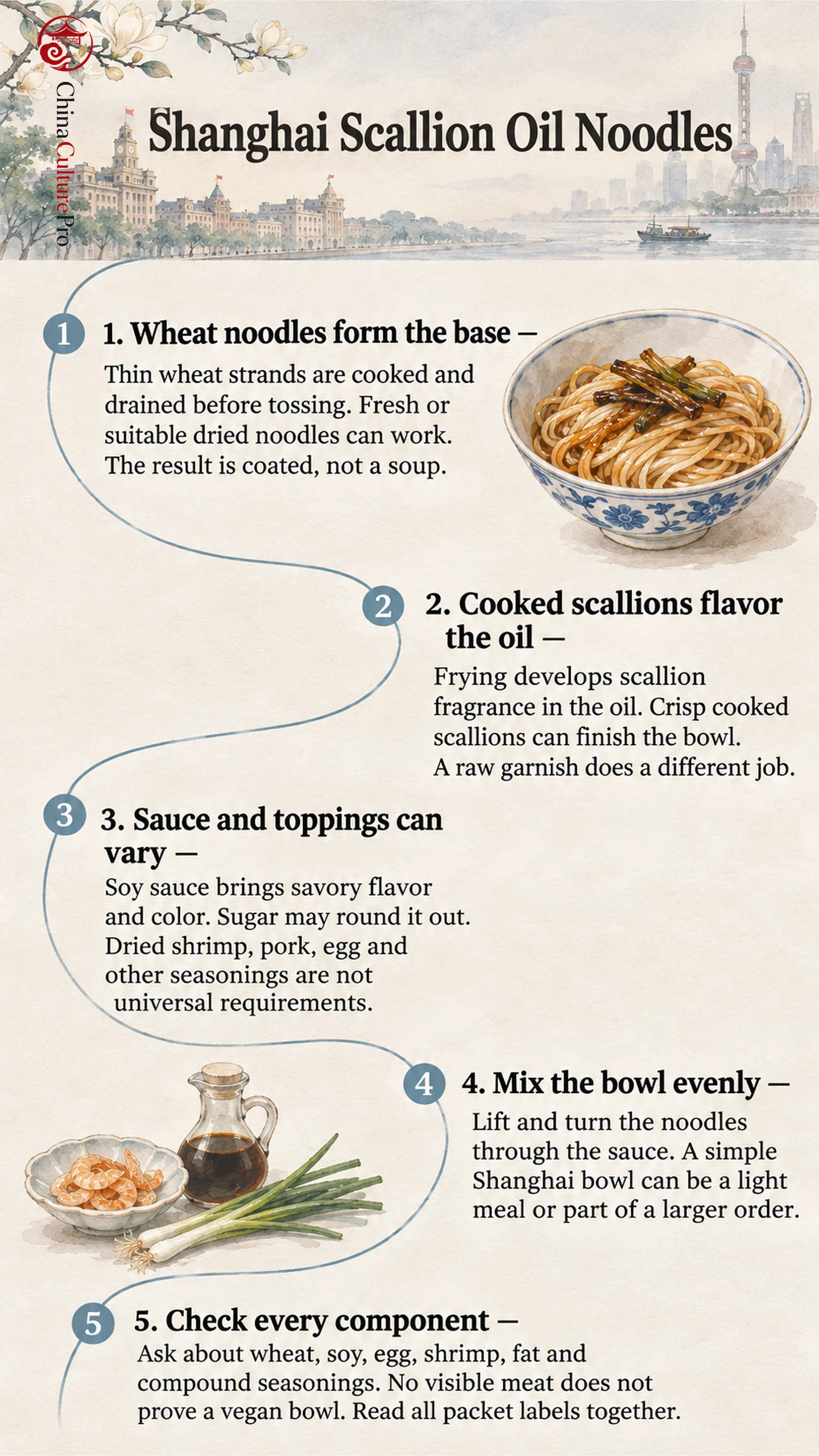
Glossy brown noodles arrive with a small tangle of browned scallions on top. Lift the strands and their fragrance becomes more obvious: the oil carries the scallion aroma through the bowl. Among Chinese noodles, this Shanghai favorite makes a compact ingredient list do several different jobs, from texture to seasoning.
The Wheat Noodles and Their Texture
Thin wheat noodles are a familiar choice, with enough bite to remain distinct under the oil and sauce. Fresh noodles are common, but an appropriate dried wheat noodle can also work. One cook’s published version uses semi-fresh noodles and offers dried alternatives, demonstrating that access to one particular fresh product is not essential.[2]
The noodles are cooked separately, drained and then mixed with the seasoning. Draining matters because excess cooking water changes the coating: the goal is a glossy surface, not diluted sauce collecting like broth beneath the strands. “Tossed” does not mean that the bowl contains no liquid; oil and soy sauce are themselves part of its texture.
This also explains why the finished dish should not be identified only by its brown color. Its characteristic eating texture comes from supple strands coated in aromatic oil. Noodle thickness, the amount of seasoning and optional additions can vary. Color alone does not identify the version.
How Scallions Flavor the Oil
The defining preparation happens before the noodles are dressed. Scallions cook in oil until their fresh, sharp character gives way to a deeper, rounded fragrance. The oil becomes a carrier for that flavor, while the cooked scallions can contribute a crisp garnish. An authored preparation removes the browned scallions and returns them at serving.[3]
That relationship is different from scattering raw chopped scallions over otherwise plain noodles. The raw garnish adds a fresh allium note; infused oil distributes cooked scallion flavor around the strands. Both may appear in a bowl, but they perform different jobs.
The finished scallions can be quite dark. Crisp, aromatic pieces and acrid, overcooked pieces have different flavors; a single shade of brown is not a reliable description of the preparation.
Soy Sauce, Sweetness and Optional Toppings
The oil supplies fragrance, while soy sauce supplies much of the savory seasoning. Published versions often combine light and dark soy sauces, with the latter contributing deeper color. Sugar may round out the seasoning without turning the noodles into a sweet dish. See the guide to Chinese soy sauce for the difference between product types.
Kaiyang(开洋,kāiyáng)means dried shrimp. A Shanghai catering chef’s published version combines it with scallion oil, light and dark soy sauces, sugar and chicken seasoning.[4] This is evidence of a recognizable local variation, not a rule that every plain bowl must include shrimp or chicken-derived ingredients.
Other home-cooking adaptations include oyster sauce, animal fat or optional chili oil.[5] Such additions change the ingredient checks and sometimes the flavor emphasis. They should not be mistaken for the defining scallion oil itself. A diner asking for the plain dish still needs to know what is already in the sauce.
Eating Cong You Ban Mian in Shanghai
Scallion oil noodles belong to everyday Shanghai cuisine, rather than only to formal banquets. Local food guidance presents both a simple bowl and versions made more substantial with extras such as pork chops or egg.[1] The same basic noodle preparation can therefore function as a light meal or accompany a larger order.
When sauce sits beneath the noodles, lift and turn the strands through it so that the bowl is evenly seasoned. Keeping the topping on the surface while eating only the pale upper noodles misses much of the intended coating. The motion is mixing, not a requirement to fry the assembled noodles again.
For ordering, distinguish the plain scallion-oil bowl from a named topping version. Ask about shrimp before the sauce is added if that matters to you. Extra meat or egg can be a separate choice, while scallion oil remains the defining aromatic.
Comprobaciones de ingredientes y dieta
A simple appearance does not guarantee a simple allergen profile. Wheat noodles contain gluten, and soy sauce often contains wheat as well as soy. Egg noodles introduce egg; dried shrimp introduce crustacean shellfish; sesame-containing finishing oils or sauces add another ingredient to check. The FDA identifies these among major food allergens.[6]
For a plant-based version, confirm the noodle ingredients, cooking fat and every sauce component. Lard, shrimp, chicken seasoning or oyster sauce can make a meat-free-looking bowl unsuitable. Picking off a visible topping does not remove ingredients already mixed into the oil or sauce. The wider guide to Chinese vegetarian food explains why those hidden components matter.
Ask about shared utensils and preparation surfaces when cross-contact is relevant. For a packaged product, read the noodle and sauce-packet labels together and follow its preparation instructions. The dish name alone does not verify the contents of an individual product.
FAQs About Scallion Oil Noodles
Are scallion oil noodles spicy?
The familiar soy-and-scallion version does not require chili. Chili oil may be offered or added separately.
Do scallion oil noodles always contain shrimp?
No. Dried-shrimp versions are well established, but plain versions also exist. Ask what is already in the sauce.
Are scallion oil noodles vegan?
They can be. Confirm the noodles, fat, seasoning and toppings; a bowl without visible meat is not enough evidence.
Can you use dried noodles?
Yes. A suitable dried wheat noodle is an alternative, with texture and preparation depending on the product.
Fuentes
[1] Shanghai Municipal Government. Scallion Oil Noodles: A Taste of Simplicity and Flavor
[2] Maggie Zhu. Scallion Oil Noodle: An Authored Home-Cooking Version
[3] Judy, The Woks of Life. Shanghai Scallion Oil Noodles
[4] Ge Ruying, Shanghai Catering Service. Chef Demonstration: Dried-Shrimp Scallion Oil Noodles
[5] Elaine. Scallion Oil Noodles: A Home-Cooking Adaptation
[6] U.S. Food and Drug Administration. Food Allergies: What You Need to Know