
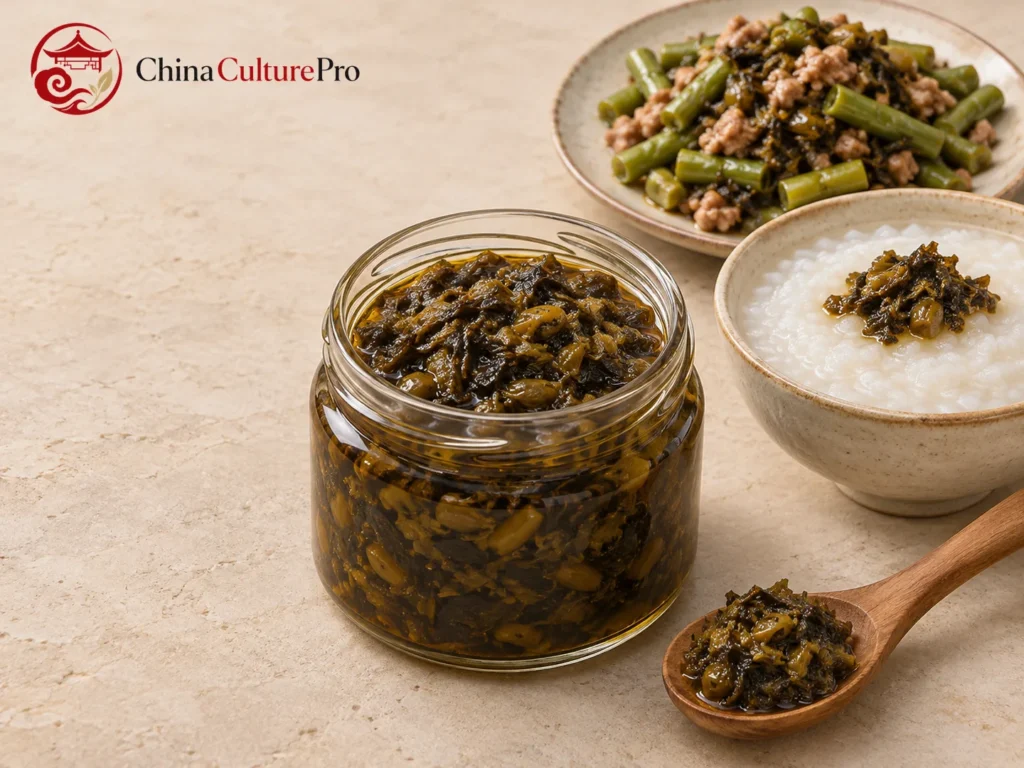

Quick Answer: What Is Chinese Olive Vegetable?
Gan Lan Cai (橄榄菜, gǎn lǎn cài), often labeled Chinese olive vegetable, is a savory condiment made with mustard greens, olives and oil. It is a prepared relish rather than a fresh vegetable or a jar of whole olives.[1][2]
- Use a small amount to flavor green-bean stir-fries, fried rice or congee.[3][4]
- The greens and their flavorful oil both contribute to the dish.[4]
- Check for occasional hard olive pits before serving.[2][4]
Its name does not mean that any olive paste or salted mustard-green product will give the same result.

Treat this dark, oily condiment as part of a dish’s seasoning rather than as a full serving of vegetables.
What Is in a Jar of Gan Lan Cai?
The condiment is associated with Chaoshan (潮汕, cháo shàn), the Teochew food region of Guangdong. Olive flesh and mustard leaves are combined and cooked, with additional seasonings varying by preparation.[1]
The Chinese olive is a fruit associated with Canarium album, not a name for the mustard plant.[6] In the finished condiment, the greens can be the most visually obvious component, finely chopped and surrounded by seasoned oil.[2][4]
Read the actual ingredient list. One commercial example lists mustard leaf, vegetable oil, olive, sesame, salt, flavor enhancer and a preservative. That is an example of a formulation, not a recipe that every producer follows.[5]
How Its Flavor and Texture Differ from Other Preserves
Expect a savory, earthy flavor, salt and soft chopped greens in oil, rather than the crunch of a plain pickle.[3][4]
| Ingrediente | Qué es | What changes in a dish |
|---|---|---|
| Chinese olive vegetable | A prepared mustard-green and olive condiment with oil | Adds seasoned greens and an oily, savory coating |
| Plain preserved mustard greens | Mustard vegetables preserved with salt or other seasonings | Do not automatically supply the olive character or the same oil |
| Whole jarred olives | Preserved olive fruits rather than a mustard-green relish | Supply pieces of fruit, not the same cooked leafy condiment |
These distinctions explain why matching the word “olive” or “preserved” is insufficient when shopping for a recipe.[1][2]
Three Ways to Use Chinese Olive Vegetable
- Green-bean stir-fries: combine it with cooked green beans, with or without minced pork. Stir it through so the seasoning reaches the beans instead of remaining in a dark clump.[2][3]
- Fried rice: break apart the greens as you stir a modest amount through the rice.[3][4]
- Congee: serve a little as a savory condiment with mild rice porridge.[4]
Judge the salt after incorporating it. A green-bean recipe may need little additional salt once the olive vegetable has been mixed through.[3]
How to Portion and Add It to a Cooked Dish
These steps apply to a purchased condiment being added to a prepared dish, not to making an oil-preserved product at home.
- Portion and inspect: use a clean spoon and remove any hard olive pits.
- Separate the clumps: loosen the greens with some seasoned oil, as the recipe requires.
- Add and distribute: stir through at the stated stage; taste the finished dish before adding salt.[2][3][4]
The oil is part of the seasoning. Do not automatically rinse it away as though preparing a plain brined pickle.[4]
Buying, Storing and Substituting
Look for the Chinese characters and a description such as “olive vegetable” or “preserved olive vegetables.” Confirm that the ingredient list includes the mustard-green and olive combination. Do not buy plain olives expecting the same product.[1][5]
Follow the physical package’s storage directions. Some products explicitly require refrigeration after opening; a general claim that every opened jar can sit in the pantry for months is not a substitute for that instruction.[5] Keep the spoon clean and close the container after use.
Another mustard preserve can provide a salty vegetable accent, but changes the olive-and-oil character. Follow a recipe written for that alternative.[1][3]
FAQs About Chinese Olive Vegetable
Is olive vegetable just chopped olives?
No. Mustard greens are a central component, and oil and other seasonings make it a prepared vegetable condiment.[1][2]
Should I rinse Chinese olive vegetable?
Not as a default step. Its seasoned oil is part of what you use, unlike excess brine you might remove from another pickle.[4]
Can I use another mustard-green preserve instead?
Some dishes allow that change, but the replacement will not automatically reproduce the olive flavor and oily texture. Adjust the recipe accordingly.[1][3]
Is every brand vegan or sesame-free?
Check the actual ingredients and allergen information. A vegetable-based name is not enough to establish a product’s suitability; some formulations contain sesame.[5]
Fuentes
[1] National Forestry and Grassland Administration. Chinese Olives and Their Culinary Products
[2] The Woks of Life. Stir-Fried Green Beans with Pork and Chinese Olive Vegetable
[3] China Sichuan Food. Green Beans with Chinese Olive Vegetable
[4] Pups with Chopsticks. Chinese Olive Vegetable
[5] Fairmart, TT Veggie Fresh Mart. Olive Vegetables: Ingredients and Storage
[6] Royal Botanic Gardens, Kew. Canarium album