
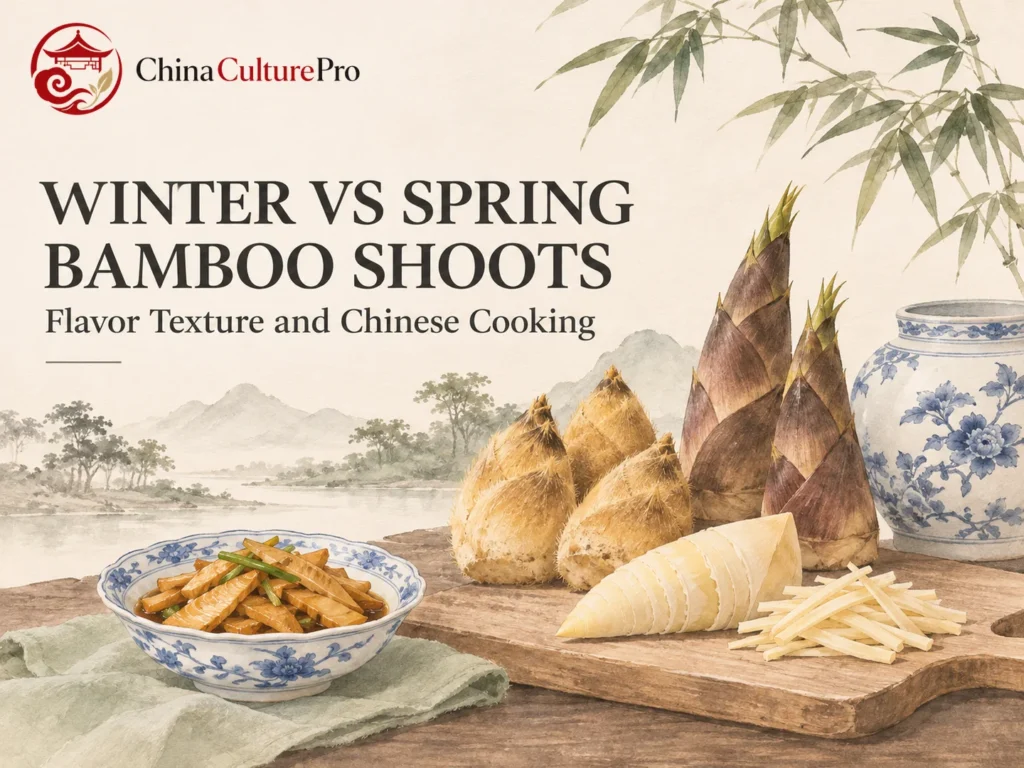

Quick Answer: Winter vs Spring Bamboo Shoots
Both winter bamboo shoots (冬笋, dōngsǔn) and spring bamboo shoots (春笋, chūnsǔn) are valued in Chinese cooking, but their harvest stage affects texture.
- Winter: Underground shoots generally have finer, sweeter flesh and cost more.
- Spring: Emerging shoots have a firmer texture and a prominent place in seasonal dishes.
- Preparation: Fresh shoots need thorough boiling; canned or explicitly preboiled products follow a different preparation route.
These are seasonal descriptions, not a reliable test of whether a packaged shoot is already cooked.
A market label tells only part of the story. To choose bamboo shoots for a Chinese dish, distinguish the seasonal ingredient from the processing that makes it ready for the pan. This is one practical side of Chinese food culture.
What the Seasonal Names Refer To
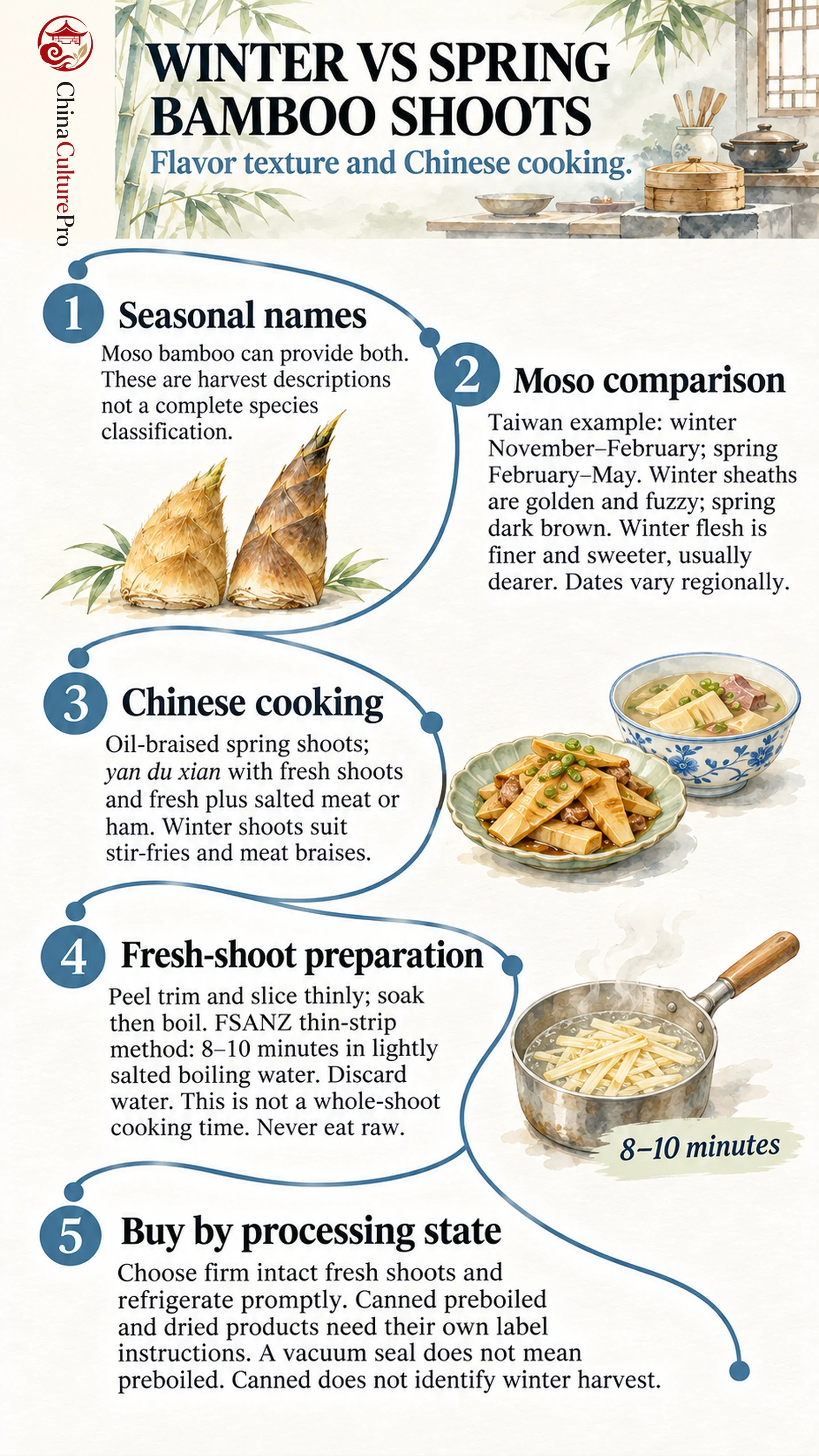
Moso bamboo (孟宗竹, Mèngzōngzhú) can produce both winter and spring shoots. The comparison concerns when its shoots develop and are harvested, rather than two unrelated vegetables. Winter shoots are dug while underground; spring shoots develop into the emerging growth associated with the spring harvest.[2]
The wider bamboo-shoot market also includes other edible bamboo species. Consequently, a shop’s general “spring bamboo shoots” label should not be treated as a botanical identification or a guarantee that every shoot will resemble a Moso example.
Harvest, Appearance and Texture Compared
The following comparison uses Moso shoots, with harvest months from Taiwan’s agricultural guidance.[1]
| Característica | Winter shoots | Spring shoots |
|---|---|---|
| Illustrative harvest period | November–February | February–May |
| Harvest stage | Still below ground | Emerging spring growth |
| Outer sheath | Golden with fine fuzz | Dark brown to black-brown, with prickly hairs |
| Eating texture and flavor | Finer flesh, prized for sweetness | Firmer flesh; still enjoyed for its crispness |
| Usual price relationship | Generally dearer | Usually less expensive than winter shoots |
Calendar dates are regional, not a worldwide standard. A Chinese forestry manual describes Moso winter shoots from October to February and emerging spring shoots in April–May, illustrating why the place and crop matter more than a rigid date cutoff.[2]
Choosing Shoots for Chinese Dishes
Decide how visible the shoot’s own texture should be, then choose the cut and final cooking method.
- Braised spring shoots: Oil-braised bamboo shoots (油焖笋, yóumènsǔn) let the seasonal ingredient lead the dish. Suzhou’s spring repertoire includes braised shoots as well as shoots stewed with pork.[3][7]
- A layered meat soup: Yan du xian (腌笃鲜, yāndǔxiān) combines fresh shoots with fresh and salted meat or ham. Its contrast comes from that combination, rather than treating bamboo as a neutral garnish. It is a useful entry into Jiangsu cuisine.[3]
- A finer-textured winter ingredient: Winter shoots suit stir-frying and meat braises when their delicate flesh is the quality you want to preserve. Higher price does not make them compulsory for every bamboo-shoot dish.[1]
For regional context beyond Suzhou, explore Zhejiang cuisine. When substituting between seasonal shoots, judge the prepared ingredient’s tenderness rather than copying a cooking time unchanged.
Preparing Fresh Bamboo Shoots Safely
Fresh bamboo shoots contain cyanogenic glycosides and should not be eaten raw. Thin strips and whole shoots require different handling; a boiling time for one is not a universal rule for the other.[5]
- Peel and trim: Remove the tough outer leaves and fibrous base, then slice the edible flesh into thin strips. Soak it in water before thorough boiling.[4]
- Use the right boiling guidance: For its thin-strip method, Food Standards Australia New Zealand specifies lightly salted boiling water for 8–10 minutes. That instruction does not describe cooking an intact large shoot.[5]
- Discard the cooking water: Drain the prepared shoots and throw away their boiling water rather than using it as the soup base.[5]
- Continue with the chosen dish: Use the prepared shoots in the final braise, soup or stir-fry. Follow the supplier’s preparation instructions for the product you bought, especially if its form differs from thin fresh strips.
The final seasoning belongs to the dish; preprocessing comes first. The guide to Chinese cooking methods explains the later cooking techniques.
Buying and Storing Fresh or Packaged Shoots
Check both the ingredient name and its processing state before choosing a substitute.
- Fresh, unpeeled shoots: Choose firm, intact shoots without decay. Keep whole unpeeled shoots refrigerated in the crisper and use promptly; cooked shoots can also be frozen.[6][7]
- Canned or explicitly preboiled shoots: Canning reduces the cyanide hazard through processing. Follow the label; water-packed canned shoots may be rinsed, sliced and cooked into a dish. A vacuum seal alone does not mean “preboiled.”[5][7]
- Dried shoots: Treat them as a different pantry product, not a fresh shoot with identical texture. Follow the packet’s soaking and cooking directions rather than adding dry pieces directly to a quick stir-fry.
For Chinese home cooking, match the processing state to your preparation time. Follow the label’s storage and use-after-opening instructions.[7]
FAQs About Winter and Spring Bamboo Shoots
Do winter and spring bamboo shoots come from the same plant?
They can. Moso bamboo produces both seasonal crops; the names describe harvest timing and development rather than necessarily identifying different species.[2]
Can I substitute spring bamboo shoots for winter shoots?
Often, but expect a firmer result. Adjust the cut and final cooking to the actual tenderness, and do not omit fresh-shoot preparation.
Can winter bamboo shoots be eaten raw?
No. Sweetness does not establish safety: fresh shoots require peeling, soaking, cutting and thorough boiling before eating.[4]
Are canned bamboo shoots always winter shoots?
The word “canned” does not establish a harvest season. If the product does not specify winter shoots, do not infer that identity from its packaging.
Fuentes
[1] Taiwan Ministry of Agriculture. 萬能竹和筍 好處一籮筐
[2] Fu Maoyi, Yang Xiaosheng and Jiang Shenxue. Technical Manual on Utilization of Sympodial Bamboos, Chapter 6, page 147
[3] Suzhou Industrial Park Administrative Committee. Spring bamboo shoots
[4] Hong Kong Centre for Food Safety. Natural Toxins in Food
[5] Food Standards Australia New Zealand. Cassava and bamboo shoots
[6] Washington State University Extension. Bamboo Shoots
[7] Changle District Market Supervision Administration. 关于竹笋的消费提示,爱吃竹笋的你速看!