


Quick Answer: What Is Riverbank Attributed to Dong Yuan?
Riverbank (溪岸圖, Xī’àn Tú) is a large ink-and-color landscape on silk in the Metropolitan Museum of Art, New York, traditionally attributed to Dong Yuan (董源, Dǒng Yuán). The museum dates it to the Southern Tang period and retains a qualified artist attribution. Mountains, wind-bent trees, waterfalls and a riverside retreat dominate the scene. Its age and authorship have prompted substantial disagreement: the museum defends an early date, while James Cahill argued for a modern origin.[1][3][4]
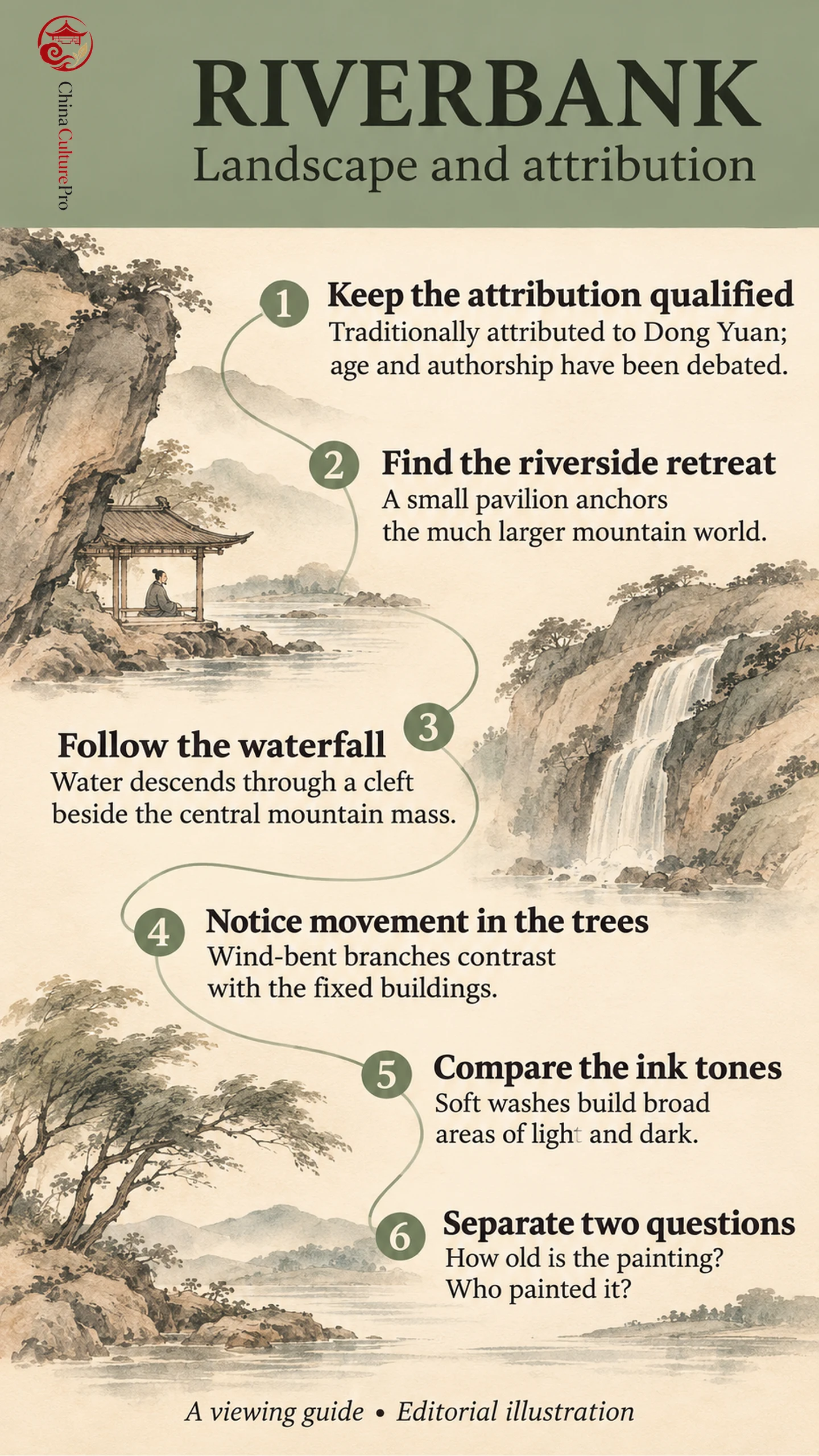
A small building beside the water can be easy to overlook beneath these mountains. Finding it changes the picture’s scale: what first appears to be an immense arrangement of hills becomes a landscape containing shelter, household activity and paths through difficult terrain.
The Met’s Hanging Scroll at a Glance
Keep the painted surface separate from the longer and wider mounting. The distinction matters when comparing photographs that include different amounts of surrounding fabric.[1]
| Campo | Current collection identification |
|---|---|
| Title | Riverbank |
| Artist attribution | Attributed to Dong Yuan |
| Museum’s period assignment | Southern Tang dynasty, 937–76 |
| Medium and format | Ink and color on silk; hanging scroll |
| Image dimensions | 220.3 × 109.2 cm |
| Overall dimensions with mounting | 336.6 × 121.9 cm, excluding knobs |
| Collection | Metropolitan Museum of Art, New York |
| Accession number | 2016.750 |
The period label records the museum’s assessment. It does not remove the attribution debate or turn the proposed artist’s identity into a certainty.
A Small Riverside Retreat Anchors the Mountain World
Look for the pavilion beside the river, to the right of the lower mountain masses. A seated scholar faces the water, with household figures behind him. Buildings extend back into a more complex retreat, while other people approach or work nearby.[2]
The architecture creates a pause within a restless setting. Its horizontal rails and compact roof are much smaller than the surrounding slopes, yet they provide a recognizable place from which a person might look outward. The landscape becomes a relation between a protected interior and the environment beyond it.
That relation is useful when exploring the ideal of withdrawal associated with Chinese literati painting. Here, reclusion includes a household and access routes. It is not represented simply by an isolated person in an empty wilderness.
Water, Trees and Mist Connect Different Scales
At the lower left, trees rise from a projecting bank. Across from them, open water occupies the lower-right area. Moving upward, the eye encounters the retreat and a more compressed succession of slopes. A waterfall descends through a cleft on the left side of the central mountain mass.
The contrast between those areas gives the picture several kinds of distance. The foreground trees mark a near edge; the pavilion supplies a middle-scale human landmark; the narrowing valley leads attention farther into the landscape. Some passages are easy to follow, while others dissolve into darkened or misty transitions.
The branches bend with the wind, adding motion to a scene whose buildings remain fixed. Water, foliage and approaching travelers contribute to the impression of weather moving through the landscape.[2]
Rather than trying to identify every distant form at once, follow one continuous relation: a tree against a slope, a stream beside a bank or a roof below a rising hill. The general guide to Chinese landscape painting offers a wider context for these shifts of scale.
Soft Ink Washes Give the Hills Their Mass
The mountain surfaces are built through transitions of tone and softly worked texture. Broad areas of light and dark carry much of their weight. The museum reads this handling as a feature connecting the work with an early phase of landscape painting, before more emphatic descriptive linework became dominant.[2]
For close looking, separate that historical interpretation from the visible effect. Compare a softly shaded slope with a sharply legible branch or architectural edge. Different degrees of definition guide attention across the same sheet.
Then reduce the image on screen or move farther away. The large tonal groups remain visible after the small figures disappear. Returning to a detail restores the household and paths. The painting therefore rewards both an overall view and a slower search through its smaller incidents.
Dating and Authorship Are Separate Questions
The Met defends the painting’s early date while explicitly declining to claim a firmly established work from Dong Yuan’s own hand. Those positions are compatible: a painting could be early without its individual maker being securely known.[3]
James Cahill took a different position. He argued that the work was a forgery by the twentieth-century painter Zhang Daqian (張大千, Zhāng Dàqiān). His case included comparisons of landscape forms and the interpretation of damage patterns in the silk. These are his arguments, rather than independently established findings adopted here.[4]
The dispute was addressed at a 1999 symposium, with differing positions subsequently published. A signature, seals, stylistic comparison and physical condition each enter the discussion; none should be substituted for the full argument. The guide to painting inscriptions and seals explains why such marks require interpretation.[3]
How to Look Closely while Keeping the Attribution Qualified
- Read the label precisely: Keep the museum’s period assignment separate from its qualified artist attribution.
- Find the retreat: Locate the small pavilion and examine its relationship with the surrounding mountain forms.
- Trace water and movement: Follow the river, waterfall, trees and approach paths through the composition.
- Compare interpretations: Distinguish what is visibly present from competing claims about its age and maker.
FAQs About Riverbank Attributed to Dong Yuan
Does the museum claim that Dong Yuan certainly painted it?
No. Its label says attributed to Dong Yuan, and its explanation acknowledges the difficulty of securely identifying his individual hand.[1][3]
Has Riverbank been called a modern forgery?
Yes. James Cahill argued for an attribution to Zhang Daqian. The Met rejects that dating and presents the work as an early landscape; the disagreement should remain explicit.[3][4]
Is the painting as large as its full mounting?
No. The image measures 220.3 × 109.2 cm. The mounting extends beyond the painted silk, so an overall measurement describes a different boundary.[1]
Fuentes
[1] Metropolitan Museum of Art. Riverbank: Collection Record
[2] Metropolitan Museum of Art. Riverbank: MetCollects
[3] Metropolitan Museum of Art. Riverbank: Acquisition Announcement and Attribution Statement
[4] James Cahill. Riverbank: A Closer Look, Lecture Notes