
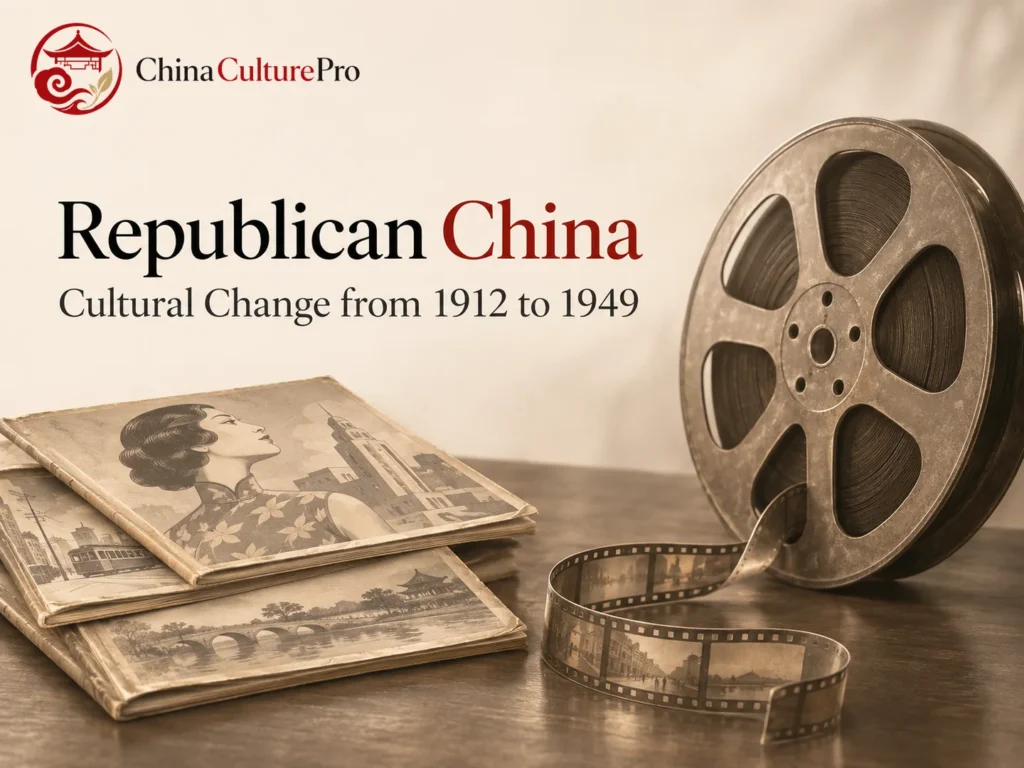

Quick Answer: What Was Republican China?
Republican China usually refers to the period from the founding of the Republic of China (中华民国, Zhōnghuá Mínguó) in 1912 to the establishment of the People’s Republic of China on the mainland in 1949, when the Republic of China government relocated to Taiwan.[1][16]
- Print and language: Writers and editors developed new uses for vernacular Chinese in fiction, essays and education.[3][4][5]
- Popular culture: Shanghai publishers and studios reached audiences with pictorial magazines and sound films.[7][8][9][17]
- War and migration: War displaced students, teachers and artists and shifted some cultural activity inland.[15][22]
The period included competing political authorities and distinct regional experiences.[2][17]
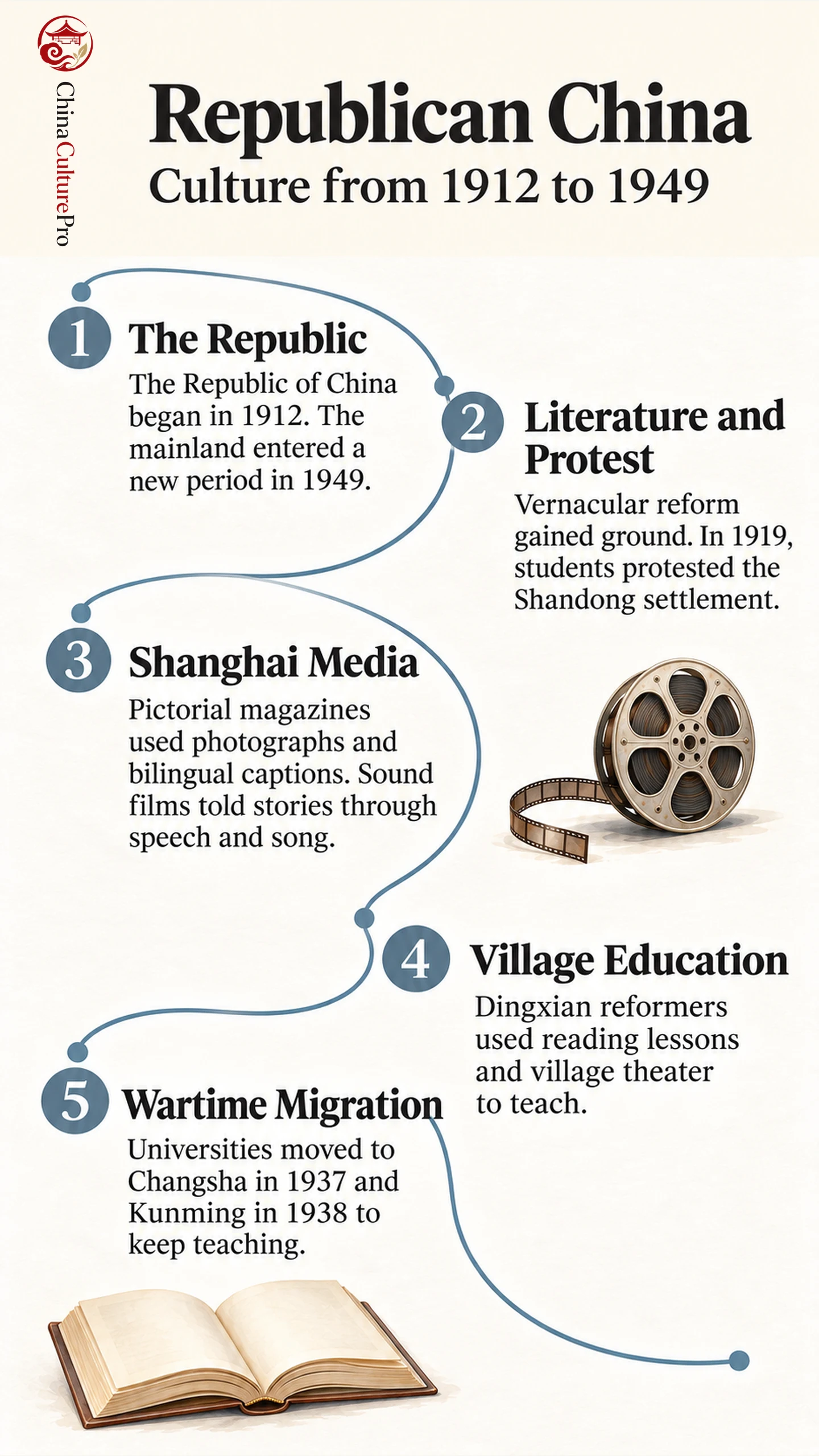
A bilingual Shanghai pictorial, a village theater and a university that moved across provinces offer three ways into the cultural history of the republic.[7][13][15]
The Republic and Its Changing Political Setting
The 1911 Revolution brought the Qing dynasty to an end. Sun Yat-sen (孙中山, Sūn Zhōngshān) took office as provisional president in Nanjing on January 1, 1912. The Qing emperor abdicated the following month. Publishers carried their presses, distribution relationships and readership from the late Qing dynasty into the republic.[1][2][20]
One example was Shen Bao (申报, Shēnbào), a Shanghai newspaper founded in 1872. Its illustrated supplement in the late Qing had already shown how a commercial press could package visual accounts of current events for urban readers. Later pictorials could build on an existing market for reading news through images.[7][20]
In the years often called the Nanjing Decade, 1928–1937, Nanjing was the Nationalist government’s capital and Shanghai was a major center of publishing and film production. Shanghai’s industries also relied on networks outside the city. A film’s production address therefore tells only part of its history. Exhibition venues and local distributors shaped who could see it. By the mid-1920s Shanghai had at least twenty film theaters as well as smaller halls that regularly screened films. In Zhejiang and Fujian, missions and other organizations also helped distribute or exhibit films. A dedicated theater and a screening arranged by a local institution brought viewers into the same medium through different kinds of places.[2][17]
New Culture, May Fourth and Written Chinese
The New Culture Movement (新文化运动, Xīn Wénhuà Yùndòng) brought debates about literature, education and society into magazines and universities. In 1917, Hu Shi (胡适, Hú Shì) argued that writers should put substance into their work, avoid routine imitation of earlier writers and accept vernacular expressions. Written vernacular Chinese, or baihua (白话, báihuà), had a long history. Its advocates sought to give it a larger place in literary and public life.[3][4][18]
Lu Xun (鲁迅, Lǔ Xùn) showed what that could mean in fiction. His 1918 Diary of a Madman (狂人日记, Kuángrén Rìjì), published in New Youth (新青年, Xīn Qīngnián), opens with a classical-style preface before switching to the narrator’s diary in vernacular Chinese. The narrator reads signs of cannibalism into everyday life. The shift in register changes whose voice readers hear and gives the story room to turn a familiar social order into something disturbing.[5][19]
The May Fourth Movement (五四运动, Wǔsì Yùndòng) takes its name from the Beijing student demonstrations of May 4, 1919. Protesters opposed the Paris Peace Conference decision to transfer former German rights in Shandong to Japan. Political mobilization and cultural reform then intersected, although the literary debates had begun before the demonstrations.[3][6][18]
Pictorial Magazines, Film and Printmaking
The Young Companion (良友, Liángyǒu), launched in Shanghai in 1926, used photography and captions in Chinese and English. Readers could move through a page by looking at the pictures, reading short captions or following the longer text. In a different segment of print culture, The Ladies’ Journal (妇女杂志, Fùnǚ Zázhì) ran from 1915 to 1931 and provided a recurring publication venue devoted to women. These serials gave publishers ways to address several kinds of readers and interests.[7][21]
The 1937 film Street Angel (马路天使, Mǎlù Tiānshǐ), directed by Yuan Muzhi (袁牧之, Yuán Mùzhī), follows poor residents of a Shanghai neighborhood. Zhou Xuan (周璇, Zhōu Xuán) plays a young singer displaced from Manchuria. Her songs matter inside the plot. They help her make a living and give her a way to express memories of displacement while the camera stays on the city around her.[8][9]
Printmaking also carried public messages. In 1932, Hu Yichuan (胡一川, Hú Yīchuān) made the woodcut To the Front! (到前线去, Dào Qiánxiàn Qù). It places a figure with a flag at the front of a surging group. A carved block can produce multiple impressions, which made woodcuts suitable for circulation. The work is one example of the modern woodcut movement several years before the full-scale war with Japan.[10][11]
Education and Reform Beyond the Metropolis
In 1929, the rural education experiment associated with James Yen (晏阳初, Yàn Yángchū) began its work in Dingxian (定县, Dìngxiàn), Hebei. Reading lessons were part of a wider effort that also addressed livelihoods, health and participation in local affairs. Village theater gave reformers a way to communicate through performance as well as through printed lessons. In a village play, performers could show a practical problem through a conversation or an action. That gave people an opportunity to engage with the subject without first working through a written lesson. The organizers also hoped that making and watching plays would bring neighbors together around village affairs. Theater was part of their approach to organizing community life.[12][13]
The New Life Movement (新生活运动, Xīn Shēnghuó Yùndòng), promoted by Chiang Kai-shek (蒋介石, Jiǎng Jièshí) from 1934, approached daily life through moral discipline. In a speech that year, Chiang applied its principles to matters such as clothing, food and housing. The address is evidence of what Chiang asked people to do. In Dingxian, the surviving record of classes and performances also gives historians evidence of how a local project worked on the ground.[12][13][14]
War, Displacement and the 1949 Transition
Full-scale war with Japan began in 1937. Peking University, Tsinghua University and Nankai University first joined in a temporary institution in Changsha. In 1938 the institution moved to Kunming as the National Southwest Associated University (国立西南联合大学, Guólì Xīnán Liánhé Dàxué). It operated there until 1946. The two moves explain why university life in wartime Kunming drew students and teachers from campuses far to the north.[2][15]
Wartime cultural production also relied on people and material that could travel. Theater troupes took performances on the road, while cartoons and newspapers carried news and calls for resistance. Both Nationalist and Communist organizers used popular forms to reach audiences, including rural communities. Communist productions also used peasant heroes and images of village life to advance their political program. Together these channels help explain how a war that disrupted established publishers and schools also changed where readers and spectators encountered public culture.[22]
After Japan’s defeat in 1945, the Chinese Civil War resumed on a large scale. In 1949 the Chinese Communist Party proclaimed the People’s Republic of China, and the Republic of China government relocated to Taiwan. These events mark the end of this period in a mainland history and set the context for cultural changes after 1949.[16]
FAQs About Republican China
What years does Republican China refer to?
In histories focused on the mainland, the term usually covers 1912 to 1949. The Republic of China was founded in 1912. In 1949 the People’s Republic of China was established on the mainland, and the Republic of China government relocated to Taiwan.[1][16]
Were New Culture and May Fourth the same event?
New Culture refers to a broader movement of intellectual and literary reform that was already underway before 1919. May Fourth began as a protest over the Shandong settlement. Some writers, students and publications participated in both, and their concerns often overlapped.[3][6][18]
Why was Shanghai important to Republican-era culture?
Shanghai housed commercial publishers, pictorial magazines and film studios. Producers there could combine photos and bilingual captions in a magazine or use dialogue and music to tell stories on screen. Regional exhibition and distribution networks took some of this work to audiences elsewhere.[7][8][9][17]
Fuentes
[1] U.S. Department of State. The Establishment of the Republic of China
[2] Library of Congress. China: Country Profile, Historical Background
[3] Columbia University. Hu Shi: A Preliminary Discussion of Literary Reform
[4] University of Hawai‘i at Mānoa Library. Revolution in Chinese Language and Literature
[5] University of Tokyo Center for Philosophy. Reverberations of a Utopian Utterance
[6] The National Archives. May Fourth Movement, 1919
[7] Shanghai Municipal Government. A Look Back at The Young Companion Pictorial
[8] Virtual Shanghai. Street Angel: Film Catalogue
[9] Ohio State University MCLC Resource Center. Street Angel: Film Translation and Notes
[10] Guangdong Museum of Art. Collection Guide: Hu Yichuan’s To the Front!
[11] The Metropolitan Museum of Art. The Printed Image in China
[12] SOAS University of London. Participation and Protest: The Dingxian Rural Experiment
[13] Twentieth-Century China. Acting Out Reform: Theater and Village
[14] Columbia University. Chiang Kai-shek: Essentials of the New Life Movement
[15] Tsinghua University. History of Tsinghua University
[16] U.S. Department of State. The Chinese Revolution of 1949
[17] University of California eScholarship. Regional Cultural Enterprises and Cultural Markets in Early Republican China
[18] Columbia University. Before and After the May Fourth Movement
[19] Bulletin of SOAS. The Influence of Western Literature on Lu Xun’s Diary of a Madman
[20] MIT Visualizing Cultures. The Dianshizhai Pictorial: Shanghai’s Illustrated Press
[21] USC Libraries. Chinese Women’s Magazines in the Late Qing and Early Republican Period
[22] University of California Press. War and Popular Culture: Resistance in Modern China, 1937–1945