


Quick Answer: What Was the Boxer Rebellion?
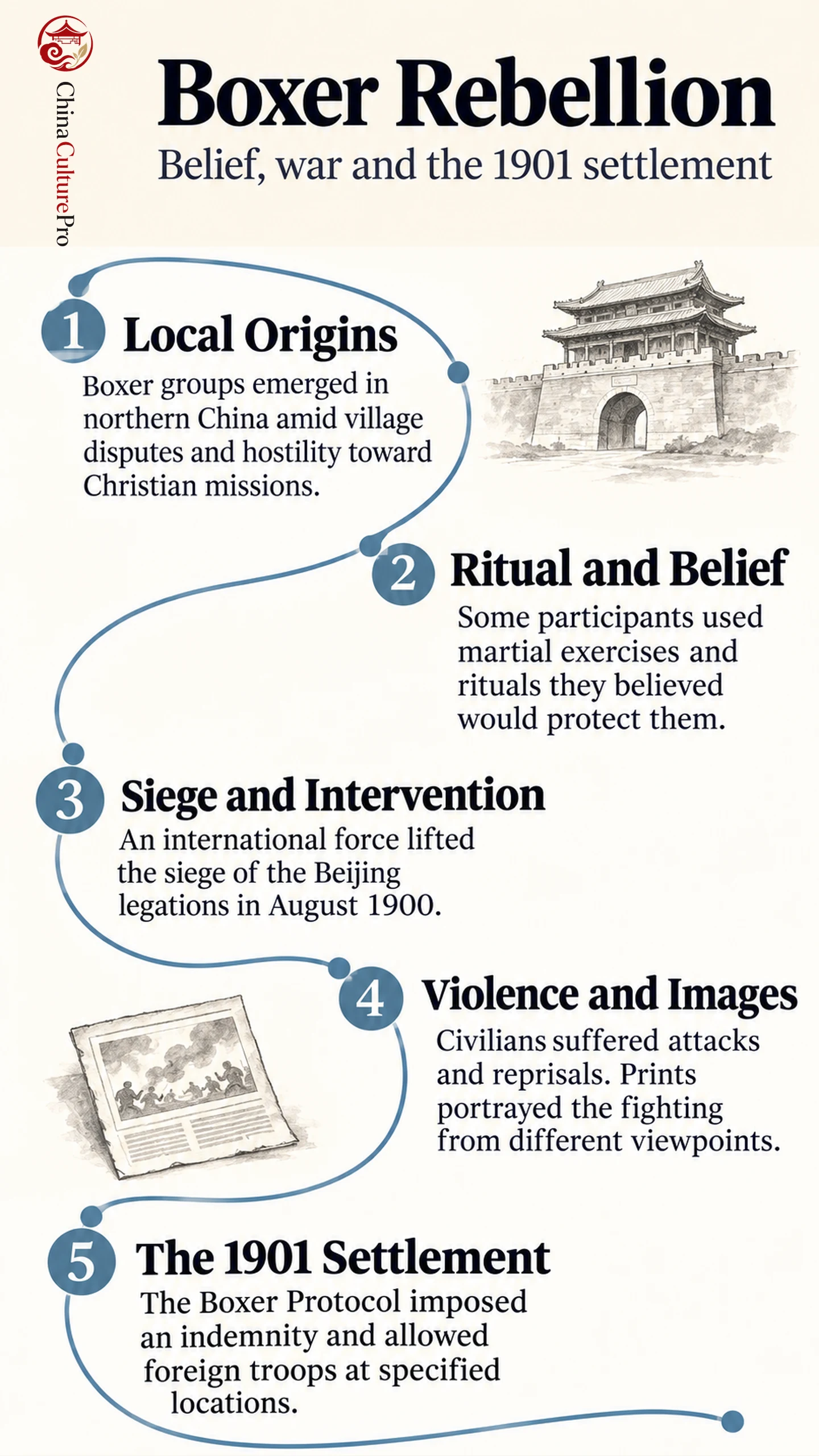
The Boxer Rebellion (义和团运动, Yìhétuán Yùndòng) was an uprising in northern China that became an international war in 1900. Local groups attacked Chinese Christians and foreign missionaries. The siege of foreign legations in Beijing led to a multinational military campaign and a settlement in 1901.[1][2][3][4][9]
- Local origins: Village disputes, anti-Christian mobilization and martial rituals helped shape Boxer groups.[1][2]
- An international war: Boxers and some Qing forces besieged the legations. An international army entered Beijing in August 1900.[1][3][4]
- The settlement: A 1901 agreement required an indemnity and gave foreign powers military and diplomatic privileges.[9][10][11]
The rebellion is often dated 1899–1901, with earlier local violence and the largest military intervention in 1900.[1][2][3][9][12]
A village ritual, a siege and two prints of the fighting bring different kinds of evidence to the history of the uprising.[1][3][7][8]
Shandong, Missions and the Boxer Groups
Boxer groups emerged in parts of Shandong and neighboring areas in the late 1890s. Participants used names including Righteous and Harmonious Fists (义和拳, Yìhéquán) and Righteous and Harmonious Militia (义和团, Yìhétuán). Foreign observers called them Boxers because of their martial exercises. The movement included locally organized groups with varying leadership and practices.[1][2]
Christian missions had expanded in China with protections negotiated after the Opium Wars. When missionaries intervened in local disputes, some villagers saw converts as having a new source of influence with officials. Questions of religious affiliation became entangled with competition over resources and local authority. Drought and hardship added pressure in parts of northern China.[1][2]
The people targeted included Chinese Christians living in the same communities as their attackers. Missionary diaries and records preserve particular accounts of destroyed missions and the deaths of converts and missionaries. Their perspective reflects the institutions and places those writers knew.[1][5][6]
Martial Ritual and Popular Belief
Boxer groups combined physical training with practices such as incantations and spirit possession. Some participants believed that they could call on deities or heroic figures for protection. Certain rituals were believed to make fighters resistant to bullets. Accounts of those ceremonies describe the hopes and commitments that fighters brought to them.[1][2]
The exercises and ceremonies drew on practices already familiar in village life, including performance traditions and stories of supernatural protection. A shared ritual could bring people together before an attack. Its local form and meaning could vary among groups. The beliefs help explain participation, alongside the social conflicts in which the movement grew.[1][2]
The Qing Court, the Siege and the Alliance
The Qing dynasty faced conflicting advice about the Boxers. Some Qing officials suppressed the groups, and some provincial leaders sought to keep their provinces out of the war. As foreign intervention escalated, the court under Empress Dowager Cixi (慈禧太后, Cíxǐ Tàihòu) backed the fight against foreign forces in the north. The seizure of the Dagu forts by foreign naval forces in June raised the stakes along the route from the coast to Beijing.[1][3][4]
Foreign diplomats, soldiers, missionaries and Chinese Christians took refuge in Beijing’s Legation Quarter. Boxer groups and Qing troops took part in the siege, which lasted about 55 days. The international force that fought to reach the quarter is known as the Eight-Nation Alliance (八国联军, Bāguó Liánjūn). It brought together Austria-Hungary, Britain, France, Germany, Italy, Japan, Russia and the United States. Its troops entered Beijing on August 14, 1900, and lifted the siege of the legations.[1][3][4]
Civilians, Occupation and Images of War
Chinese Christians, foreign missionaries and civilians caught in the fighting suffered violence. The occupation brought further harm. Foreign forces looted property and carried out punitive actions, and reprisals affected people well beyond the diplomats and soldiers at the center of the siege. Evidence of attacks and reprisals comes from records with different perspectives and geographic coverage.[1][5][6]
Images of the war reached audiences who had never seen the battlefield. Chinese nianhua (年画, niánhuà), or New Year prints, pictured Boxers and Qing troops fighting together. One print celebrated a victory at Yangcun, showing foreign prisoners presented to a Qing commander. Military accounts describe the alliance’s advance through Yangcun in August. The print shows how publishers wanted readers to understand the fighting.[3][7]
A chromolithograph issued in Tokyo in 1900 showed American, British and Japanese forces storming a Beijing gate. The Tokyo print makes the advance of foreign troops the focus, while the Yangcun print puts a Qing commander at the center of a victory scene. Comparing the images with military records helps separate what the publishers wanted to celebrate from the outcome of a particular battle.[7][8]
The Boxer Protocol and Its Consequences
The Boxer Protocol (辛丑条约, Xīnchǒu Tiáoyuē) was signed on September 7, 1901. It required an indemnity with principal of 450 million Haikwan taels (海关两, hǎiguān liǎng), a customs unit for weighing silver. The agreement calculated the debt in gold equivalents and set annual interest at 4 percent, with repayment of principal over thirty-nine years. The 450 million figure therefore describes the principal of the original agreement.[9][10]
The agreement also allowed the legation quarter to be defended by foreign powers and permitted troops at specified points between Beijing and the coast. It called for the destruction of the Dagu forts and included punishments and restrictions. The Qing remained in power under a settlement that reduced its control in important areas. The dynasty faced further reforms and crises before the 1911 Revolution.[9][11]
FAQs About the Boxer Rebellion
Who were the Boxers?
They were participants in local groups in northern China who used martial exercises and religious rituals. Their campaigns targeted Chinese Christians and foreigners, and some groups later fought alongside Qing troops.[1][2][3]
Why did foreign armies intervene?
The governments involved sent forces to protect their nationals and interests, relieve the besieged legations and secure access to Beijing. These actions took place within wider competition among foreign powers in China.[1][3][4][11]
What did the Boxer Protocol require?
It imposed an indemnity of 450 million Haikwan taels in principal, with interest. It also provided for foreign guards and troop positions and required the destruction of forts and other measures affecting Qing control.[9][10]
Fuentes
[1] MIT Visualizing Cultures. The Boxer Uprising: Background and Belief
[2] University of California Press. The Origins of the Boxer Uprising
[3] National Army Museum. The Boxer Rebellion
[4] U.S. Naval History and Heritage Command. Bluejackets and Marines in China, 1900–1901
[5] Yale Divinity Library. Missionary Archives on the Boxer Rebellion
[6] Modern Asian Studies. Atrocity and Reciprocity During the Boxer War
[7] MIT Visualizing Cultures. Chinese New Year Prints and the Boxer Uprising
[8] Library of Congress. Allied Armies Launch an Offensive on Beijing
[9] Library of Congress. Boxer Protocol, September 7, 1901
[10] U.S. Department of State. Indemnity Bond Under the Final Protocol
[11] U.S. Department of State. The Open Door Policy and China
[12] Routledge Encyclopedia of Modernism. Boxer Rebellion, 1899–1901