

Quick Answer: What Is Qilu Culture?
Qilu(齐鲁,Qílǔ)culture is a regional cultural tradition associated with Shandong. Its name combines two ancient states whose histories contributed to later regional identity. It includes Confucian learning and ritual, archaeological objects, sacred landscapes and continuing local arts.
- Historical foundations: Early pottery, bronzes and musical instruments reveal changing societies.
- Confucian heritage: Qufu connects teaching, commemoration and the history of a prominent family.
- Wider traditions: Mountain worship, Buddhist art and shadow puppetry also belong to the region’s cultural record.
Qilu is a historical and cultural label. It neither describes one unchanging tradition nor establishes the beliefs or personality of everyone living in Shandong.
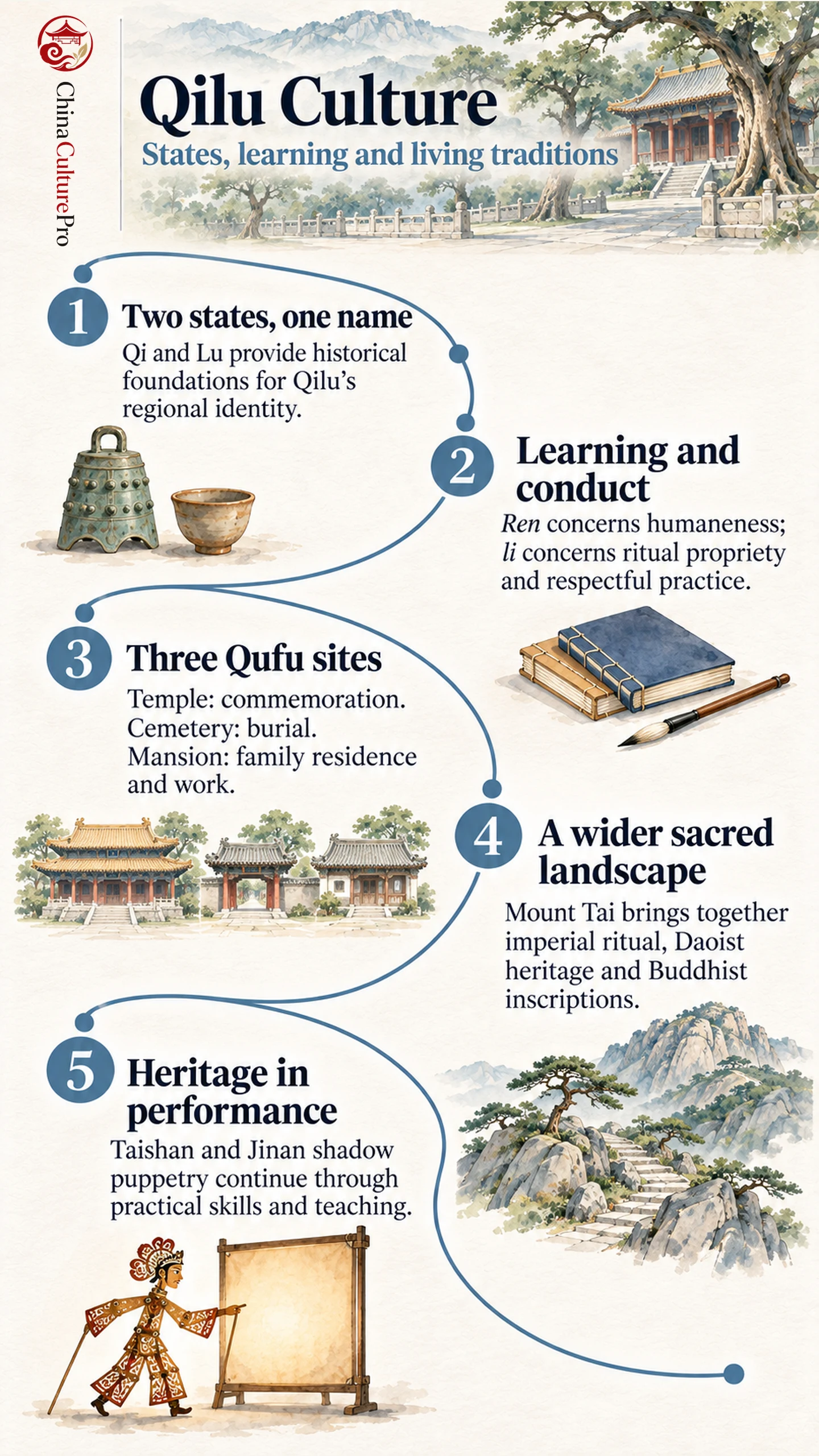
Qilu culture becomes clearer when a ritual bronze, a scholar’s teaching and a shadow-puppet performance are considered in their own settings. Shandong’s famous Confucian associations connect these histories, but its regional identity also contains different institutions, artistic practices and religious traditions.
Qi and Lu: Two States Behind the Regional Name
The ancient states of Qi(齐,Qí)and Lu(鲁,Lǔ)give Qilu its name. Both belonged to the political landscape of the Zhou period, within areas of present-day Shandong.
Lu became closely associated with the preservation of Zhou ritual traditions. Qi developed important coastal activities, including fishing and salt production. [1] These are historical contexts for comparing institutions and resources; they should not become claims that one population was naturally conservative and another naturally entrepreneurial.
The region’s archaeological record also begins before these states. Neolithic jade and pottery show earlier forms of craftsmanship and status display. Later ritual bronzes and musical instruments belong to different social settings. [1]
For example, excavated objects associated with Qi include bronze tableware, while a Western Zhou bronze vessel bears an inscription identifying a Lu connection. Chime bells provide evidence for the material equipment of ceremonial music. [2] Identifying an object’s date and context explains more than treating everything found in Shandong as the expression of a single ancient culture.
Confucian Learning: Ritual and Moral Practice
Confucius(孔子,Kǒngzǐ)is central to Qilu’s intellectual heritage. His teachings connect learning, personal conduct, family relationships and government. Two useful concepts are ren(仁,rén), often translated as benevolence or humaneness, and li(礼,lǐ), ritual propriety.
Ren concerns how a person regards and treats others. Li includes cultivated forms of conduct through which respect and social responsibilities are practiced. In this account, outward ceremony has ethical significance through the participant’s attitude and conduct; the presence of impressive objects alone does not establish moral cultivation. [3]
These ideas provide an entry into Confucianism, rather than a complete summary of it. Texts associated with Confucius were transmitted, interpreted and selected over time. Later educational and political uses therefore need to be distinguished from an uncomplicated account of his original intentions. [3]
That distinction matters for regional culture. A temple dedicated to a teacher, an imperial ceremony and a modern ethics discussion can all draw on Confucian traditions while doing different things. None provides a reliable guide to a present-day resident’s private convictions.
Qufu’s Three Sites Have Different Functions
Qufu’s three principal Confucian heritage sites are collectively called San Kong(三孔,Sān Kǒng). Their shared association with Confucius can obscure the differences among commemoration, burial and the administration of an influential household.
| Site | Principal historical function |
|---|---|
| Temple of Confucius(孔庙,Kǒngmiào) | Commemoration and ritual offerings honoring Confucius |
| Cemetery of Confucius(孔林,Kǒnglín) | Burial ground for Confucius and generations of his descendants |
| Kong Family Mansion(孔府,Kǒngfǔ) | Residence and working premises of his direct descendants |
The temple began as a memorial after Confucius’s death and was repeatedly rebuilt and expanded. The mansion developed into an aristocratic complex through the family’s recognized position, while the cemetery preserves a different kind of lineage history. [4]
Together, the sites show how teaching acquired institutional authority over centuries. Their standing buildings should be read as products of successive periods and patronage, rather than as an intact architectural scene from Confucius’s lifetime. The distinction between household, commemorative institution and burial landscape gives each part of the ensemble a clearer meaning.
Mount Tai and Shandong’s Wider Religious Landscape
Mount Tai(泰山,Tài Shān)adds a sacred landscape to this regional picture. Imperial worship associated the mountain with ceremonies honoring heaven and earth. Its temples, inscriptions and pathways record the ways rulers, religious communities, writers and other participants gave meaning to the mountain. [5]
This setting includes more than Confucian commemoration. Daoist temples and Buddhist inscriptions coexist within its cultural record. The carved Buddhist scriptures, for example, connect the mountain to Chinese Buddhism, while imperial ceremonies expressed a different relationship between sacred landscape and political authority. [5]
Shandong’s broader material heritage also includes Buddhist sculpture, stone reliefs and traditions associated with the Penglai immortals. [6] These expand the story beyond one philosophical lineage without requiring every practice to be combined into a single belief system.
The overlapping traditions discussed in religion in China provide a useful wider context. Historical association with a sacred place does not mean all its participants understood it in the same way.
Living Arts Beyond the Monumental Sites
Shadow puppetry shows regional knowledge in performance. In the Taishan tradition, carved figures, singing, accompaniment and remembered repertoire work together. Artists preserve skills while also developing new ways to perform them; a well-known solo technique combines several tasks in one performer, but it should not be treated as the format of every show. [7]
Jinan supplies another local example. Performer Li Juan has taught in schools and universities as well as presenting shows. Puppet movement must be coordinated with singing and music, so transmission involves practical collaboration and rehearsal, alongside the making of figures. [8]
These cases belong within Chinese performing arts, and show why cultural heritage depends on ongoing activity. A surviving object and a performance skill require different kinds of care.
Food provides another regional entry point, covered separately in Shandong cuisine. Across these subjects, the most useful approach is to name the locality, practice and historical setting. As in Chinese cultural geography, the regional label supplies a frame; specific communities and institutions supply the detail.
FAQs About Qilu Culture
Does Qilu Mean the Same Thing as Shandong?
Qilu is widely associated with Shandong, but its meaning is historical and cultural. Shandong names a present-day province, while Qilu recalls the ancient states and their later legacies.
Is Qilu Culture Entirely Confucian?
No. Confucian learning is prominent, alongside archaeological traditions, mountain worship, Buddhist and Daoist heritage, local performance and other regional practices.
Does Shandong’s Heritage Describe Every Resident’s Values?
No. A region’s historical institutions cannot establish an individual’s beliefs, ethics or character. Shared heritage allows varied interpretations and participation.
Fuentes
[1] Antiquities and Monuments Office, Hong Kong. Harmony of Rites and Music: Exploring the Qilu Culture through Shandong Relics
[2] Hong Kong Government. Harmony of Rites and Music Exhibition Opens
[3] Mark Csikszentmihalyi, Stanford Encyclopedia of Philosophy. Confucius
[4] UNESCO World Heritage Centre. Temple and Cemetery of Confucius and the Kong Family Mansion in Qufu
[5] UNESCO World Heritage Centre. Mount Taishan
[6] Tsinghua University Art Museum. The Evolution of Rites in the East: The Essence of Shandong’s Ancient Civilization
[7] Taishan UNESCO Global Geopark. Mount Taishan Shadow Puppetry
[8] Jinan Municipal Government. Jinan Shadow Puppet Show