
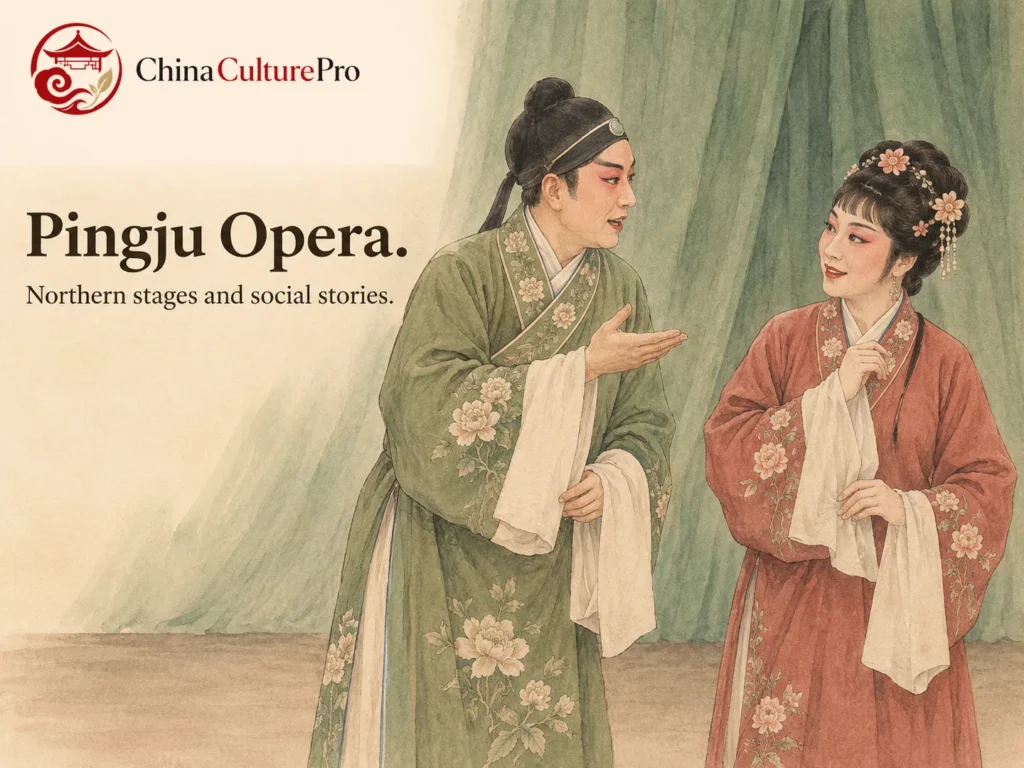

Quick Answer: What Is Pingju?
Pingju(评剧,píngjù) is a northern Chinese theatre form that developed in eastern Hebei. It combines spoken dialogue, singing and stylized acting. Its repertoire includes comedy, family disputes and stories about people seeking a say in their own lives.
Performers helped spread the form through Tianjin, Beijing and northeastern China. Plays such as *Flowers as Matchmaker*, *Liu Qiao’er* and *Third Sister Yang Brings a Lawsuit* give different examples of how Pingju uses conversation and song to carry a story.
A family dispute can begin in dialogue and turn into a sung declaration. Listen to who is allowed to speak, who interrupts and when a character finally gets a longer line. These details give the conflict a shape onstage.
From Eastern Hebei to Northern Stages
Pingju grew out of performance traditions in eastern Hebei, including around Luanzhou and the wider Tangshan area. Around the beginning of the twentieth century, performers adapted paired lianhualao(莲花落,liánhuālào), a form of spoken and sung entertainment, with elements from other genres. The form took shape as performers incorporated music and stage techniques from other traditions into the paired format. [1]
Playwright and performer Cheng Zhaocai was an important figure in that development. Works associated with him include *Flowers as Matchmaker* and *Third Sister Yang Brings a Lawsuit*. The name Pingju came into formal use in 1935, after the early repertoire and stage practice had begun to take shape. [2]
Dialogue, Song and Character
A scene can pass between a conversation and a passage in which one person sings at greater length. Listen for what changes when the character moves into song. A brief complaint can develop into a sung passage that spells out what a character wants. The spoken exchanges and songs serve the same dramatic situation.
Early Pingju took in elements from other performance forms, including Peking opera, shadow puppetry and Hebei clapper opera. The developing ensemble used instruments from the Hebei clapper tradition. The different influences help explain its place within Ópera china, while the names and conventions of individual genres still matter. [2]
Three Plays and Their Social Settings
Some Pingju works use mistaken identities and family arrangements as comedy. Others put a dispute before officials or give it a more serious tone. These three plays offer distinct settings for listening to how a character argues, asks or answers.
| Work | Central situation | What to follow |
|---|---|---|
| *Flowers as Matchmaker* | A visit arranged by a matchmaker leads to substitutions and misunderstandings. | Notice when the audience knows more than the characters do. [3] |
| *Liu Qiao’er* | A young woman resists her father’s attempt to decide her marriage for financial gain. | Follow how she states her own choice and how the case is resolved. [3] |
| *Third Sister Yang Brings a Lawsuit* | A woman challenges the account of her sister’s death and pursues justice. | Watch how speaking to family members differs from presenting a case to authorities. [4] |
The works share a concern with choices inside a household. Each gives that conflict a different tone and setting. Use the synopsis to identify the situation before comparing a song or an actor’s delivery.
Stage Companies, Recordings and Heritage
China’s national heritage inventory included a Pingju project from Luannan County in 2006. [1] A Beijing project associated with the China Pingju Theatre followed as an extension in 2008. [2] The records document local and institutional transmission. The listings recognize how the tradition was being carried on in each place.
CCTV’s archive credits Xin Fengxia in recorded versions of *Flowers as Matchmaker* and *Liu Qiao’er*. Seeing the same artist in different works gives a way to compare parts and dramatic settings. A full version can show how the audience reaches the song, while an excerpt lets you return to the actor’s phrasing. [3]
How to Watch a Pingju Scene
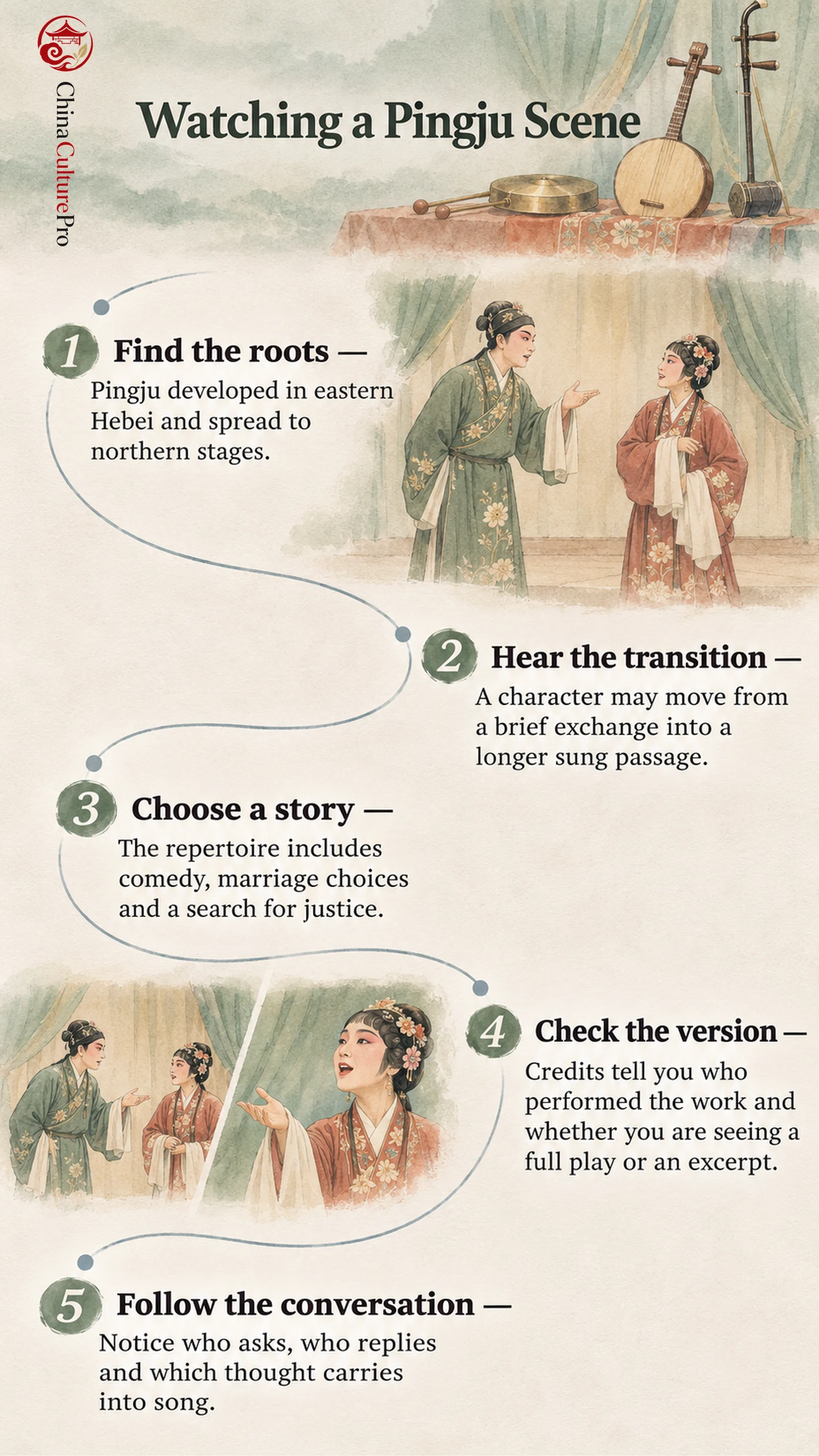
Choose a scene with a clear cast and synopsis. First, follow the conversation. Who asks a question, who replies and who changes the subject? When the scene moves into singing, listen for which idea or emotion gets more time.
If you compare a stage recording and a film, look at the credits first. A close camera view can direct attention to the face. A wider stage view can show the reaction of another actor. These differences affect what you notice within the same story.
FAQs About Pingju
Is Pingju the same as Peking opera?
They are distinct forms. Pingju developed in eastern Hebei and has its own singing, performance conventions and repertoire.
Where did Pingju develop?
It took shape in eastern Hebei, including the Luanzhou area, and spread to several northern cities and northeastern China.
What is a good first Pingju performance?
Try a credited excerpt from *Flowers as Matchmaker* for comedy or *Liu Qiao’er* for a story about marriage and personal choice.
Fuentes
[1] China Intangible Cultural Heritage Digital Museum. Pingju, Luannan Project
[2] China Intangible Cultural Heritage Digital Museum. Pingju, China Pingju Theatre Project
[3] CCTV Opera Channel. Pingju Video Archive
[4] CCTV Opera Channel. Third Sister Yang Brings a Lawsuit, Stage Performance