


Quick Answer: What Are Nuomici?
Nuomici (糯米糍, nuòmǐcí), known in Cantonese as lo mai chi, are filled glutinous-rice sweets associated with Guangdong and Hong Kong. A soft, chewy rice-flour wrapper encloses a sweet center, and many versions have a fine coconut coating.[2][3][4]
- Wrapper: Cooked glutinous-rice-flour dough, soft and slightly stretchy.
- Filling: Examples include crushed peanuts, sweet red bean paste and mango.
- Surface: Coconut is familiar, but cooked rice-flour coatings are documented too.
The wrapper, filling and surface coating are separate choices. Coconut outside does not tell you what is inside.[2][5]
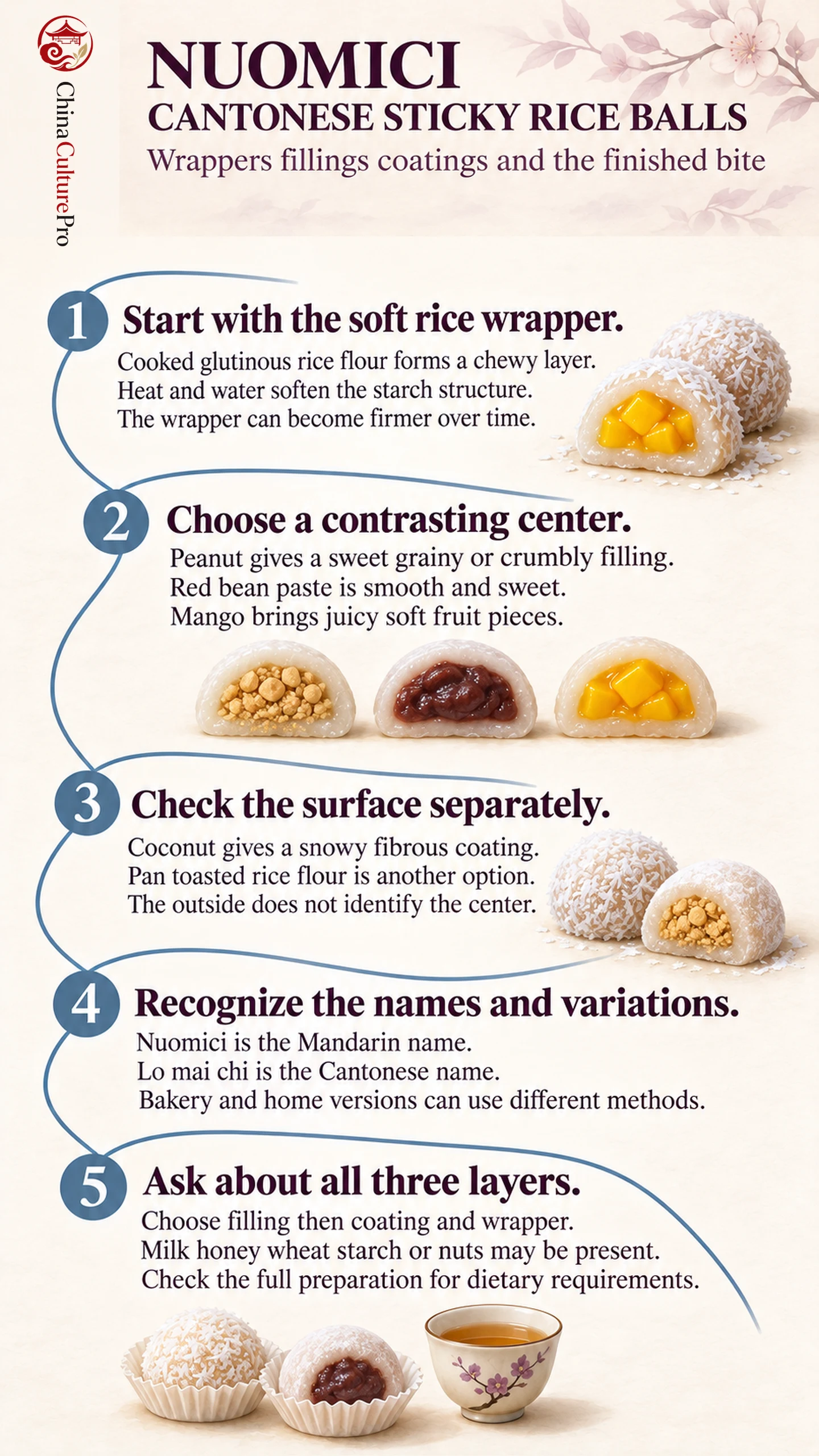
A snowy surface can hide a crumbly peanut center, smooth bean paste or juicy mango. Nuomici are best understood as three layers: a chewy wrapper, an enclosed filling and a coating. Each contributes a different part of the finished bite.
Rice Flour and the Soft, Stretchy Wrapper
The wrapper begins with glutinous rice flour, often combined with another starch and a liquid. In a common approach, a batter is steamed into a cohesive dough, then cooled enough to enclose the filling. The rice layer is cooked before the finished ball is assembled.[2][4]
Heat and water gelatinize the starch, producing the soft, sticky structure. Over time, starch molecules rearrange, a process called retrogradation, and the wrapper becomes firmer.[1]
Peanut, Bean Paste and Fruit Fillings
The same pale wrapper can hold very different textures. Three documented choices illustrate the range:[2][3][4]
| Relleno | Texture and flavor contrast |
|---|---|
| Peanut | Sweet crushed nuts bring a grainy, sometimes crumbly center. |
| Red bean paste | A smooth, sweet paste contrasts with the chewy rice wrapper. |
| Mango | Soft fruit pieces add juiciness and a fresh fruit flavor. |
Peanut fillings may be loose sugar-and-nut mixtures or lightly bound with peanut butter and honey. Other choices include mango pieces and sweet red bean paste. Sesame fillings are documented as well.[1][2][3][5]
Coconut Coating and Flour-Dusted Versions
Desiccated coconut gives the outside a snowy, fibrous finish and helps make the sticky ball easier to pick up. It is a coating, which differs from a coconut filling sealed inside. Coconut milk can also appear in the wrapper, giving a third role for the same ingredient.[2][4]
A documented alternative coats a peanut-filled ball with pan-toasted glutinous rice flour. Other preparations suggest roasted soybean powder or sesame seeds. The appearance of the dusting alone does not identify it.[4][5]
A Cantonese Sweet in Bakery and Home Kitchens
Within Cantonese food culture, these are familiar local sweets and bakery treats. English labels such as “coconut mochi” describe a similar chewy appearance but do not disclose the filling.[1][2][3]
Home preparations also adapt the method. Alongside steamed wrappers, a published peanut version cooks its rice dough in a saucepan.[3]
How to Choose and Eat Nuomici
Choose the center first, then ask about the surface and dough. These small Chinese sweets are usually presented as individual pieces, often in little paper cups, ready to pick up and eat.[2][4][5]
For vegetarian or vegan ordering, check all three layers. Milk can occur in the wrapper and honey in a peanut filling. Some preparations also use wheat starch, so a rice-based name alone does not establish whether the entire sweet meets a gluten-free requirement.[1][3][4]
FAQs About Nuomici
Do nuomici always have a coconut coating?
No. Pan-toasted glutinous rice flour is one documented alternative.
Why do nuomici become firm?
Their cooked starch gradually rearranges during storage, making the wrapper less soft and stretchy.
Are nuomici always dairy-free?
No. Some wrappers contain milk; check the specific preparation.
Does a rice-flour wrapper guarantee the whole sweet is gluten-free?
No. Check the complete dough, filling, coating and product information rather than relying on the rice-based name.
Fuentes
[1] Hong Kong Science Museum, original food-science explainer. Why Do Soft, Chewy Glutinous Rice Balls Go Hard?
[2] Elaine, original recipe, China Sichuan Food. Sticky Rice Cake with Coconut: Nuomici
[3] Andrea Nguyen, original cooking account adapting Kristina Cho’s recipe, Viet World Kitchen. Coconut and Peanut Mochi Balls: Nuomici
[4] Rachel, original recipe, Assorted Eats. Chinese Coconut Mochi: Nuomici
[5] Susan Siow, original recipe, Vege Angel. Vegetarian Recipe: Nuomici