


Quick Answer: What Are Chinese Coconut Fillings?
Chinese coconut fillings include shredded-coconut filling (椰蓉馅, yēróng xiàn), smooth coconut custards and coconut-flavored pastes. They share a flavor rather than one formula.[2][3][4]
- Textured filling: Coconut particles remain recognizable within a sweet mixture.
- Smooth filling: Coconut milk or cream flavors a custard or another paste.
- Finished pastry: The wrapper, filling and outer coconut coating are separate components.
These comparisons describe preparations, not official grades.
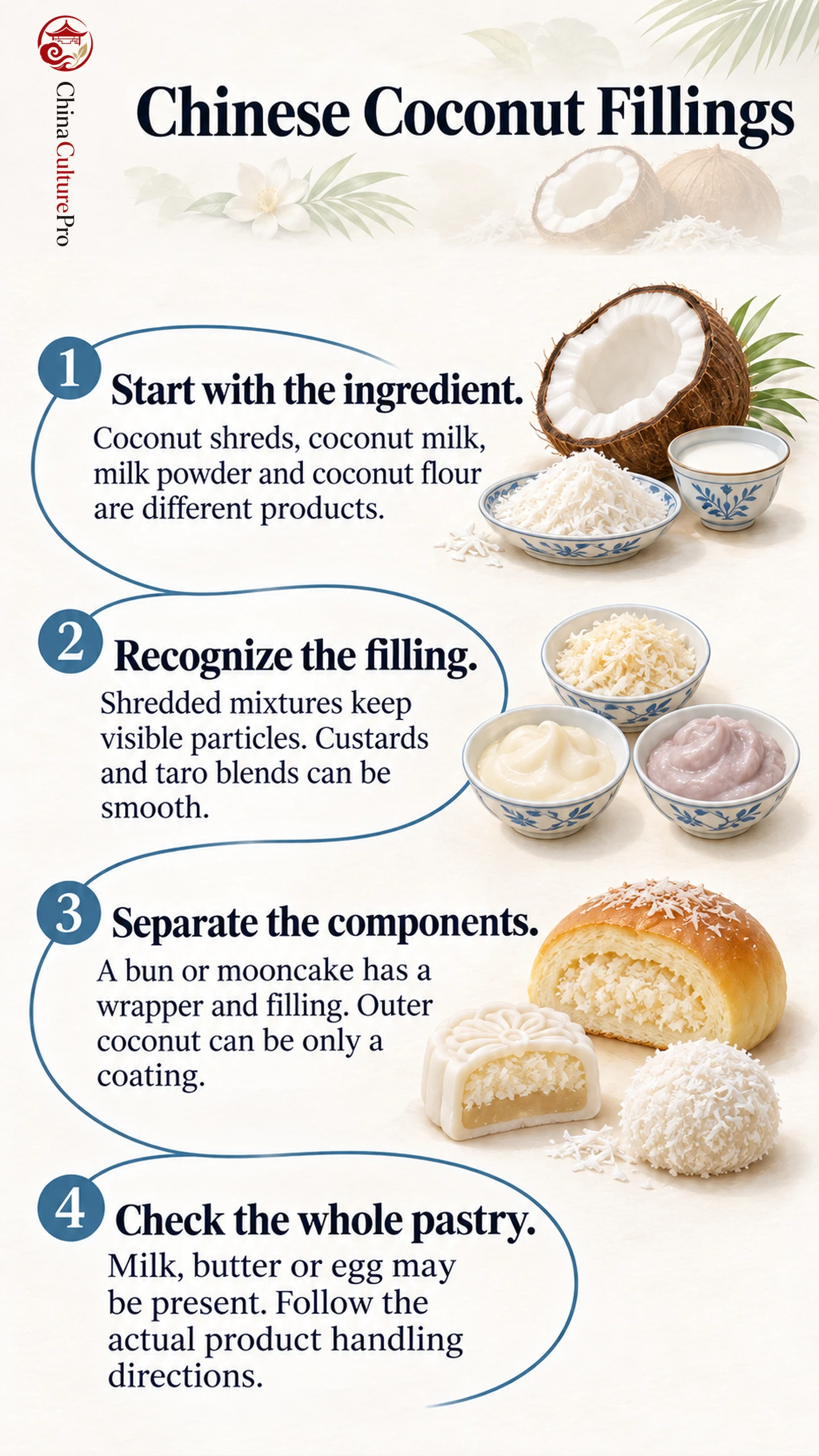
A coconut-filled bun and a coconut-flavored mooncake need not share the same center. Some fillings retain fine shreds, while others are smooth and creamy. Separating the coconut ingredient from its sweetened base makes those differences easier to understand at a bakery.
Coconut Flesh, Desiccated Coconut and Coconut Milk
Yerong (椰蓉, yēróng) and yesi (椰丝, yēsī) refer to fine coconut particles or shreds. Desiccated coconut is dried coconut meat in different particle sizes; some fillings instead use fresh grated coconut.[1][5]
Coconut milk and cream supply a liquid component. Coconut milk powder is dried coconut milk; coconut flour is a different milled product, often made after extraction. Neither is another name for desiccated shreds.[1]
Three Useful Filling Styles to Recognize
| Filling style | Documented composition | Textura |
|---|---|---|
| Shredded coconut mixture | Desiccated coconut, sugar, butter, egg and milk powder in one bun version. | Fine particles in a rich sweet center. |
| Coconut custard | One version uses coconut cream with milk, egg and starch ingredients. | Smooth and scoopable once set. |
| Taro paste (芋泥, yùní) with coconut milk | One preparation combines cooked taro with coconut milk and sugar. | A smooth, starchy paste carrying both flavors. |
These formulas are examples. A Malaysian Chinese steamed bun uses desiccated coconut with palm sugar and sugar for a sticky, juicy center. One snow-skin mooncake mixes fresh coconut with lotus paste, butter and dried cranberries.[2][3][4][5][7]
Buns, Mooncakes and Coconut Coatings
Hong Kong-style cocktail buns (鸡尾包, jīwěibāo; Mandarin pinyin) hold coconut filling in a central pocket or layers.[2]
Steamed baozi (包子, bāozi) also take coconut fillings, including palm-sugar mixtures or taro-coconut paste. See the baozi guide for the wider bun category.[4][7]
For mooncakes (月饼, yuèbǐng), separate the filling choice from the distinction between snow-skin and baked wrappers. Coconut-taro paste and fresh coconut mixed with lotus paste offer different centers.[4][5]
Nuomici (糯米糍, nuòmǐcí) can have an outer coconut coating. This does not identify the center.[2]
Reading Labels and Matching the Finished Pastry
For vegetarian or vegan eating, check both filling and wrapper. Coconut flavor does not guarantee the absence of milk, butter or egg.[2]
One coconut milk powder lists milk protein and declares milk. This is a specific formula, not a rule for all coconut powders.[6]
Follow the product or bakery’s handling directions. Prepared moist filling is different from dry shreds; the documented taro-coconut paste is stored covered and chilled.[4]
FAQs About Chinese Coconut Fillings
Is coconut filling just desiccated coconut?
No. It is an ingredient; a filling combines coconut with other components.
Is coconut flour the same as desiccated coconut?
No. Coconut flour and dried coconut shreds are different processed products. Use the form intended by the preparation.
Are coconut fillings dairy-free or vegan?
Some are. Others contain milk, butter or egg; check the complete pastry.
Does coconut on the outside mean coconut filling inside?
No. Coconut may be a topping or coating; the hidden center can be a different filling.
Fuentes
[1] Tetra Pak. Coconut Food Production: Desiccated Coconut, Flour and Milk Powder
[2] China Sichuan Food. Coconut Buns: Shredded Filling and Topping
[3] The Hong Kong Cookery. Coconut Milk Custard Pastry Filling
[4] The Woks of Life. Taro Coconut Filling: Smooth Paste and Pastry Uses
[5] Oriental Cuisine. Coconut Snow Mooncake: Fresh Coconut and Lotus-Paste Example
[6] AYAM. Coconut Milk Powder: Milk-Protein Ingredient Declaration
[7] Ruyi Asian Recipes. Sweet Coconut Steamed Bun: A Malaysian Chinese Example