


Quick Answer: Who Was Lin Huiyin?
Lin Huiyin (林徽因, Lín Huīyīn, 1904–1955) was a Chinese architect, architectural historian and writer. She studied at the University of Pennsylvania and helped document historic buildings in China.[1]
- Education: Lin took architecture courses at Penn and graduated with a fine arts degree in 1927. Penn awarded her an architecture degree posthumously in 2024.[1][2]
- Fieldwork: She read an inscription that helped date the East Hall at Foguang Temple (佛光寺, Fóguāng Sì).[4]
- Literature: Her poetry and fiction appeared in the same magazines she helped produce.[5]
Her writing included introductions to historic buildings for general readers, bringing the concerns of an architect to readers who had never studied design.[7]
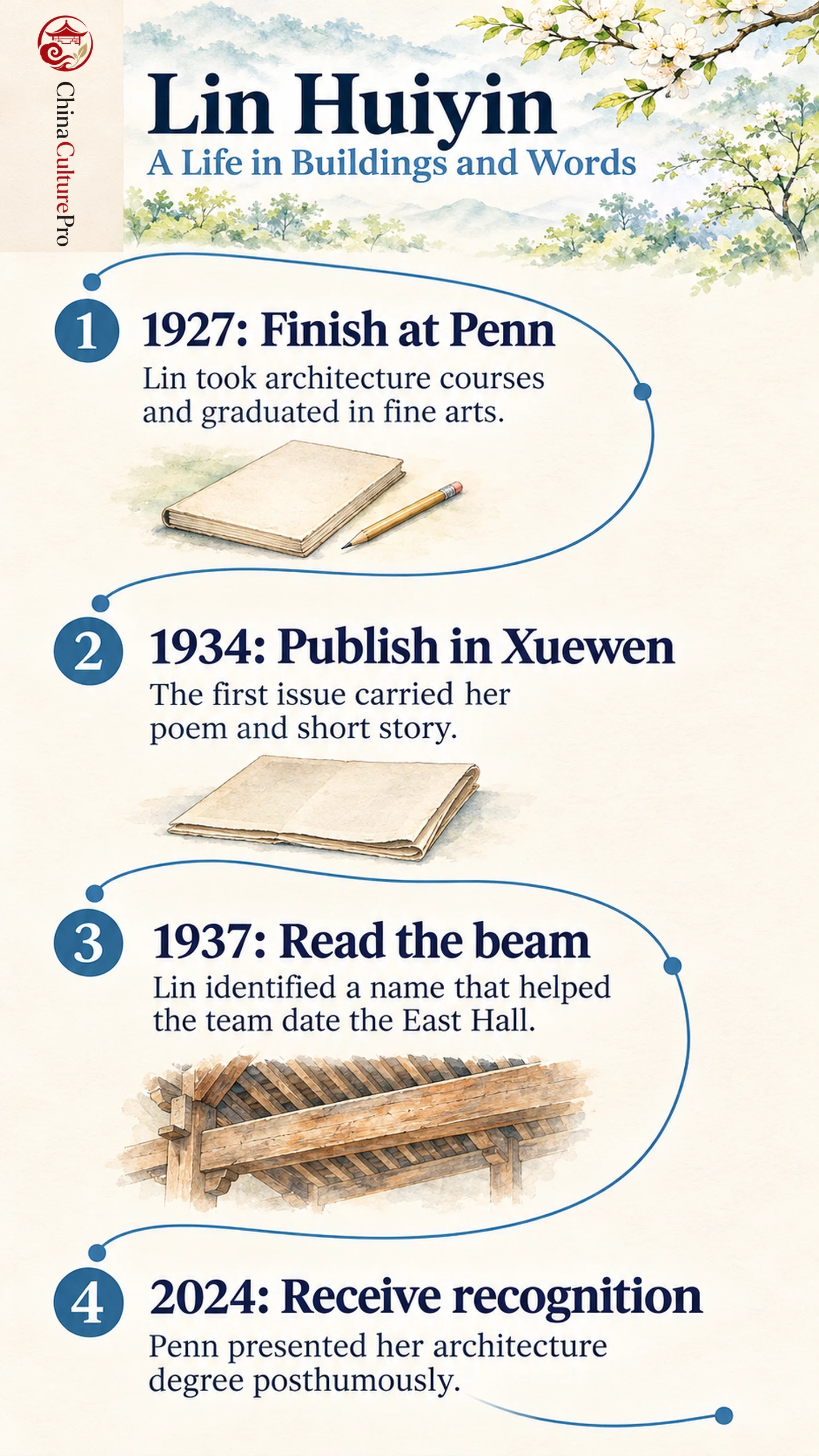
A name on a timber beam helped Lin and her colleagues place a historic hall in the ninth century. In another part of her career, a magazine cover she designed introduced readers to both a poem and a short story of her own. Her record spans work usually encountered in separate places, from measured drawings to literary periodicals.
How Lin Huiyin Studied Architecture at Penn
Lin arrived at Penn in 1924 with her future husband, Liang Sicheng (梁思成, Liáng Sīchéng). The architecture program did not admit women. She enrolled in fine arts, took most of the required architecture courses, and worked as a teaching assistant in architectural design.[2]
She also studied stage design at Yale. On her return to China, she helped establish the architecture department at Northeastern University in Shenyang. In the 1930s she took part in field surveys of historic Chinese architecture.[1][3]
What Lin Huiyin Found at Foguang Temple
Lin traveled to Foguang Temple in Shanxi in 1937 with Liang and colleagues from the Society for Research in Chinese Architecture (中国营造学社, Zhōngguó Yíngzào Xuéshè). On the underside of a beam in the East Hall, she read part of a faint inscription naming the patron Ning Gongyu (宁公遇, Níng Gōngyù).[4]
The same name appeared on a stone pillar in front of the hall. The date on the pillar corresponds to 857 CE. The match gave the team a basis for dating the timber hall to the Tang dynasty.[4]
Lin Huiyin’s Poetry, Fiction and Writing on Beijing
The first issue of Xuewen (学文, Xuéwén) published her poem You Are the April of This World (你是人间的四月天, Nǐ Shì Rénjiān de Sìyuètiān) and short story In Ninety-Nine Degrees (九十九度中, Jiǔshíjiǔ Dù Zhōng) in 1934. Lin also designed the issue’s cover using a motif from a Han stone inscription.[5] The April poem draws on spring images such as fine rain, new leaves and swallows among the beams.[6]
In her later essays on Beijing, she wrote about places such as the Forbidden City and the Temple of Heaven. She explained how the buildings were arranged and constructed for readers without specialist training.[7]
FAQs About Lin Huiyin
When Did Lin Huiyin Receive an Architecture Degree?
Penn presented the posthumous Bachelor of Architecture to her family in May 2024. The certificate bears the year 1927, the year she originally graduated in fine arts.[1]
Was Lin Huiyin Also Known as Phyllis Lin?
Yes. Penn’s archive identifies her as Phyllis Whei Yin Lin, the name under which it catalogs her 1926 student greeting card.[3]
Did Lin Huiyin Work on the National Emblem?
Yes. She participated in the collaborative design of the national emblem of the People’s Republic of China.[3]
Fuentes
[1] Tsinghua University. Lin Huiyin Receives an Architecture Degree a Century Later
[2] University of Pennsylvania Almanac. Penn to Award Posthumous Architecture Degree to Lin Huiyin
[3] University of Pennsylvania Archives. Holiday Greeting Cards, Phyllis Whei Yin Lin
[4] CCTV. The 1937 Identification of the Foguang Temple East Hall
[5] Tsinghua University Archives. Lin Huiyin and Her Times
[6] Beijing Municipal Administration of Cultural Heritage. Reading Lin Huiyin’s April Poem
[7] Tsinghua University Archives. The Short Prose of Architect Lin Huiyin