


Quick Answer: Who Was Lang Shining?
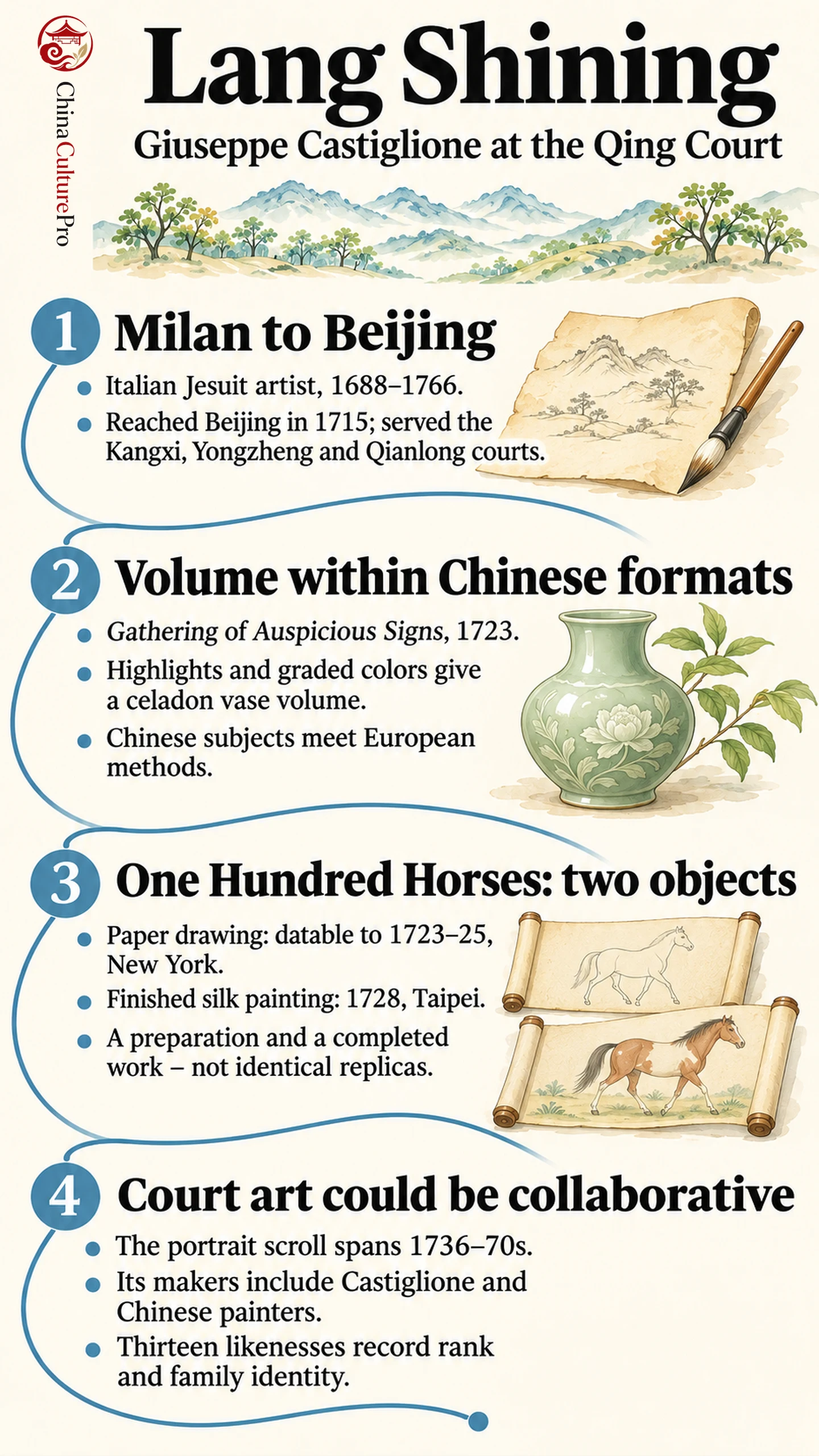
Lang Shining (郎世宁, Láng Shìníng) was the Chinese name of Giuseppe Castiglione (1688–1766), an Italian Jesuit artist who worked at the Qing imperial court. His paintings adapted European naturalism to Chinese formats and imperial taste.[1]
- He reached Beijing in 1715 and spent roughly half a century serving the court.[1]
- One Hundred Horses (百骏图, Bǎi Jùn Tú) survives as both a preparatory drawing and a completed silk painting.[2][3]
- Portraits, animals and flowers formed part of his range, with some court works made collaboratively.[4][5]
A famous artist’s name on a collection record does not necessarily mean that every part of the object was painted by him alone.
Check the support, format, date and maker attribution before comparing style. These details distinguish a preparatory drawing from a finished painting and an individual contribution from a shared project.
From Milan to the Qing Court
Born in Milan, Castiglione came to Beijing as a missionary in 1715. His long career coincided with the Kangxi, Yongzheng and Qianlong reigns of the Qing dynasty.[1][6]
Court service shaped what he painted and how his pictures functioned. Lifelike description could document a ruler’s appearance, animals and imperial activities while also presenting an image of authority.[1] This was an artistic career within a patronage system, with commissions and expectations guiding the work.
How His Paintings Adapted European Methods
Gathering of Auspicious Signs, dated 1723, provides a compact example. A celadon vase holds plants associated with good rulership. Highlights on the glaze and carefully graded colors give the vessel and plants a sense of volume, while the auspicious subject and hanging-scroll format belong to Chinese court painting.[4]
The horse drawing offers another comparison: perspective organizes depth, while horses seen at oblique angles reveal his skill in foreshortening—showing forms as they extend toward or away from the viewer.[2] Rather than reading “European influence” as a single imported style, look at how a specific technique serves a specific object. His practice expands the range of Chinese painting beyond an exclusively ink-monochrome model.
Four Objects That Clarify His Work
| Objeto | Fecha | Material and format | Collection |
|---|---|---|---|
| Gathering of Auspicious Signs | 1723 | Hanging scroll; ink and colors on silk. | National Palace Museum, Taipei.[4] |
| One Hundred Horses—preparatory drawing | Datable to 1723–25 | Handscroll; ink on paper. | Metropolitan Museum of Art.[2] |
| One Hundred Horses—finished painting | 1728 | Handscroll; ink and colors on silk. | National Palace Museum, Taipei.[3] |
| Portraits of the Qianlong Emperor and His Twelve Consorts | 1736–70s | Handscroll; ink and color on silk; Castiglione and other painters. | Cleveland Museum of Art.[5] |
The horse scrolls record different stages of making. The paper drawing served as a model; the finished silk version extends to about 7.76 meters. Preparing a composition for imperial review formed part of the court’s working process.[2][3]
Collaboration and the Limits of a Famous Name
The Cleveland portrait scroll is especially instructive. Its thirteen likenesses represent the emperor, the empress and eleven other consorts. The portraits accumulated over different moments of court life, and the collection attributes the scroll to Castiglione and Chinese painters.[5]
Its cataloged span reaches into the 1770s, after Castiglione’s death in 1766. That chronology matters: the entire object cannot be assigned to a single sitting or a sole painter.[1][5]
Formal likeness also communicated status and family identity.[5] These pictures help explain how Chinese emperors used visual representation, while their shared production shows why court art requires attention to workshops as well as individuals.
FAQs About Lang Shining
Are Lang Shining and Giuseppe Castiglione the same person?
Yes. Lang Shining is the Chinese name used by the Italian artist Giuseppe Castiglione during his career in China.[1]
Did he paint One Hundred Horses twice?
The two museum objects are related stages, rather than identical finished replicas: one is a preparatory paper drawing, the other a completed silk painting.[2][3]
Were his Chinese court paintings all made in oils?
No. The works compared here include ink on paper and ink with colors on silk. European training does not establish a painting’s medium.[2][5]
Fuentes
[1] Columbia University. Giuseppe Castiglione
[2] Metropolitan Museum of Art. One Hundred Horses
[3] National Palace Museum. Conceiving and Completing One Hundred Horses
[4] National Palace Museum. Selected Castiglione Works
[5] Cleveland Museum of Art. Portraits of the Qianlong Emperor and His Twelve Consorts
[6] City University of Hong Kong. Giuseppe Castiglione—Lang Shining Exhibition