


Quick Answer: What Is a Konghou?
Konghou (箜篌, kōnghóu) is a historical name for several Chinese plucked instruments. Today it commonly refers to a modern Chinese harp. On a double-row model, the player can pluck a string and press its partner to change the pitch as the sound rings.[1][2][3]
- Historical forms: Written accounts distinguish horizontal, vertical and phoenix-headed instruments.[2]
- Modern design: Some versions have two rows of strings and a tall frame.[2][3]
- Sound: Pressure on a paired string can create a bend or vibrato.[2][3]
A museum figure can show how an older harp was held. The linked strings belong to modern instrument design.[1][2]
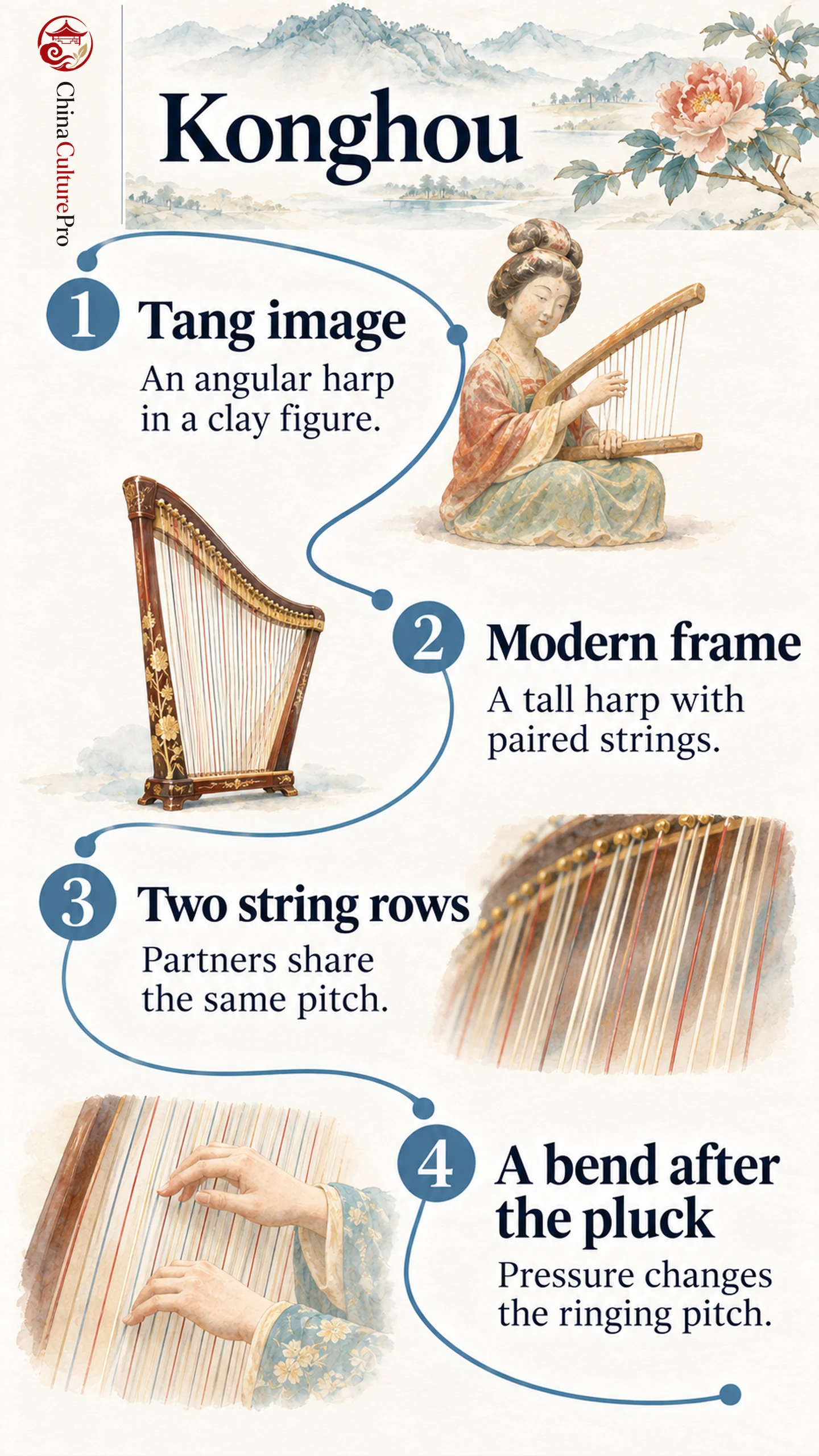
From the front, a modern konghou looks like a tall concert harp. A side view reveals the second row of strings. Watch one hand near the opposite row when the other plucks a note. A small press can change the pitch while that note rings.[2][3]
The Konghou in Tang Art
A late seventh-century earthenware figure in the Metropolitan Museum of Art holds an angular harp. The piece belongs to a group that also shows a lute, small copper cymbals and clapping. Look at the angle where the two main parts of the harp meet. That outline is useful for recognizing the older form in art.[1]
A figure provides evidence of the shape and playing position. Its size and painted details leave questions about the stringing and tuning open. The Chinese Music Archive records attempts at recreating historical forms in the 1930s. It places development of a new concert design in the 1970s, when researchers and makers drew on both harp design and Chinese instruments.[1][2]
How Two Rows of Strings Bend a Note
The Chinese Music Archive describes a model with two sets of strings, two rows of bridges and an upright paulownia soundbox. Strings across from one another are tuned to the same pitch in pairs. On a coupled design, pressure on one changes the tension of its partner. A player can pluck one side and press the other side to make the sounding note rise.[2][3]
A brief press can shade one sustained note. Repeated pressure can make its pitch waver. The rows also give two hands access to matching pitches. The archive’s description covers one design. To identify the mechanism on a particular instrument, look for the bridges and paired strings, and consult the maker’s description.[2][3]
What to Listen for in a Performance
In a solo, start with a single ringing note. Listen for a small movement in its pitch after the attack, then follow a quick passage to hear how sharply the plucks begin. The Chinese Music Archive also documents konghou in accompaniment and ensemble playing.[2][3]
For another example of a plucked instrument in a modern Chinese ensemble, the daruan uses a fretted neck. On the konghou, the two rows and the pressure mechanism give the player’s hands a different job.[2][3]
FAQs About the Konghou
Is the modern konghou the same as the Tang harp?
The Tang figure shows an angular harp. The modern concert instrument draws on twentieth-century designs, including the paired-string mechanism on double-row models.[1][2]
Do the two rows play different notes?
On a coupled double-row konghou, each pair is tuned to the same pitch at rest. Pressing one string can raise the pitch of the other while it sounds.[2][3]
Fuentes
[1] The Metropolitan Museum of Art. Female Musician with Harp
[2] Chinese Music Archive. Plucked Instruments: Konghou
[3] Visit Beijing. Konghou