


Quick Answer: Who Was Jiang Wei?
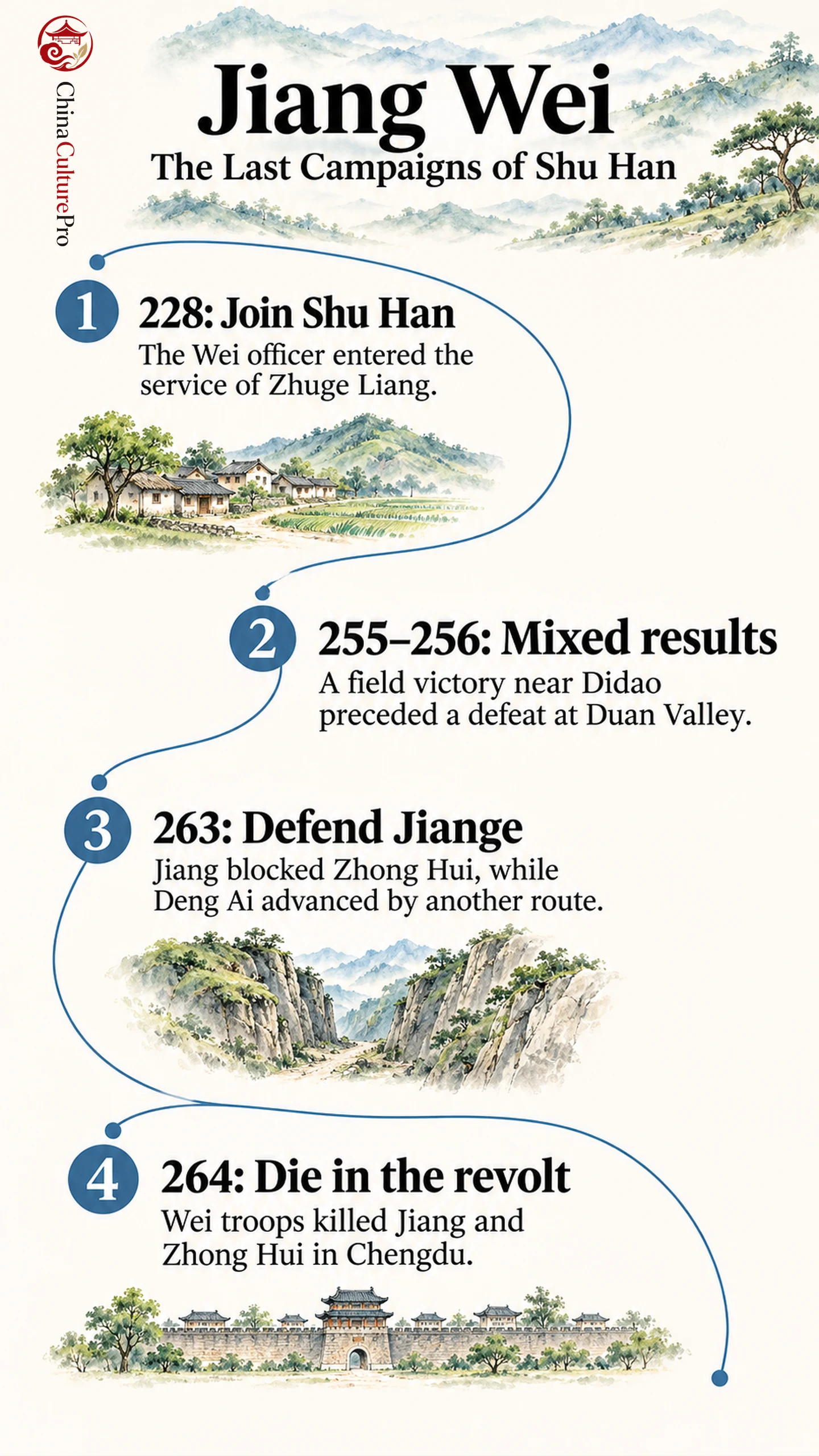
Jiang Wei (姜维, Jiāng Wéi, 202–264) was a general of Shu Han (蜀汉, Shǔ Hàn) in the Three Kingdoms period. He began as an officer in Wei (魏, Wèi) and joined Zhuge Liang (诸葛亮, Zhūgě Liàng) in 228.[2]
- Northern campaigns: Jiang repeatedly led troops against Wei and eventually became Shu Han’s general-in-chief.[2]
- Last defense: He checked a Wei army at Jiange (剑阁, Jiàngé) in 263, while a different force advanced toward Chengdu.[3]
- Death: He died in 264 when Wei troops turned against Zhong Hui (钟会, Zhōng Huì) in Chengdu.[3]
Shu Han’s surrender came while Jiang still had troops in the field.[2]
The defense of a mountain pass can succeed even as the wider campaign is lost. That is what happened to Jiang Wei in 263. His stand at Jiange was the last phase of a career built on taking the offensive.
How Jiang Wei Entered Shu Service in 228
Jiang held office in Tianshui. Chen Shou says his superior suspected disloyalty and fled. Turned away at two towns, Jiang joined Zhuge Liang.[1]
A version from the Weilüe preserved in Pei Songzhi’s notes says people in Jiang’s home town asked him to approach Zhuge. Chen’s account has the town shutting him out. The second version has residents welcoming him before persuading him to go. In both, the Shu retreat made the move permanent.[1]
What the Northern Campaigns Achieved
Jiang believed his knowledge of the northwest could help him win local allies among the Qiang and others and cut off territory held by Wei. Fei Yi (费祎, Fèi Yī), a senior Shu minister and commander, limited the forces Jiang could take.[1]
After Fei’s death in 253, Jiang led larger armies into Wei territory.[2]
In 255 Jiang defeated a Wei field army near Didao (狄道, Dídào), then laid siege to the city. Wei reinforcements ended the siege. In 256 Deng Ai (邓艾, Dèng Ài) defeated Jiang at Duan Valley (段谷, Duàn Gǔ). Jiang asked for a reduction in rank after the losses.[1]
The two battles show the distance between winning in the field and holding a contested region. The strain also prompted criticism at court, where the official Qiao Zhou argued against aggressive campaigning.[2]
How Shu Han Fell Despite the Defense at Jiange
In 263 Jiang and other Shu generals fell back to Jiange and blocked Zhong Hui’s main advance. Deng Ai took a separate route through Yinping (阴平, Yīnpíng) and defeated a Shu force at Mianzhu. The road to Chengdu was open. The Shu ruler Liu Shan (刘禅, Liú Shàn) surrendered to Deng.[3]
Jiang surrendered to Zhong Hui after receiving news from Chengdu. With Deng Ai under arrest, Zhong tried to turn his command into a revolt against the Wei leadership. His troops turned on him and Jiang.[3]
FAQs About Jiang Wei
Was Jiang Wei Zhuge Liang’s successor?
Jiang eventually took charge of major campaigns against Wei. Jiang Wan and Fei Yi held leading positions in the intervening years after Zhuge Liang’s death.[2]
Why did Jiang Wei join Zhong Hui?
Accounts preserved in Pei Songzhi’s notes say Jiang hoped to use Zhong’s rebellion to restore Shu Han. His participation and death are better established than the details of his secret plans.[1][3]
How does the novel treat Jiang Wei’s surrender?
Romance of the Three Kingdoms presents it as a deliberate ruse. In the novel Jiang takes his own life as the revolt fails. Chen Shou’s account of the uprising says Wei soldiers killed him.[3][4]
Fuentes
[1] Chen Shou with notes by Pei Songzhi. Records of the Three Kingdoms, volume 44, Biography of Jiang Wei
[2] J. Michael Farmer. Shu-Han, The Cambridge History of China
[3] Chen Shou with notes by Pei Songzhi. Records of the Three Kingdoms, volume 28, Biographies of Deng Ai and Zhong Hui
[4] Attributed to Luo Guanzhong. Romance of the Three Kingdoms, Chapter 119