


Quick Answer: What Are Huaxi Beef Rice Noodles?
Huaxi niurou fen(花溪牛肉粉,Huāxī niúròu fěn)is a beef-and-rice-noodle specialty associated with Huaxi in Guiyang, Guizhou.
- Foundation: Rice noodles and beef broth form the familiar soup bowl.
- Toppings: Prepared beef and supporting ingredients complete the serving.
- Variations: Original-broth, red-broth and pickled-pepper versions appear on actual menus.[1][2]
The name describes a regional food, not a promise that every shop or packet has identical ingredients or chili heat.
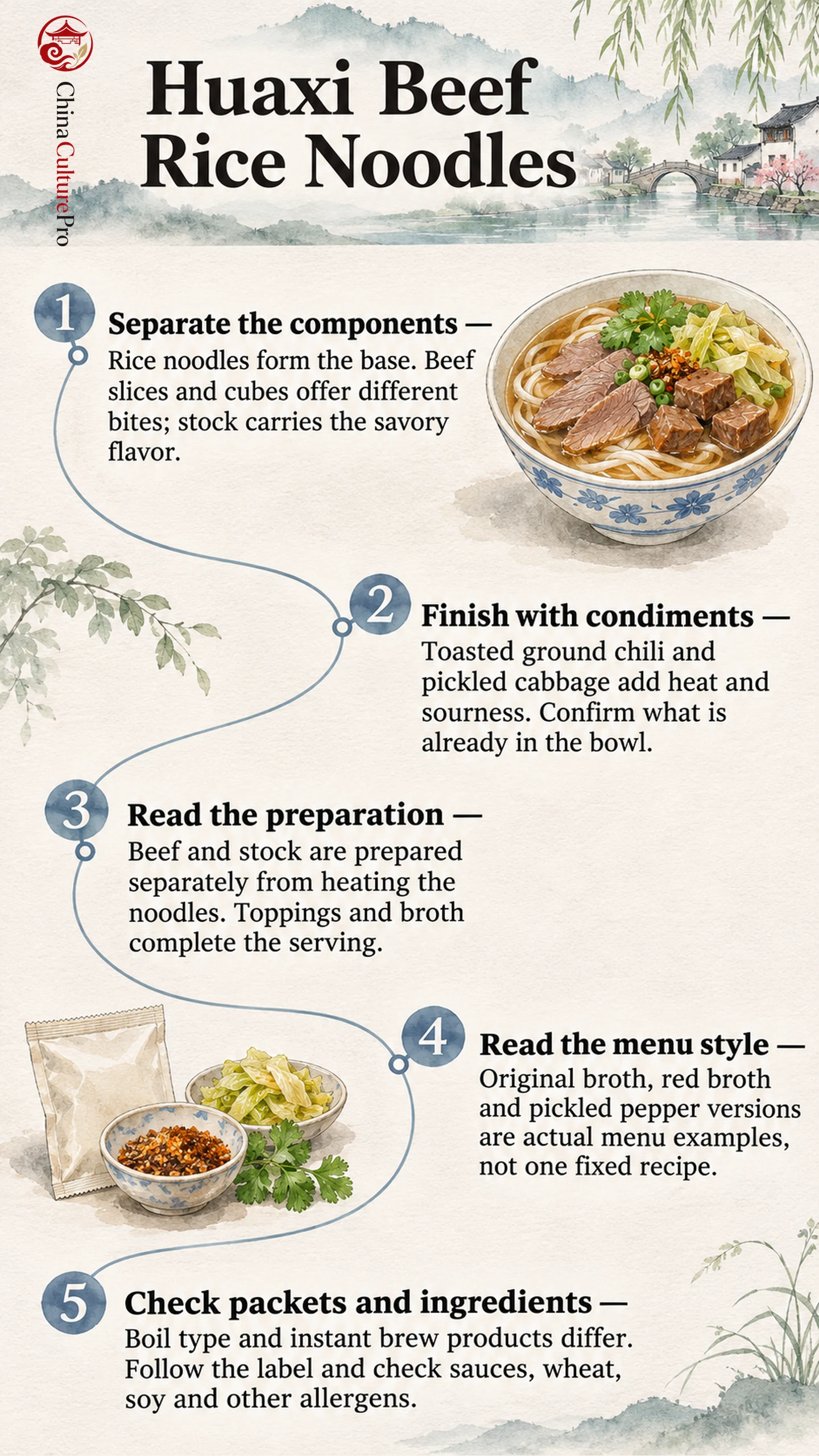
White rice noodles wind beneath beef slices, tender cubes and a scattering of herbs. A spoonful of pickled cabbage and a little toasted chili can change the bowl again. This Guizhou specialty becomes easier to understand when the noodle base, prepared meat, broth and finishing condiments are considered separately.
Rice Noodles, Beef and the Topping Mix
Rice noodles supply the staple portion beneath the prepared beef. A documented Huaxi-style formulation combines thin cooked beef slices with braised beef cubes; tendon or offal can be additional choices. Those forms offer different textures within one order.[3]
The stock has its own preparation, using beef bones, beef fat and aromatics. Pickled cabbage, cilantro and scallion appear in the topping mixture. The broth and visible beef are related components, but removing one does not remove the other from the meal.[3]
A packaged-product definition uses rice as the main raw material and allows added edible starch. Check the actual ingredients when comparing these rice-based noodles with wheat varieties.[4]
Toasted Chili and Pickled Cabbage
Hulajiao(煳辣椒,hú làjiāo)is a finishing seasoning made by pan-roasting dried chili and grinding it.[4]
Pickled cabbage supplies a sour contrast to the beef stock. A documented serving method includes the cabbage and herbs in the bowl, while chili, vinegar, soy sauce and Sichuan pepper can be adjusted at the table. This separates the prepared base from a diner’s final seasoning choices; ask what has already been added before requesting a mild bowl.[3]
For more about these accompaniments, explore Chinese preserved vegetables. Their function in this dish is seasoning and texture, not replacing the noodle portion.
How the Beef and Noodles Reach the Bowl
The meat is prepared before the individual serving is assembled. One local account divides the beef between pieces cooked for slicing and pieces cut into cubes for a separate stewed preparation. This is why slices and cubes can share a bowl without having identical textures.[5]
The noodles are heated in boiling water, drained into a serving bowl and topped with the prepared meat, pickled cabbage and herbs. Broth is then added. Noodle heating, beef preparation and stock-making are therefore distinct jobs, rather than one process of cooking every raw ingredient together in the customer’s bowl.[5]
The noodles, meat and broth retain distinct jobs within these cooking methods.
Guiyang Food Culture and Menu Variations
Beef rice noodles are a familiar Guiyang breakfast, with Huaxi among the city’s recognizable styles. The bowl fits an everyday noodle-shop meal as well as a visitor’s introduction to local flavors.[2]
Huaxi is the geographical reference, while the dish is encountered more widely in Guiyang. An actual producer’s menu includes original-broth, pickled-pepper, red-broth and green-pepper preparations, plus a minced-beef mixed-noodle version. These are concrete examples of menu variation, not a classification that every restaurant must follow.[1]
Read the full preparation name. A red-broth bowl and an original-broth bowl may differ before any table condiment is added; a mixed-noodle version also changes the relationship between noodles and liquid. For an order, confirm the broth, beef cuts, pickles, herbs and chili rather than relying on a generic photograph.
Packaged Products and Dietary Checks
A 2025 group standard distinguishes cook-in-water and instant-brew packaged Huaxi noodles. The first requires cooking; the second is designed for preparation with hot water. Follow the packet’s own directions and storage label.[4]
Rice as the noodle base does not establish that the complete meal is gluten-free. Check sauces and seasoning packets for wheat, soy and other relevant allergens, and consider shared equipment. The meat and broth also need to be assessed together for anyone avoiding animal ingredients.[6]
FAQs About Huaxi Beef Rice Noodles
Are Huaxi beef rice noodles made from wheat?
The characteristic noodle base is rice. Individual products can include added starch, while sauces require a separate ingredient check.
Is every version very spicy?
No fixed heat level follows from the name. Broth style and added condiments both matter; ask before ordering.
Can packaged Huaxi noodles be soaked instead of boiled?
Only an instant-brew product is designed for that approach. A cook-in-water packet must follow its cooking directions.
Fuentes
[1] Guizhou Huaxi Beef Rice Noodle Industry Development and Operation Group. Menu and product descriptions
[2] Nanming District, Guiyang. Guiyang rice noodles with beef
[3] Guizhou culinary association standard, National Digital Standards Library. T/QLY 077—2021
[4] Guizhou specialty-food group standard, National Digital Standards Library. T/TSSP 055—2025
[5] Guizhou Agricultural Economy Network. Huaxi beef rice noodles
[6] US Food and Drug Administration. Food Allergies: What You Need to Know