


Quick Answer: What Is the Difference Between Guzheng and Guqin?
The guzheng (古筝, gǔzhēng) and guqin (古琴, gǔqín) are both Chinese plucked zithers. The quickest distinction is what you see under and beside the strings.
- Guzheng: Look for a row of raised movable bridges, one for each string. Twenty-one strings are common on a modern model.
- Guqin: Look for seven strings close to a smooth soundboard and thirteen small position marks. There is no row of individual movable bridges.
- Sound clue: A guzheng player can bend a plucked note by pressing beyond its bridge. A guqin player can slide a fingertip along a stopped string.
Listen and look together when you can. Both instruments can produce a pitch that moves after the pluck. [1][2][3][4]
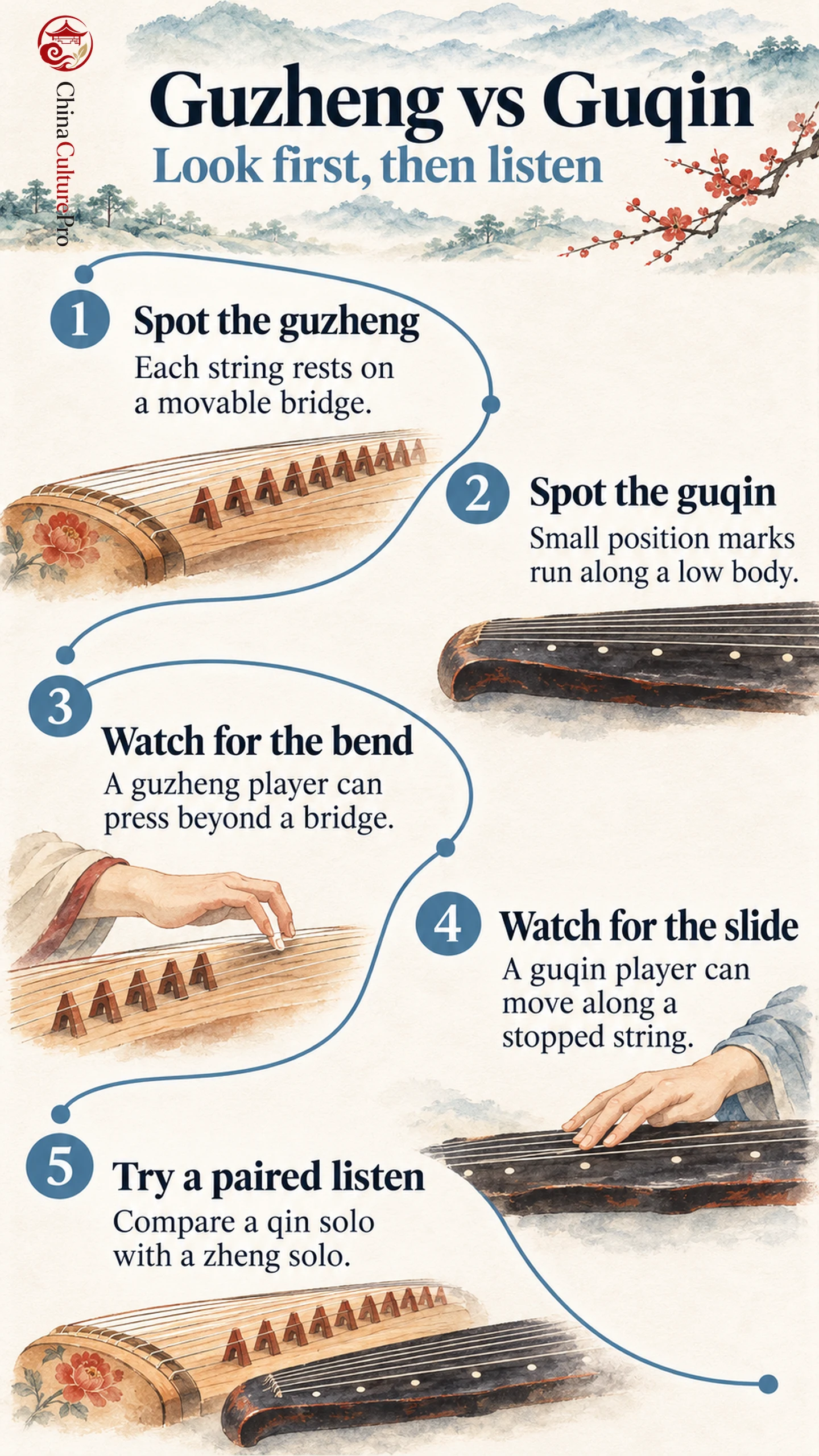
In a performance video, you can usually tell these two zithers apart before you hear a note. Look for the raised bridge line on the guzheng or the near-flat playing surface of the guqin. Then watch where the player’s fingers go when the pitch changes. The broader guide to Chinese musical instruments explains what makes these two instruments zithers.
Guzheng and Guqin Compared
| Criterio | Guzheng | Guqin |
|---|---|---|
| Common visible form | A long body with separate raised bridges | A low body with thirteen small position marks |
| String count | Usually 21 on a common modern model, with other counts in use | Seven |
| Left-hand pitch change | Pressure on the far side of a bridge can bend a note | A finger can stop a string and slide along the soundboard |
| Useful sound clue | A sweep can set successive strings ringing | A light touch can produce a bell-like harmonic |
These are identification cues, rather than an inventory of everything either instrument can do. Read the individual guzheng and guqin guides for more on construction and the range of techniques. [1][2][3][4]
How to Tell a Bend From a Slide
On a guzheng, the right hand commonly starts a note on the sounding side of a bridge. The left hand can press the string on the opposite side. That increases tension and can raise the pitch you hear. Watch for the hand moving down toward the soundboard. It can release the pressure again without another pluck. [1][2]
On a guqin, a left-hand finger can hold a string against the playing surface on the sounding length. After the right hand plucks, the stopped finger can travel lengthwise. Listen for a continuous change of pitch as that fingertip moves. In a video, check whether the hand presses beyond a bridge or along the sounding length. [4]
Where You Hear Each Instrument
The guqin has a documented history of intimate solo playing and literati cultivation. The guzheng’s solo repertoire includes regional traditions and modern concert works. It can participate in ensembles and contemporary compositions. These traditions overlap in using plucked strings but organize musical gestures in different ways. [1][2][4]
A collection of qin and zheng performances lets you compare both without changing listening sources. Try the qin and zheng tracks with two questions in mind. Do you notice a change inside a single note, or a succession of plucks? How much space remains between the phrases? See Chinese traditional music for ways to carry that comparison into other solo and ensemble repertories. [5]
FAQs About Guzheng vs Guqin
Are Both Instruments Zithers?
Yes. Their strings extend along the length of the body. Both belong to the plucked string family.
Can I Tell Them Apart by String Count Alone?
Seven strings are characteristic of the guqin. Zheng string counts have varied, so look for its raised bridges as well. [1][2][3]
Are Guqin Position Marks Bridges?
They are inlaid visual references that help players locate notes and harmonics. The guzheng’s movable bridges physically support the strings. [1][3][4]
Fuentes
[1] Eastman School of Music. Music Without Borders: About the Guzheng
[2] Michael Sidney Timpson. Zheng’s Musical Functionalities and Techniques
[3] The Metropolitan Museum of Art. Xiangpu’s Treasure Guqin
[4] UNESCO. Guqin and its music: playing techniques
[5] Smithsonian Folkways. China