

Quick Answer: What Is Xi’an Drum Music?
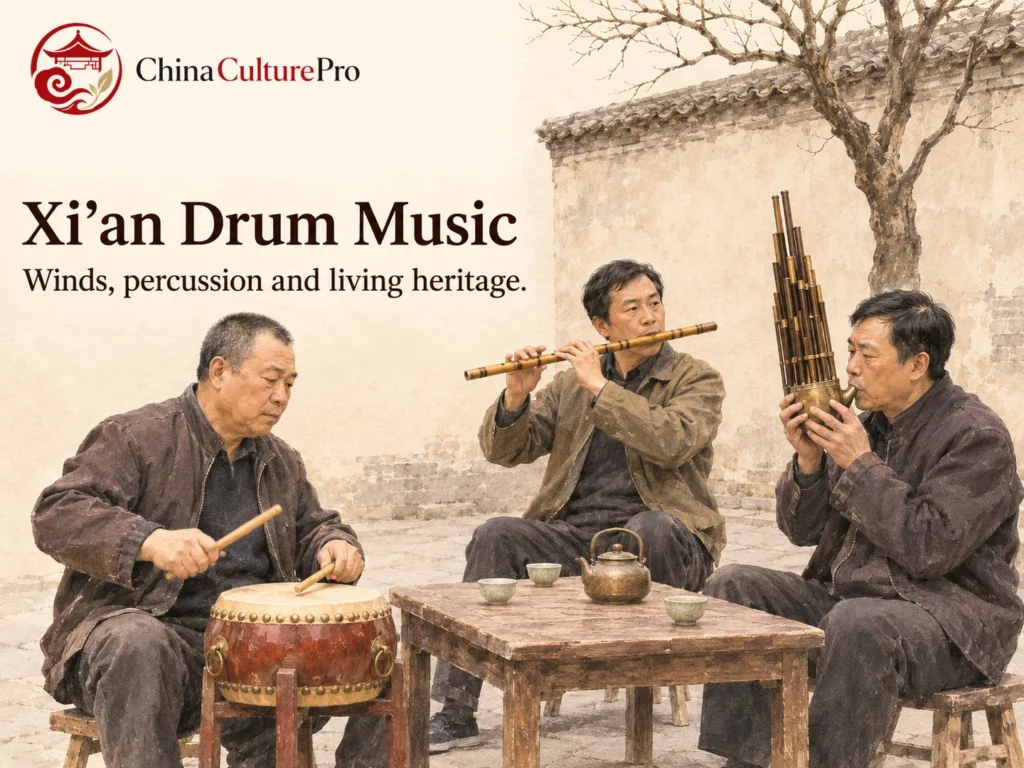
Xi’an drum music, also called Xi’an guyue(西安鼓乐,Xī’ān gǔyuè), is a traditional ensemble practice from Xi’an and surrounding communities in Shaanxi. Drums and gongs play with wind instruments. Certain performances also include a male chorus.
Musicians distinguish seated and walking forms, with pieces and arrangements suited to each. Local societies pass on the music through handwritten notation and oral teaching. China added the tradition to its national heritage inventory in 2006. In 2009, UNESCO inscribed it under the name Xi’an wind and percussion ensemble.

A drum phrase can organize a whole group, while the sustained sound of a flute or mouth organ helps carry the tune. The interplay matters whether the musicians are gathered around a table, moving together or performing on a concert stage.
Winds, Drums and the Ensemble’s Sound
The percussion includes several kinds of drum as well as gongs and other struck instruments. Flutes, reed pipes and the sheng(笙,shēng), a mouth organ, can carry sustained tones. The exact combination depends on the society and the piece. The national heritage museum describes the interplay of winds and drums and gongs as central to the tradition. [1]
The principal drummer can coordinate changes of pace and emphasis, particularly in seated music. A description in the national heritage archive records the drummer switching between percussion instruments during a piece. Listen for a change in the drummer’s pattern, then hear how the winds enter or carry on through it. [2]
Seated Music and Walking Music
Seated music, zuoyue(坐乐,zuòyuè), and walking music, xingyue(行乐,xíngyuè), describe configurations of an ensemble. They relate to repertoire and purpose as well as posture. At a temple fair, the national heritage account also identifies a male choral component called nianci(念词,niàncí). A performance can therefore bring voices into a tradition usually described by its instruments. [1]
| Forma | How the musicians are arranged | What to notice |
|---|---|---|
| Seated music | Players sit in groups, traditionally in an interior or courtyard. | Listen for a drummer’s cues between passages and the way winds sustain the melodic line. |
| Walking music | Players perform standing or while moving as a group. | Notice which instruments can travel and how the percussion keeps the moving group together. |
The archive describes seated groups arranged around a table. It also notes that a seated lineup can include plucked strings, while winds and percussion are practical for a moving group. These are documented practices that help explain why a stationary or procession performance can sound different. [2]
What a Handwritten Score Can Tell Us
The Shaanxi heritage case study describes handwritten scores in a character-based notation known as banzipu(半字谱,bànzìpǔ). The notation uses forms of Chinese characters and marks to indicate musical information. Its conventions have historical precedents associated with the Tang and Song periods. A later copy can preserve an older way of writing music. Dating the tune itself takes other evidence. [3]
Musicians also learn through yunqu(韵曲,yùnqǔ), in which a teacher sings phrases for a student to imitate. The student hears the shaping of notes and rhythm that a bare set of symbols cannot fully convey. The handwritten book and the oral lesson work together. That distinction matters when reading claims about music inherited from ancient Chang’an. [1]
Local Music Societies and Heritage Recognition
The Dongcang Music Society is one example of how the tradition continues through local groups of musicians. The national heritage archive documents the society’s training effort and a staged performance of pieces such as “Bawang Bian” and “Xiangshan Shegu.” A public performance gives the society a way to share pieces that its members teach and rehearse. [2]
The 2009 UNESCO decision records the participation of six musicians’ associations in the nomination. China’s national listing dates to 2006. These records recognize a community practice and help document how musicians safeguard instruments, scores and knowledge. A society can maintain its own versions and ways of teaching within that shared intangible heritage. [4]
How to Listen to Xi’an Drum Music
Start with the 2008 film credited to Shaanxi Art Research in the UNESCO catalog. Watch how the players are arranged before picking out individual instruments. Follow a line from the winds, then listen for the percussion at the end of a phrase. If you hear voices, check whether they join the instruments or come to the foreground as a separate passage. [5]
When comparing it with music from a Chinese orchestra, listen for what holds the players together. In a seated Xi’an ensemble, try following a drummer’s cue through the next phrase. Comparing two documented performances can reveal what belongs to a particular piece and what recurs in the tradition.
FAQs About Xi’an Drum Music
Is Xi’an drum music a percussion solo?
It is an ensemble tradition. Wind instruments share the music with drums, gongs and other percussion, and voices appear in some settings.
What is the difference between seated and walking music?
Seated groups perform in place. Walking music can accompany a moving group, with a lineup and pieces suited to that setting.
Can a handwritten score reproduce a historical performance?
A score preserves part of the musical evidence. Oral transmission helps explain how musicians phrase and play what the symbols record.
Fuentes
[1] China Intangible Cultural Heritage Digital Museum. Xi’an Drum Music
[2] China Intangible Cultural Heritage Digital Museum. Xi’an Drum Music and Its Transmission
[3] Shaanxi Provincial Department of Culture and Tourism. Xi’an Drum Music Safeguarding Case
[4] UNESCO. Decision 4.COM 13.26
[5] Shaanxi Art Research. Xi’an Wind and Percussion Ensemble, 2008 Film