


Quick Answer: What Defines Gansu Culture?
Gansu (甘肃, Gānsù) stretches across several landscapes in northwest China. The Hexi Corridor (河西走廊, Héxī Zǒuláng) linked oasis settlements along the Silk Roads. Dunhuang (敦煌, Dūnhuáng) preserves evidence of exchange in paintings and manuscripts, while Gannan (甘南, Gānnán) and Linxia provide different views of monastic life and shared music.[1][2][3][4][5]
- Western Gansu: The Hexi Corridor and Dunhuang record movements of people, objects, art and writing through oasis settlements.[1][2]
- Gannan: Labrang Monastery (拉卜楞寺, Lābǔlèng Sì) in Xiahe is part of the Tibetan Buddhist landscape near the edge of the plateau.[3][6]
- Linxia: Local singing gatherings are part of the wider Hua’er (花儿, huā’ér) tradition shared by different communities in northwest China.[4][5]
Start with a region. A cave painting at Dunhuang and a song at a Linxia gathering answer different questions about life in Gansu.
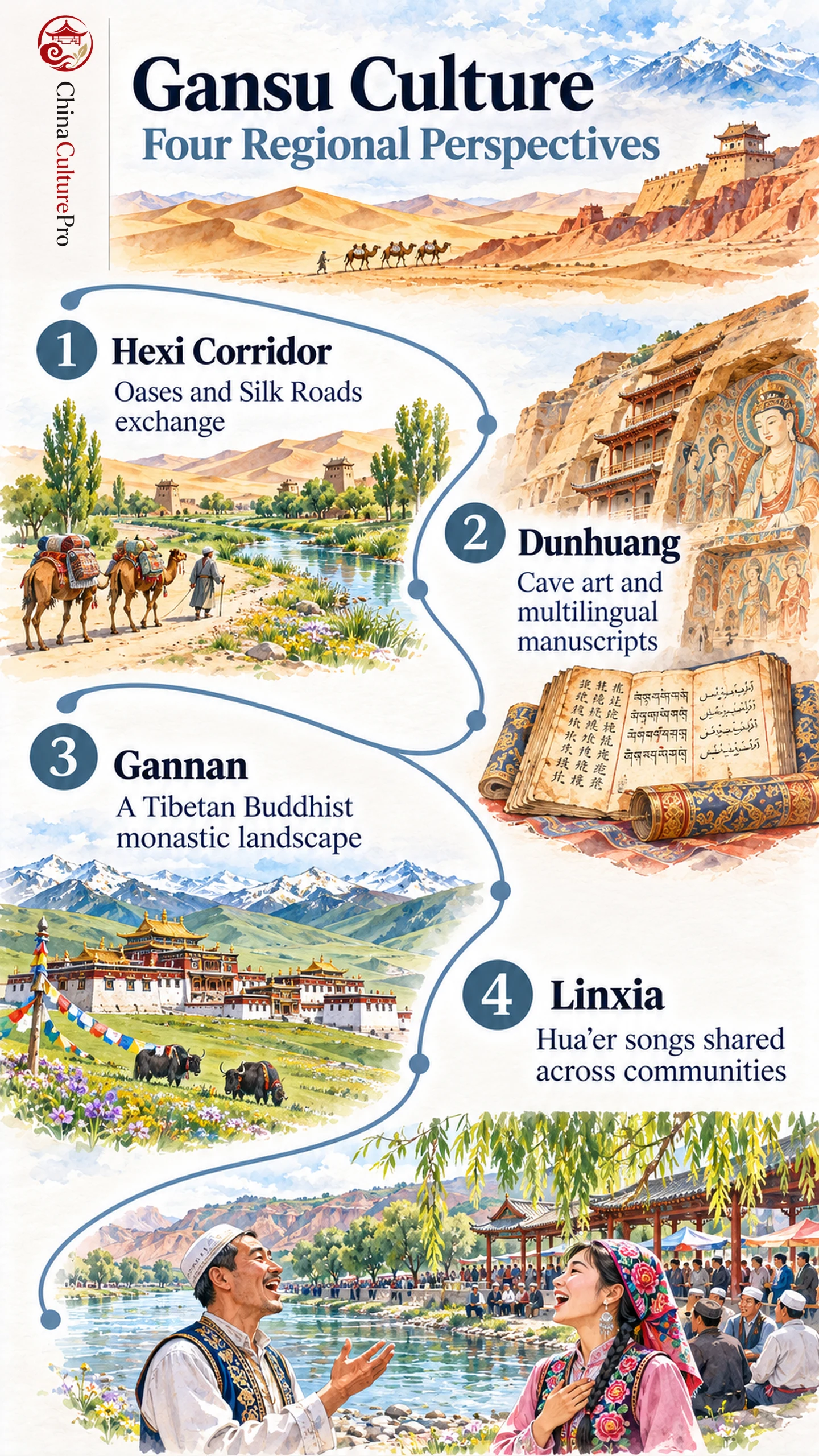
One of the best ways to follow a route is to ask what connects its stops. Gansu’s oases, river settlements, mountain towns and plateau communities show several kinds of movement and exchange.
Four Ways to Read Gansu Culture
| Region or place | En qué fijarse | What it explains |
|---|---|---|
| Hexi Corridor | Oases between mountains and desert | Where routes and settlements could grow along the Silk Roads.[1][6] |
| Dunhuang | Cave paintings, sculptures and manuscripts | How religious and written traditions traveled and changed.[2] |
| Gannan | The buildings and ceremonies of Labrang Monastery | Tibetan Buddhist education, artistic practice and public observance.[3] |
| Linxia | Singers at a local Hua’er gathering | How people share tune families and make up verses in a social setting.[4][5] |
The Hexi Corridor and Dunhuang
The Hexi Corridor runs along the northern side of the Qilian Mountains. Oases gave settlements a place to grow between dry stretches. The routes passing through them carried people and goods westward from the region of Chang’an and modern Xi’an toward Central Asia. The roads and tracks changed over time.[1][6]
Near the Dunhuang oasis, the Mogao Caves contain paintings and sculpture made over many centuries. A Sui-era cave painting includes a camel pulling a cart. Other caves preserve religious compositions and depictions of everyday life. The Dunhuang murals and Dunhuang manuscripts offer different evidence. One preserves what artists painted on walls. The other includes texts in Chinese, Tibetan and other languages.[2]
Gannan and Eastern Gansu
Gannan lies on the edge of the Qinghai–Tibet Plateau. Labrang Monastery, in Xiahe, was founded in 1709 and is a center of the Gelug tradition of Tibetan Buddhism. During a documented ceremony, monks and attendants unrolled a large image of the Buddha for communal observance. The site is an example of a living institution, with links in religious life to areas beyond Gansu, including parts of Qinghai.[3][6]
Eastern Gansu has a different landscape and its own Buddhist sites. The Maijishan Grottoes near Tianshui preserve sculpted figures on a steep hillside. They are part of the UNESCO-listed Chang’an–Tianshan route network. The caves and the monastery preserve very different evidence about Buddhist religion, art and learning.[1][7]
Linxia and Hua’er Singing
In the Linxia Hui Autonomous Prefecture, the Lianhuashan gathering is one setting for Hua’er, a type of folk singing. Singers can draw on established tune families and improvise verses within inherited forms. Gathering for song gives performers a way to address each other and share the experience with an audience.[4][5]
Hua’er also belongs to people in Qinghai, Ningxia and elsewhere in north-central China. Its presence in different places helps explain why a musical tradition can be local in one performance and regional across generations of singers.[4]
FAQs About Gansu Culture
Why Was Gansu Important to the Silk Roads?
The Hexi Corridor gave overland routes access to a series of oases between arid and mountainous terrain. Dunhuang’s caves and manuscripts preserve some of the cultural exchanges associated with that network.[1][2][6]
Is Labrang Monastery in Dunhuang?
Labrang Monastery is in Xiahe in Gannan. The Mogao Caves are near Dunhuang in western Gansu. The places belong to different parts of the province and different cultural histories.[2][3]
Is Hua’er Exclusive to Gansu?
Communities in Gansu share Hua’er with people in Qinghai and elsewhere in north-central China. The form retains local tune names and distinct gathering traditions.[4][5]
Fuentes
[1] UNESCO World Heritage Centre. Silk Roads: The Routes Network of Chang’an–Tianshan Corridor
[2] UNESCO World Heritage Centre. Mogao Caves
[3] Xinhua. Buddhist Scroll Ceremony at Labrang Monastery
[4] UNESCO Intangible Cultural Heritage. Hua’er
[5] Linxia Hui Autonomous Prefecture. Lianhuashan Hua’er Gathering
[6] Scientific Reports. Landforms and Environmental Regions of Gansu
[7] China Culture. Precious Repositories of Piety and Prestige