


Quick Answer: What Are the Dunhuang Murals?
The Dunhuang murals (敦煌壁画, Dūnhuáng bìhuà) are paintings made inside Buddhist cave temples near the oasis of Dunhuang in Gansu. The best-known group is at the Mogao Caves (莫高窟, Mògāo kū), where about 45,000 square meters of murals survive across a site with 492 preserved caves. [1]
- Subjects: The paintings show Buddhas teaching, Buddhist stories unfolding in episodes, heavenly realms, and people who supported the caves. [3][4][7]
- Setting: Painters worked across walls and ceilings around niches and sculptures, so the room forms part of the composition. [3][4][5]
- Period: The surviving ensemble spans roughly a millennium, from the fourth through the fourteenth century. [1]
These figures describe Mogao. Other groups in the Dunhuang area, such as the Western Thousand Buddha Caves, have their own inventories. [8]
A crop of a painted dancer can tell you how an artist gave a figure motion. An image of the entire cave tells you what the dancer was doing there. In the Mogao caves, where paintings often cover much of the room, the distance between a detail and the whole scene is part of what makes the art worth looking at.
Why the Mogao Caves Were Painted
The Mogao temples were cut into a cliff southeast of the Dunhuang oasis, a stopping point on routes that moved people, goods and religious ideas across Asia. Construction is traditionally dated to 366. Local rulers, monks and travelers commissioned caves over the centuries, and the painted chambers gave Buddhist worship and devotion a physical setting. [1][2][5]
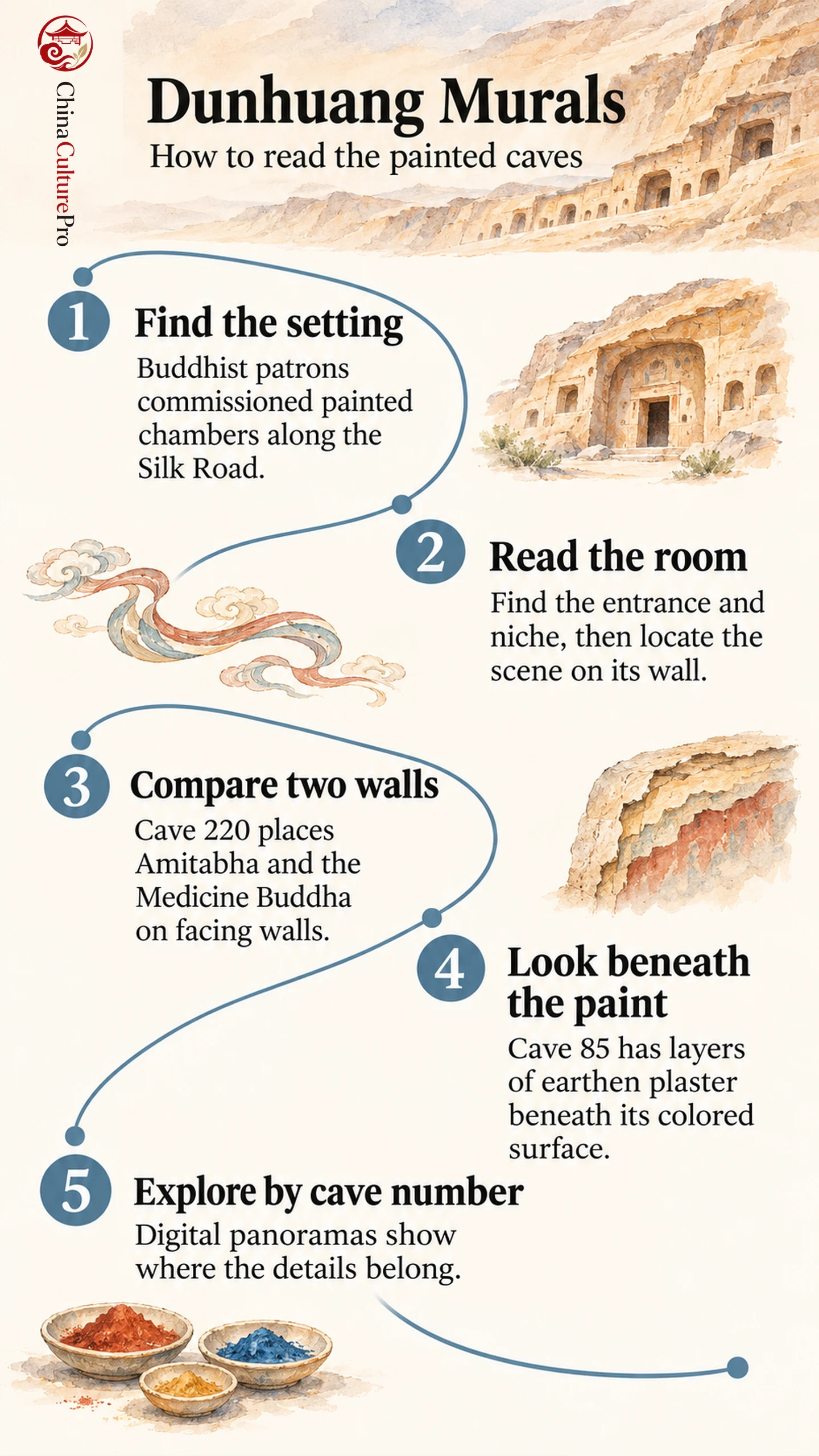
Stone, sculpture and painting work together. In Cave 220, a sculptural group occupies the west niche. Visitors entering from the east would face it, with a different Buddhist tableau to either side. The space gives each painting a position relative to the images a person would encounter on entering. That relationship distinguishes a cave chamber from a display of portable Chinese figure paintings. [4]
Among the religious scenes are details of travel and commerce. A camel pulling a cart in Sui-dynasty Cave 302 records something of the transport that connected Dunhuang to other settlements. It is one concrete clue to the exchange behind these commissions, alongside the many images drawn from Buddhist teaching. [1]
How to Read a Painted Cave
Start with the chamber. Find the entrance, the main niche or altar, and the wall you are looking at. Then see whether the image shows a single assembly, a continuous story or several stacked bands with separate jobs. In Cave 285, the south wall puts flying celestial figures (飞天, fēitiān) with instruments above the story of the Five Hundred Bandits. Small meditation cells open below the story, with other painted episodes between them. [3]
Cave 220 rewards a different kind of looking. On its south wall, pavilions and water frame Amitabha’s Western Pure Land. Musicians and dancers appear below the principal figures. On the facing north wall, the Medicine Buddha presides over a different tableau. Within each scene, look for the largest central figures and the gestures or groupings that turn your eye toward them. Readers new to these devotional subjects can find the wider context in Chinese Buddhism. [4][7]
Donors are another clue. In Cave 285, north-wall figures and written dedications sit below preaching scenes. That arrangement connects the people supporting the work to the religious images above them. Two surviving dated inscriptions also help place the early decoration in the Western Wei period. [3]
Three Mogao Caves to Compare
| Cave | Date or period | En qué fijarse |
|---|---|---|
| Cave 285 | Western Wei, with inscriptions dated 538 and 539 | Compare the musicians and the narrative band on the south wall with the donor figures beneath teaching scenes on the north wall. [3] |
| Cave 220 | Early Tang, with inscriptions dated 642 | Compare Amitabha’s Western Pure Land on the south wall with the Medicine Buddha tableau opposite it. [4][7] |
| Cave 85 | Late Tang, 862–867 | Notice how fourteen illustrated sutras surround the altar and how the cave’s extensive painted surfaces became the focus of a conservation study. [5][6] |
A cave’s earliest date does not date every visible surface. At Cave 220, later paintings once covered the early Tang images, and parts of the sculptural group were reworked. The room records successive interventions as well as its original program. [4]
Pigment, Plaster and Conservation
At Cave 85, painters worked on layers of earthen plaster laid over the cliff’s conglomerate rock. The plaster made an even surface for grounds and paint, which included inorganic pigments and organic colorants. That layered construction matters because a problem beneath the image can loosen the painted surface. [5]
Salts can move with moisture and crystallize as conditions change, causing flaking and loss. Conservators studied the cave environment alongside the condition of the painted walls, then combined stabilization with measures to slow further deterioration. Color itself can change over time, too. At Cave 220, some areas originally painted as pale skin now look brown. Treat a surviving color or a photograph as evidence of the surface you see today. [4][5][6]
Modern copies offer another way to look at details. In the 1940s, Zhang Daqian studied and copied murals at Dunhuang. Copies can bring a composition out of the dark interior and onto a portable surface. A cave panorama preserves the location of each detail within the room. [3][9]
FAQs About Dunhuang Murals
How Many Murals Are at Mogao?
The most useful measure is area. Mogao has about 45,000 square meters of murals at a site with 492 preserved caves. A single wall can contain several episodes or one composition that stretches across nearly its entire surface. [1][3][4]
Are the Library Cave Manuscripts Murals?
The Library Cave held portable materials such as manuscripts. Wall paintings are part of the cave interiors. The finds illuminate the religious and cultural life of Dunhuang through a different kind of evidence. [2]
Can You See the Murals Online?
Digital Dunhuang offers cave records and virtual interiors for selected caves, including Cave 285. Search by cave number and use the wall descriptions or English audio guide to locate a scene before zooming in. [3][7]
Fuentes
[1] UNESCO World Heritage Centre. Mogao Caves
[2] Getty. Cave Temples of Dunhuang: Buddhist Art on China’s Silk Road
[3] Dunhuang Academy. Digital Dunhuang: Mogao Cave 285
[4] Dunhuang Academy. Mogao Cave 220
[5] Piqué, Wong and Su. Methodology for the Conservation of the Wall Paintings in Cave 85
[6] Getty Conservation Institute. Wall Paintings Conservation at Mogao Grottoes
[7] Chinese Culture Promotion Office and Dunhuang Academy. Resources from Dunhuang Academy
[8] Dunhuang Academy. Digital Dunhuang: Cave List
[9] Getty. Of Color and Ink