
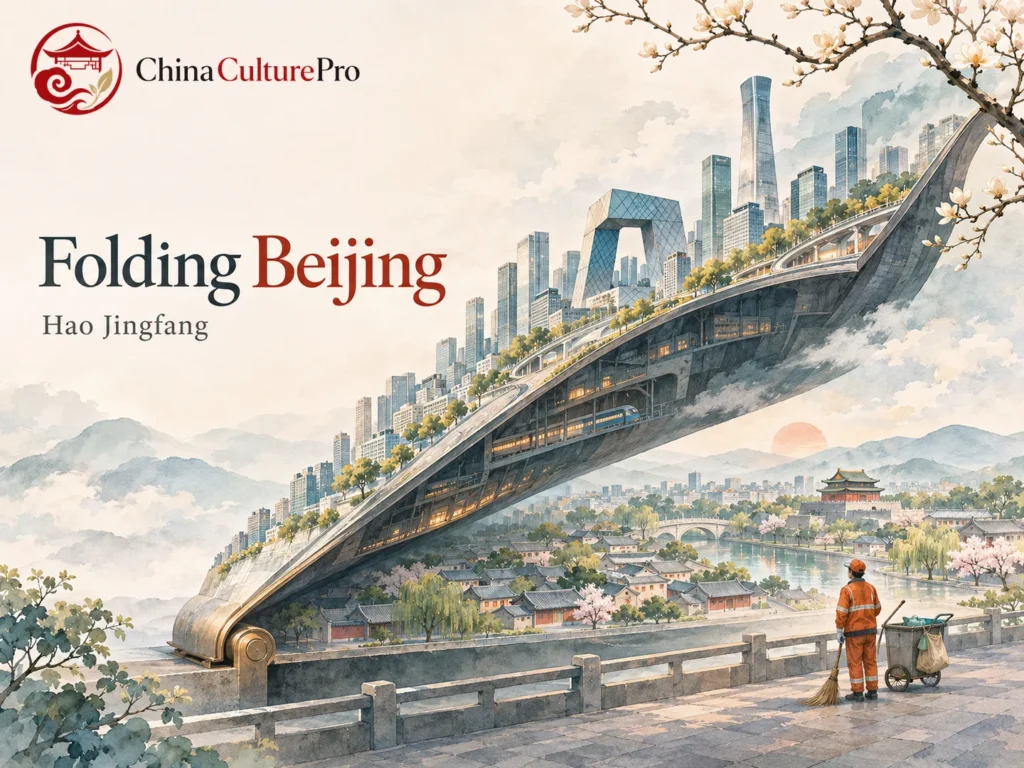

Quick Answer: What Is Folding Beijing About?
*Folding Beijing* (北京折叠, Běijīng Zhédié) is a science fiction novelette by Hao Jingfang (郝景芳, Hǎo Jǐngfāng). Beijing folds and unfolds so three populations can use the same ground at different times. Lao Dao (老刀, Lǎo Dāo), a waste worker with the shortest share of time, takes a paid job carrying a message across the spaces.[1][2]
- The city: Over 48 hours, the three spaces get 24, 16 and 8 hours respectively.
- The task: Lao Dao wants money for a child’s kindergarten fees.
- The theme: The story turns inequality into a difference in how much of each cycle people have to use.
The delivery lets Lao Dao see how the city looks to people who receive a different share of it.[1][2]
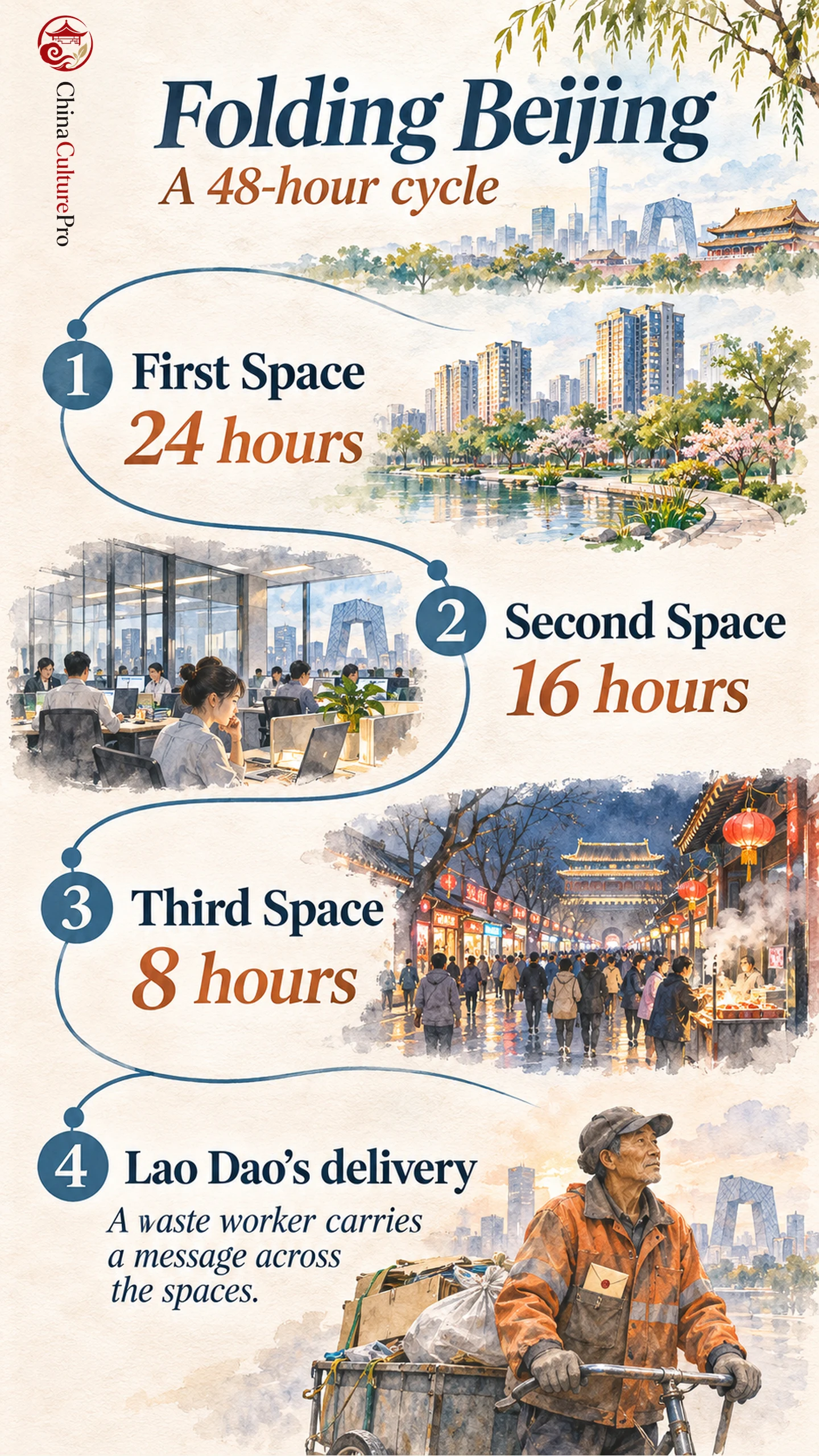
The same ground supports three different lives. Lao Dao’s errand makes it possible to compare them from the street.
How the Three Spaces Share 48 Hours
The city changes shape at set times. Residents in one space can go about their lives while people in the other spaces sleep. First Space occupies one side of the city. Second and Third Space use the other side at different times. The schedule below belongs to the story’s invented city.[2][4]
| Espacio | People | Time in one 48-hour cycle |
|---|---|---|
| First Space | About 5 million | 24 hours, from 6 a.m. to 6 a.m. the following day |
| Second Space | About 25 million | 16 hours, from 6 a.m. to 10 p.m. on the second day |
| Third Space | About 50 million | 8 hours, from 10 p.m. to 6 a.m. |
Half the cycle belongs to the smallest population. The largest population gets one sixth. Lao Dao’s waste shift takes five of those eight hours, leaving much less time for meals, errands and the people he cares about. The clock matters as much to his work as the distance from one street to another.[1][2][4]
Why Lao Dao Takes the Delivery Job
A man in Second Space named Qin Tian (秦天, Qín Tiān) wants to get a message to a woman in First Space. Lao Dao agrees to carry it for money. He needs the payment because he is saving for kindergarten for Tangtang (糖糖, Tángtáng), the child he is raising. The plot gives a technical feat an ordinary reason. For Lao Dao, the risk of crossing is tied to what he wants for Tangtang.[1][2]
As he moves, prices and ordinary gestures tell him as much as the physical change of the city. A meal that seems unremarkable in one space can represent an expense a worker in another space has to plan around. In the opening he notices food he has chosen to go without to save money. That makes later glimpses of other people’s spending matter in terms he and the reader can measure.[1][2]
What the Folding City Keeps Out of Sight
The timetable lets people benefit from work they seldom see. Lao Dao handles waste, a job the city depends on, during the hours allocated to its most crowded space. Elsewhere, people have a larger share of time and can form very different ideas of what a day normally allows. They occupy the same ground without having to live alongside the people who use it later.[1][2][4]
The story also raises a question about automation. If machines can do more of the work, the people who designed the system still have to decide what happens to those who depended on the jobs. The city’s extraordinary engineering can distribute access in an unequal way with great precision. A good schedule for one group can leave little time for another group to change its position.[4][6]
How to Read the Story’s Inequality
Keep track of what Lao Dao knows at each stage. He knows how his own shift works and how much he can save. He has to learn what things cost elsewhere and how someone who lives there might react to his presence. Following the delivery through his eyes helps the reader see boundaries that the city’s residents can go years without crossing.
In Lao She’s Rickshaw Boy, a worker’s view likewise makes an urban economy visible, though the setting and devices are different. Ma Jian’s Beijing Coma gives the city another kind of uneven time, through the memories and bedside present of one narrator.
FAQs About Folding Beijing
Which Hugo Award did Folding Beijing win?
It won the 2016 Hugo Award for Best Novelette. The award record credits Hao Jingfang and English translator Ken Liu.[3]
Where can I read Folding Beijing in English?
Ken Liu’s translation appeared in the January–February 2015 issue of *Uncanny Magazine*. Look for Issue Two. It also appears in the anthology *Invisible Planets*.[3][5]
Fuentes
[1] Hao Jingfang. Folding Beijing, authorized Chinese reprint
[2] Institute of Chinese Studies. Folding Beijing, the space schedule and Lao Dao’s story
[3] The Hugo Awards. 2016 winners and the original English publication record
[4] Springer Nature. The Resilient City, a study of contemporary Chinese science fiction
[5] Tsinghua University. Hao Jingfang and Folding Beijing
[6] People’s Daily Online. Hao Jingfang on class, automation and the reception of Folding Beijing