


Quick Answer: What Is Fisherman-recluses in Autumn Mountains?
Fisherman-recluses in Autumn Mountains (秋山渔隐图, Qiū Shān Yú Yǐn Tú), by Lan Ying (蓝瑛, Lán Yīng), is a hanging landscape in the Tianjin Museum.
- Medium and size: Ink and color on paper, 139.5 × 45 cm.
- Start near the bottom: Covered boats sit beside a wooded bank.
- Continue upward: Village buildings lead toward much larger mountain forms.
The title supplies a theme of withdrawal; the painted figures do not establish named historical identities.
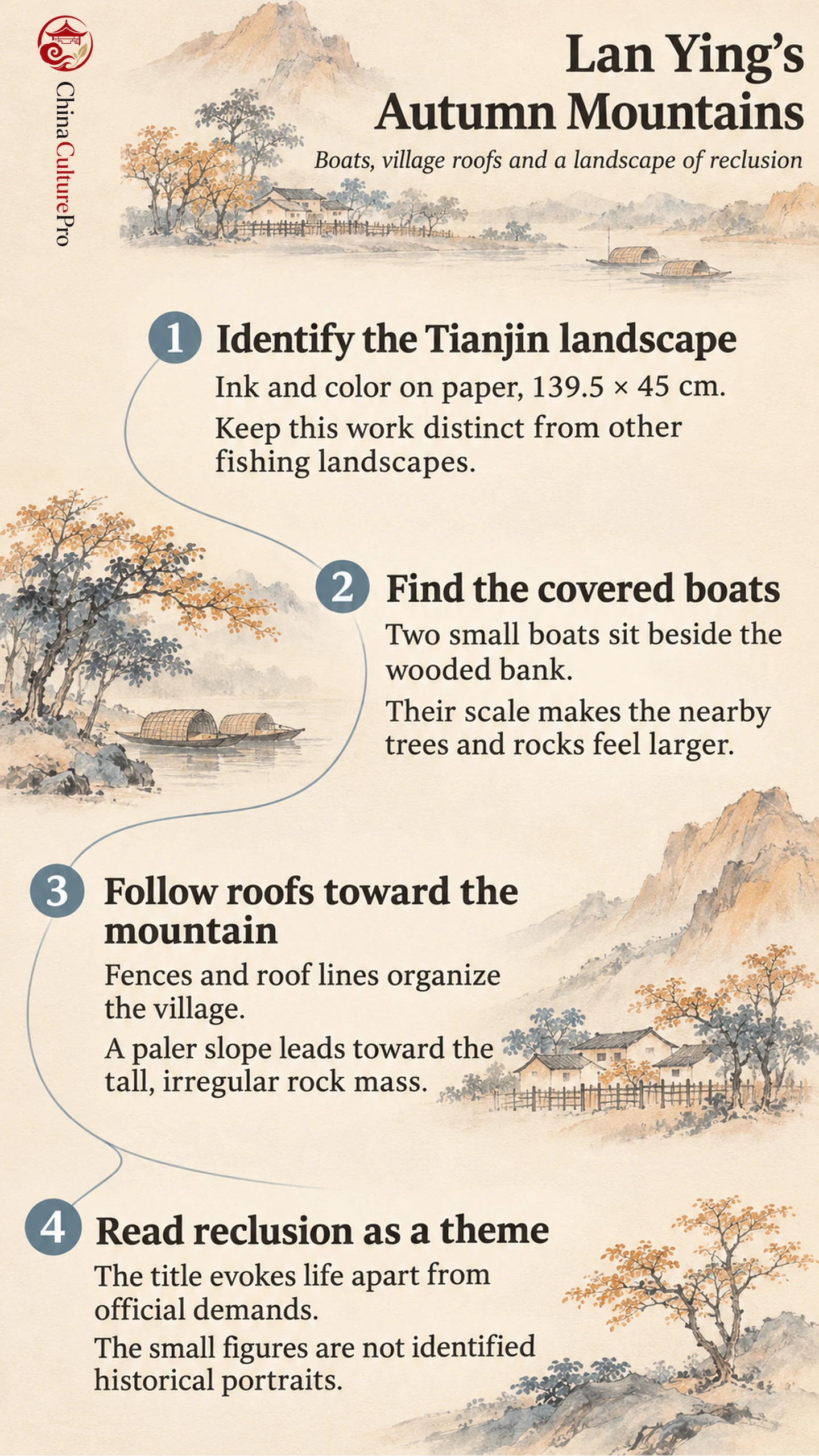
The boats are small enough to overlook beneath the foreground trees. Once found, they give a human scale to a landscape that climbs through roofs, slopes and a much taller mountain.
Look at the open area beside that mountain as well. The picture’s height comes from both the amount of terrain it stacks upward and the space it leaves around the upper forms.
Identify the Tianjin Autumn Landscape
The museum’s published collection catalog lists the painting as entry072 among its Ming works. [1]
The recorded image dimensions are 139.5 × 45 cm, on paper with color. [2]
Keep those measurements attached to the Tianjin work. Similar English titles can refer to different pictures of fishing, autumn or retirement, and the artist treated these subjects more than once.
The scroll-format guide explains the vertical format. Here, the narrow field can be read from a nearby inhabited bank toward a high, less accessible-looking rock mass.
The inscriptions-and-seals guide also helps separate the painted field from its writing and mounting. The short upper inscription occupies space beside the mountain rather than covering the busiest foreground.
Find the Boats beneath the Foreground Trees
Begin at the lower left. Two covered boats overlap beside the bank, with small figures visible around their uncovered ends.
Compare the rounded or angled covers with the branch network above. The boats use a few clear enclosing shapes, while the trees divide into many thinner paths.
A small red garment provides a useful point of recognition. From there, follow the boat’s low horizontal edge and compare it with the large trunks rising immediately nearby.
The landscape-painting guide develops the use of small human elements within larger terrain. Here, the boats make the adjacent roots and rocks appear substantial before the eye reaches the mountain.
Look across the wooded bank to compare exposed branches with leaf clusters. Some branches remain exposed, while other areas carry clusters of outlined leaves. Their changing density gives the foreground several distinct textures.
Follow the Village into the Mountain
The houses stand above and to the left of the boats. Roof lines, doorways and fences make a more regular pattern than the trunks and branches that partly screen them.
Trace one fence before looking at the whole settlement. Its repeated short uprights connect separate structures and give the eye a route through the inhabited area.
Above the roofs, a paler slope helps carry the landscape toward the larger rock mass. Compare its relatively open surface with the darker lines and dots on the mountain face.
The painting-techniques guide supplies a vocabulary for contour and texture. In this picture, those two jobs are easiest to distinguish where a long outer edge encloses many shorter interior strokes.
The mountain’s upper projection also shifts the balance of the image. Much of the visual weight gathers toward the left, while a broad quieter field remains to the right.
Return to the houses after looking at the summit. Their straight roof edges now seem especially small and orderly beside the larger, irregular terrain.
Understand Reclusion without Inventing a Biography
The painter worked professionally while engaging with scholar-painting ideals and earlier landscape models. Fishing reclusion was one of the themes available within that artistic world. [3]
That context gives the title a useful direction. Boats, sheltered dwellings and surrounding mountains can be read together as an image of life at a distance from official demands.
The literati-painting guide develops this relation between a landscape and a cultivated ideal. A picture can explore such an ideal without serving as a record of its maker’s daily residence.
The small figures also remain pictorial participants. Their scale and placement invite attention to human company; any specific conversation would be an imagined addition.
After considering that theme, look again at the boat covers and nearby roofs. Both offer small areas of shelter within a landscape whose largest forms remain beyond the figures’ scale.
FAQs About Lan Ying’s Autumn Mountains
Where is this painting kept?
The autumn hanging scroll discussed here is in the Tianjin Museum.
Why are the boats important?
They provide an inhabited foreground and a small-scale reference for the surrounding trees, rocks and mountain.
Does the title identify historical recluses?
It names a theme of fishing and withdrawal. It does not independently establish the painted figures as portraits of particular people.
Fuentes
[1] Tianjin Museum; Cultural Relics Press. Paintings in the Tianjin Museum, 2012: contents entry072, hosted catalog listing
[2] Chinese Fine Art Gallery. Fisherman-recluses in Autumn Mountains: artwork record265
[3] Metropolitan Museum of Art. Lan Ying: Hermit-Fisherman on a Spring River, curatorial discussion