

Quick Answer: What Was the First Opium War?
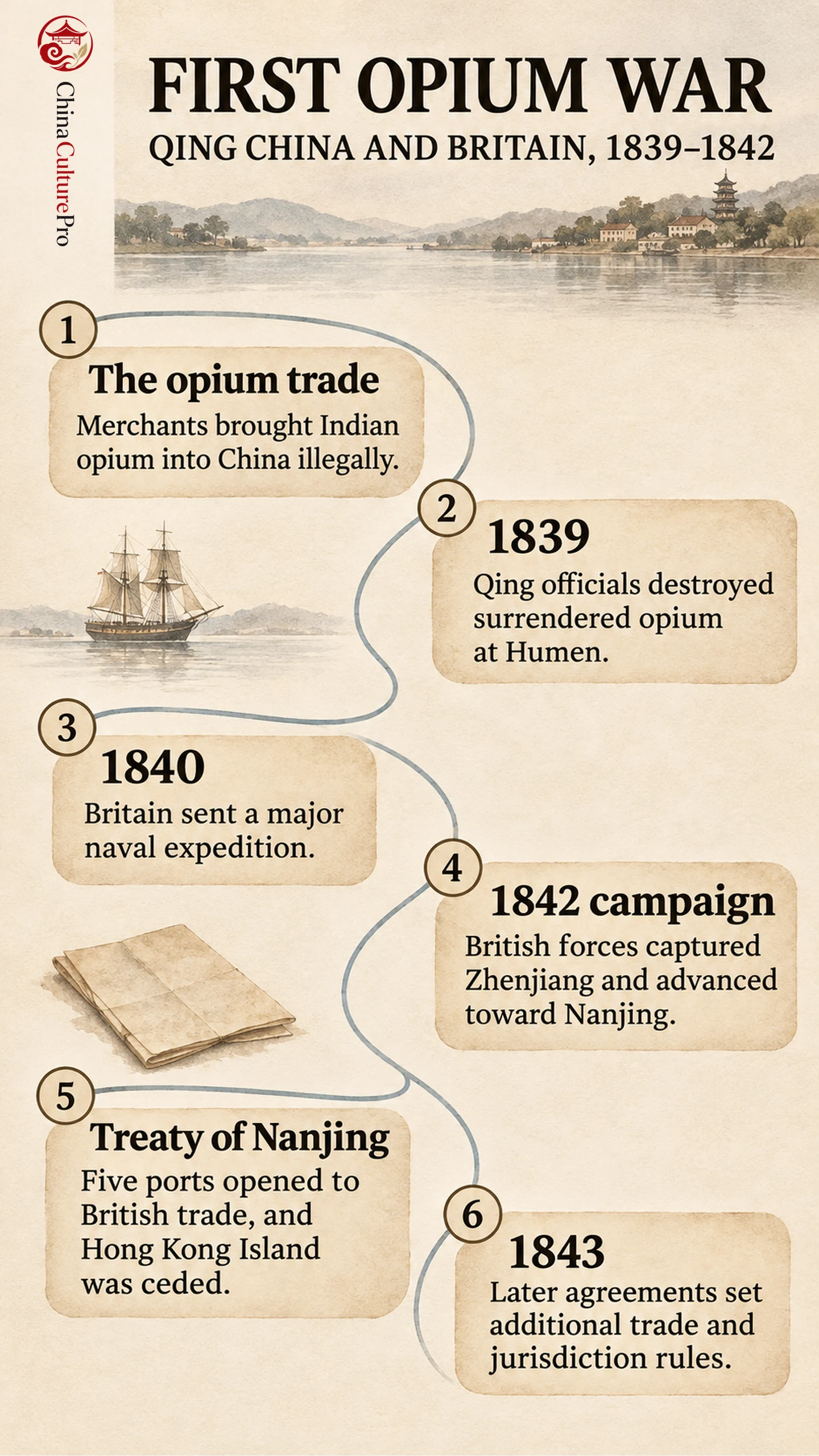
The First Opium War (第一次鸦片战争, Dì-yī cì Yāpiàn Zhànzhēng) was fought between Britain and Qing China from 1839 to 1842. Qing commissioner Lin Zexu (林则徐, Lín Zéxú) moved to suppress the illegal opium trade. Britain sent an expedition, defeated Qing forces and secured the Treaty of Nanjing (南京条约, Nánjīng Tiáoyuē) in 1842. [1][2][4][5]
- Immediate crisis: The Qing authorities seized and destroyed stocks of opium surrendered by foreign merchants.
- Campaign: British and British Indian forces moved along the coast and up the Yangtze.
- Peace terms: The treaty opened five ports to British trade, ceded Hong Kong Island and required indemnity payments. [2][4][5]
Further rules on trade and legal jurisdiction came through agreements in 1843. [5][6][8]
The treaty that ended the fighting and the rules that later governed the treaty ports belong to different documents. The first document set the peace terms. Further negotiations turned some of those commitments into working rules for merchants and officials.
How the Opium Trade Became a Military Crisis
The Qing dynasty concentrated much of its maritime trade with Western merchants at Guangzhou (广州, Guǎngzhōu), then commonly called Canton in English. British merchants buying tea and other goods dealt through licensed Chinese merchants. Private merchants moved opium grown in British-ruled India into China through an illegal trade. Its sale brought merchants silver that could be used to buy Chinese goods. [1][2][4]
In 1839, the Qing court sent Lin Zexu to enforce its prohibition. British trade superintendent Charles Elliot directed British merchants to surrender their opium under his authority. Qing officials destroyed the surrendered stocks at Humen (虎门, Hǔmén) in June. A communication addressed to Queen Victoria and associated with Lin and his colleagues argued that British subjects were profiting from harm in China. [2][3][4][9]
British merchants and officials pressed for compensation for the opium Elliot had required them to surrender. British objectives also included wider access to ports and changes in the way officials of the two governments dealt with one another. Fighting in 1839 and the dispatch of a major expedition in 1840 turned the dispute into war. [1][2][4]
How Britain Forced a Settlement
British ships could move between coastal targets. In 1840 the expedition occupied Dinghai on Zhoushan (舟山, Zhōushān), called Chusan in British accounts. In 1841 British forces took Xiamen and Ningbo. Qing forces fought at forts and cities, while the fleet could move its attacks among ports and river approaches. [4][7]
Equipment also mattered when troops came ashore. Mao Haijian’s comparison of weapons finds that British infantry firearms generally had greater range, faster loading and more consistent manufacture. These advantages shaped encounters with Qing defenders. The fleet’s ability to move men and guns between targets widened the difference. [4][7]
In 1842 the British took Shanghai, moved up the Yangtze and captured Zhenjiang (镇江, Zhènjiāng) in July. The advance put Nanjing within reach. The Qing court now faced the prospect of further fighting near a major city and agreed to negotiate. [4][7]
What the Treaty of Nanjing Required
The parties signed the treaty aboard HMS Cornwallis at Nanjing on August 29, 1842. Article II permitted British merchants and their families to reside and trade at Guangzhou, Xiamen, Fuzhou, Ningbo and Shanghai. Article III ceded Hong Kong Island. Article V ended the requirement to trade exclusively through the licensed Canton merchants. [5]
Articles IV–VII specified a total of 21 million silver dollars: six million for the surrendered opium, three million for debts to British merchants and twelve million for British expedition expenses. The payment covered stocks already surrendered. The text granted no permission to import or sell opium. [1][5]
Article X called for a published schedule of customs duties at the treaty ports. It set a direction for the negotiations that followed. The tariff itself was among the details fixed through the later settlement. [5][6]
How the 1843 Agreements Extended the Settlement
The 1843 Treaty of the Bogue (虎门条约, Hǔmén Tiáoyuē) put a tariff and trade regulations into force at the five ports. Its most-favored-nation clause extended to Britain additional privileges that Qing China might grant other foreign powers. Article XIII of the incorporated trade regulations assigned punishment of British offenders to British authorities. These rules changed which officials had authority over British subjects in the treaty ports. [5][6][8]
Other governments secured their own treaties. Successive agreements expanded the treaty system beyond the original British settlement. This was the first of the two Opium Wars, and its terms should be kept separate from those forced on Qing China after the second. [1][6]
FAQs About the First Opium War
Why is the First Opium War sometimes dated 1840–1842?
The first armed confrontations took place in 1839. The main British expedition reached Chinese waters in 1840. Dates beginning in either year reflect which stage is being counted as the start. [1][2][4]
Did the Treaty of Nanjing legalize opium?
No. The treaty required payment for the opium surrendered in 1839. It included no authorization to import or sell opium. [1][5]
Did the Treaty of Nanjing cede all of present-day Hong Kong?
No. Article III ceded Hong Kong Island. Other parts of what is now Hong Kong came under British control through later arrangements. [2][5]
Fuentes
[1] Richard S. Horowitz. The Opium Wars of 1839–1860, in East Asia in the World
[2] The National Archives, United Kingdom. Hong Kong and the Opium Wars
[3] Lin Zexu and colleagues. Lin Zexu’s Communication to Queen Victoria
[4] National Army Museum. First China War
[5] Qing China and Great Britain, USC U.S.–China Institute transcription. Treaty of Nanjing (Nanking), 1842
[6] Qing China and Great Britain, The World and Japan Database. Supplementary Treaty Signed at the Bogue, 1843
[7] Mao Haijian. The Qing Empire and the Opium War: The Collapse of the Heavenly Dynasty
[8] En-Sai Tai. Treaty Ports in China: A Study in Diplomacy
[9] The Hong Kong Polytechnic University. Understanding Modern Chinese History