

Quick Answer: What Are Dried Scallops Used For?
Dried scallops, known as conpoy, ganbei (干贝, gānbèi) or yaozhu (瑶柱, yáozhù), are dried scallop adductor muscles. They add concentrated seafood savoriness to Chinese soups, congee, fried rice and sauces.[1][2][3]
- Use them as a flavoring ingredient, often shredded after softening.[2][3]
- Choose whole pieces when appearance matters, or pieces that you can break up when the dish needs threads.[3][4]
- Rinse before soaking, and keep an extended soak refrigerated rather than leaving seafood out overnight.[1][6]
Conpoy remains shellfish. Check the product’s ingredients, preparation instructions and storage label before use.[7]

Conpoy is usually a supporting ingredient. Choose a form that suits the finished dish, then plan enough time to soften it before cooking.
Recognize Conpoy and Its Flavor
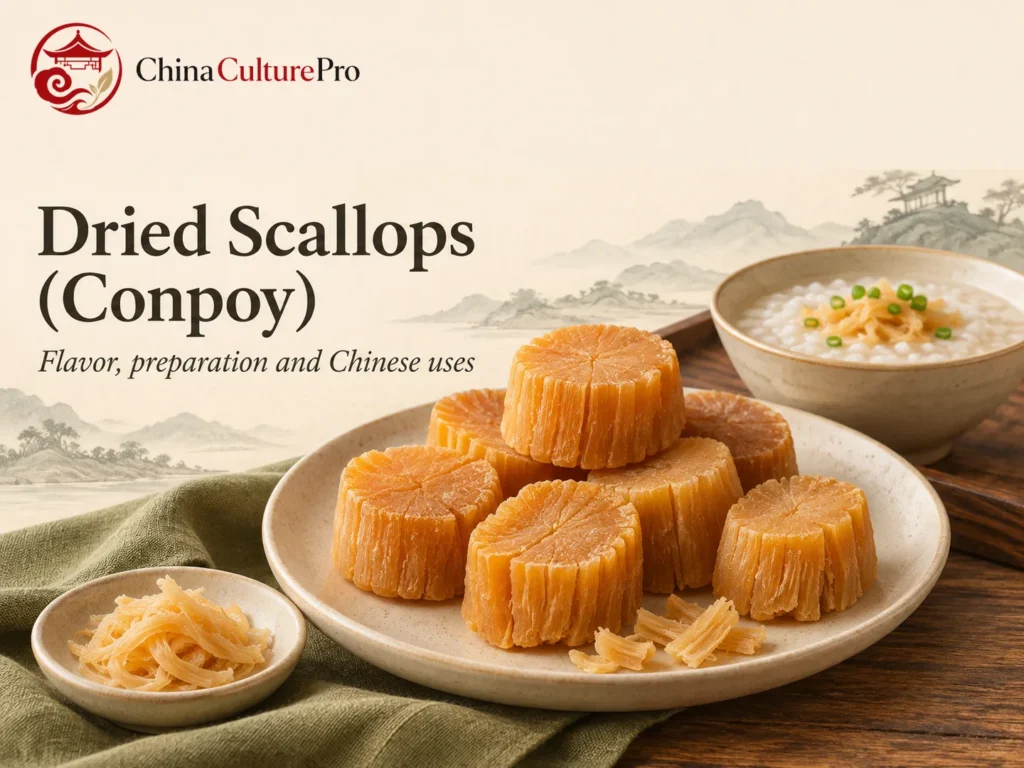
Look for firm, compact golden to amber-brown discs with visible muscle fibers. Hokkaido examples are cooked in salted water, then dried in stages to concentrate their flavor.[1]
Conpoy’s appeal is savory depth with a seafood sweetness. In Cantonese cooking, the dried ingredient can enrich a soup without requiring a bowlful of seafood. Its flavor and fibrous texture are different from those of a plump, freshly cooked scallop.[2][3]
Choose Whole Scallops or Broken Pieces
| Forma | Useful when | Buying decision |
|---|---|---|
| Larger whole pieces | The finished dish will display recognizable scallops | Pay for intact appearance only when you will use it |
| Smaller whole pieces | You want modest portions for soup or rice | Choose the amount needed for the recipe |
| Broken pieces | The scallops will be shredded into soup, sauce or filling | Intact shape matters less than sound condition |
Size is part of commercial grading, alongside shape, flesh quality, color and aroma. Larger scallops can be expensive, but a price or grade code alone does not tell you how a particular batch will suit your dish. There is little reason to pay for a pristine outline if your next step is to break it apart.[2][4]
Where Dried Scallops Work in Chinese Cooking
- Soups and congee: Add seafood savoriness to broth or rice porridge, with softened threads distributed through the bowl.[2]
- Chicken soup: Shredded conpoy can provide fine strands and depth alongside chicken in a thickened soup.[3]
- Fried rice and stir-fries: Use softened pieces as a seasoning component rather than treating them like a fresh scallop to sear.[2]
- XO-style sauce: Dried scallops are a characteristic ingredient in this intensely savory condiment.[2]
Follow the intended recipe for quantities and salt. A strongly flavored dried ingredient is most useful when its contribution remains balanced with the broth, rice or other seasonings.
Rinse, Soften and Shred
- Rinse the pieces. Lightly wash the dried scallops, then place them in a clean container with water to cover.[1]
- Soften until workable. Allow time for the fibers to loosen enough to pull apart. For a long or overnight soak, apply normal cold-seafood handling: cover and refrigerate at 40°F (4°C) or below.[1][6]
- Pull into threads. Use clean fingers or a spoon to separate the softened muscle, then cook it in the chosen dish. Smaller pieces are easier to soften than a large intact muscle.[3]
There is no single soaking time for every size and preparation. An overnight recipe and a quick method using broken pieces are different approaches; the useful endpoint for shredding is a muscle you can separate without force.[1][3]
Should You Keep the Soaking Water?
Some culinary recipes reuse the liquid as stock because it carries scallop flavor. However, archived Hong Kong food-safety advice for dried seafood recommends discarding soaking water. These are different instructions, not evidence that every bowl of soaking liquid is safe.[1][3][5]
For a cautious general approach, discard the soaking water and use fresh water or stock for cooking. Follow any specific washing and preparation directions on the product. Do not try to rescue spoiled seafood by straining its soaking liquid.[5][6]
Buying and Storage
Buy labeled products from a reliable seller, and check the package and instructions. Storage recommendations differ between products: some suppliers recommend refrigeration, while others specify controlled cool, dry conditions. Use the actual label instead of assuming all dried seafood has the same room-temperature shelf life.[4][8]
Once rehydrated, keep the scallops cold and use them promptly for cooking. Drying history is not a reason to leave a wet bowl at room temperature for hours.[6]
FAQs About Dried Scallops
Can fresh scallops replace dried scallops?
They can add seafood to a dish, but they will not reproduce conpoy’s concentrated dried flavor or shredded texture. Choose a recipe designed for fresh scallops if that is what you have.[1][3]
Are dried scallops the same as dry-packed scallops?
No. Dry-packed describes fresh or frozen scallop meat without the added solution associated with wet-packed scallops. Conpoy is a deliberately dried ingredient that usually needs softening for cooking.[1][9]
Can you eat dried scallops straight from the packet?
Some are sold as ready-to-eat snacks. Cooking-grade packets are not automatically equivalent; follow the product label.[1]
Does white powder mean the scallops are moldy?
It may be salt or amino-acid deposits, but similar-looking white mold can also occur. Do not assume every white coating is harmless; reject a suspect product if you cannot establish that it is sound.[4][8]
Fuentes
[1] Japan Ministry of Agriculture, Forestry and Fisheries. Dried Scallops: Traditional Foods in Japan
[2] The Woks of Life. Dried, Cured and Pickled Ingredients
[3] Made With Lau. Dried Scallop and Chicken Soup
[4] Gyoren Hokko. Dried Scallop Questions and Answers
[5] Hong Kong Centre for Food Safety. Safe Festive Food for a Happy Chinese New Year, Food Safety Bulletin 2009 Issue 4
[6] US Food and Drug Administration. Selecting and Serving Fresh and Frozen Seafood Safely
[7] Health Canada. Shellfish Food Safety
[8] Daiichi. Product Description of Dried Scallops
[9] FishEx Seafoods. Scallops: Wet vs. Dry