

Quick Answer: What Was the Cultural Revolution?
The Cultural Revolution (文化大革命, Wénhuà Dàgémìng) was a political and social upheaval in China from 1966 to 1976. Mao Zedong (毛泽东, Máo Zédōng) launched it to pursue continuing revolution and challenge people and institutions he regarded as threats to his political program within the Chinese Communist Party (中国共产党, Zhōngguó Gòngchǎndǎng) and wider society.[1][2][3]
- Politics: Mass mobilization, factional conflict and organized repression caused widespread persecution and deaths.
- Culture: Attacks damaged objects and historic sites, while approved revolutionary art reached large audiences.
- Education: Schooling and university admissions were disrupted, and millions of urban youths were sent to rural areas.[3][4][8][9]
Experiences differed by place and changed as the movement moved from mobilization toward tighter political control.
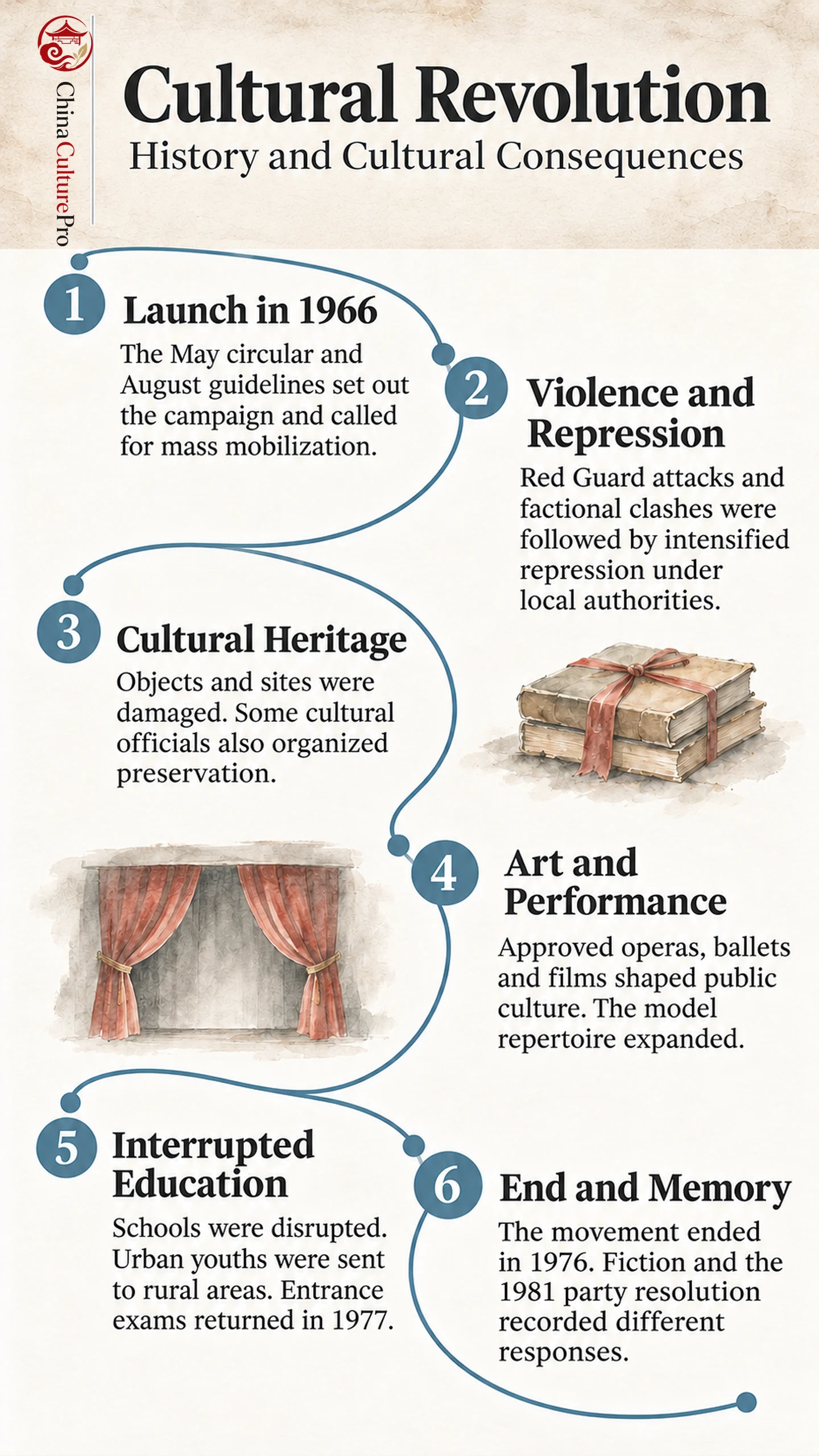
A propaganda poster, a confiscated family book and an interrupted school record show different sides of the same decade. Political directives changed who could teach, what could be performed and how people treated objects inherited from the past. The wider Chinese history overview places the movement in the years following the founding of the People’s Republic.
How the Campaign Began in 1966
The Great Leap Forward (大跃进, Dàyuèjìn) began in 1958 and was followed by severe famine and economic disruption. Subsequent recovery policies sharpened disagreements about how to govern and develop the country. Mao retained considerable authority and argued that class struggle continued under socialism. The movement that followed grew out of both that ideological position and conflict over the direction of the party.[1][3]
Two documents explain why accounts sometimes give different starting points in 1966. The May 16 Circular (五一六通知, Wǔyīliù Tōngzhī) set out allegations that opponents of socialism had gained influence within key institutions. On August 8, the Sixteen Points (十六条, Shíliù Tiáo) gave public guidance for the campaign and promoted tools such as wall posters and mass debate. The documents establish what leaders called for. What happened in individual schools, offices and towns requires different evidence.[1][2]
From Mass Mobilization to Organized Repression
Red Guards (红卫兵, Hóngwèibīng) emerged among students and became prominent in the early movement. Groups denounced teachers, officials and others accused of holding suspect beliefs or belonging to disfavored families. Public humiliation, beatings and killings accompanied the campaign. Workers and other groups also mobilized, and rival factions could attack one another while claiming to defend the same revolution.[3][4]
As fighting spread, the People’s Liberation Army (中国人民解放军, Zhōngguó Rénmín Jiěfàngjūn) intervened and military-backed authorities helped rebuild local institutions. This shift matters for understanding the death toll. A study of 2,213 county and city annals estimated 1.1–1.6 million deaths for 1966–1971 and found that most casualties in its analysis came from organized repression by authorities. These figures are estimates based on uneven records and statistical adjustments. They apply to the study’s first-phase window.[4]
The party’s Ninth Congress in 1969 endorsed the campaign and changed the leadership. New denunciation campaigns followed in the 1970s, including one in 1974 that used readings of the Chinese past to attack current political opponents.[1][4]
The Four Olds and Cultural Heritage
The campaign against the Four Olds (四旧, Sìjiù) targeted old ideas, culture, customs and habits as revolutionary activists defined them. Homes were searched, books and artworks confiscated, and religious objects and historic sites damaged or destroyed. The loss included private family possessions and community practices as well as prominent works of art.[3][5]
Responses varied, even within the institutions charged with carrying out the campaign. Archival research on Shanghai documents cultural officials organizing the protection and storage of objects while justifying those efforts in revolutionary terms. A directive in May 1967 addressed protection of cultural relics and books. Such records explain how some objects survived even as others were lost, and why one city’s experience cannot stand for the whole country.[5]
Model Works, Posters and Public Performance
New officially sanctioned productions occupied a central place in public culture. The model works (样板戏, yàngbǎnxì) promoted by Jiang Qing (江青, Jiāng Qīng) and her allies favored revolutionary subjects and exemplary characters. The Red Detachment of Women (红色娘子军, Hóngsè Niángzǐjūn) is an example of a story that moved between media. A feature film preceded the 1964 ballet, and a film of that ballet followed in 1971. The two films represent different versions of the work.[7][13]
The best-known early set contained eight model works. A March 1976 newspaper list included 18, spanning opera, ballet and symphonic works. Some productions adapted techniques from Ópera china, while ballet worked through a different performance tradition. Political controls restricted the repertoire and shaped how performers adapted their craft.[6][14]
Printed imagery brought the campaign into workplaces and homes. Posters, paper cuttings and everyday objects reproduced recognizable images of Mao and revolutionary activity. Museum collections preserve objects that mix older compositional devices with socialist visual conventions. Such material shows both the pressure to represent approved themes and the reuse of established artistic techniques.[6]
Interrupted Education and Rural Resettlement
Classroom instruction was disrupted when the movement began, and the suspension of competitive entrance examinations changed access to higher education. Schooling resumed unevenly. Some universities began admitting students through recommendations from 1970, before the restoration of examinations. A decade without the former admissions system therefore includes periods of restricted or differently organized education.[9]
The sent-down movement (上山下乡, Shàngshān Xiàxiāng) sent urban youths to villages, farms and other rural placements. It had earlier precedents and expanded sharply from 1968. Young people were expected to learn through labor and contact with rural communities. The experience also involved separation from families, restricted choices and interrupted plans for work or study. Many returned to cities after the Cultural Revolution ended, and their accounts of the experience varied.[8]
China restored the college entrance examination, commonly called the gaokao (高考, gāokǎo), in 1977. The ministry’s figures record about 5.7 million candidates and 270,000 admissions that year. The figures convey the demand for the restored route and the limited number of places available.[10]
The End in 1976 and the Years After
Mao died in September 1976. The October arrest of Jiang Qing and her associates, known as the Gang of Four (四人帮, Sìrénbāng), is generally used as the movement’s political endpoint. Reversing decisions and restoring careers took longer. A party plenum in December 1978 shifted the official emphasis toward modernization. The party’s 1981 historical resolution condemned the movement as a grave error and assigned chief responsibility to Mao. It is a primary record of the leadership’s later assessment.[1]
Writers also addressed the experiences the movement had left behind. Scar literature (伤痕文学, shānghén wénxué) made personal and family harm a subject of public writing in the late 1970s. Lu Xinhua (卢新华, Lú Xīnhuá) gave the movement an emblematic story with The Scar (伤痕, Shānghén). A surviving letter from 1978 records one reader connecting its fictional events to experiences they recognized. This exchange links the period to the subsequent development of modern Chinese literature.[11][12]
For a broader view of changing institutions and cultural production after the movement, see modern Chinese cultural history.
FAQs About the Cultural Revolution
Why do accounts give different starting dates in 1966?
May marks adoption of the circular that set the campaign’s political direction. August marks the approval of the Sixteen Points and its public mobilization guidelines. Both dates fall within the launch of the movement in 1966.[1][2]
How many people died in the Cultural Revolution?
There is no exact agreed total. One nationwide study estimated 1.1–1.6 million deaths in 1966–1971 using local histories and adjustments for gaps in their reporting. Its dates, sources and method matter when comparing it with other estimates.[4]
Did all traditional Chinese culture disappear?
No. Destruction and restrictions were extensive, but varied by place and institution. Some objects survived through preservation efforts, and older techniques continued in selected forms, including state graphics and performance.[5][6]
When did the Cultural Revolution end?
October 1976, when the Gang of Four were arrested after Mao’s death, is the conventional endpoint. The restoration of examinations in 1977 and the party’s 1981 reassessment came afterward.[1][10]
Fuentes
[1] University of Southern California. 1981 Resolution on Party History Since the Founding of the People’s Republic
[2] Columbia University. The Sixteen Points: Guidelines for the Great Proletarian Cultural Revolution
[3] The National Archives. The Cultural Revolution
[4] Stanford University. Rebellion and Repression in China, 1966–1971
[5] The China Quarterly. Revolutionizing Antiquity: The Shanghai Cultural Bureaucracy in the Cultural Revolution, 1966–1968
[6] Ashmolean Museum. Cultural Revolution State Graphics in China
[7] The Opera Quarterly. Re-makes/Re-models: The Red Detachment of Women between Stage and Screen
[8] Cambridge University Press. Chairman Mao’s Children: Introduction
[9] Tsinghua University. Research on the Send-Down Movement and Education
[10] Ministry of Education of China. Thirty Years of College Entrance Examination Statistics
[11] Frontiers of Literary Studies in China. Scar: A Social Metaphor for Working Through Revolution Trauma
[12] Fudan University Library. Reader Correspondence on Lu Xinhua’s The Scar
[13] Harvard Film Archive. The Red Detachment of Women
[14] Heidelberg University. Continuous Revolution: The 1976 Model Works List