

Quick Answer: What Is Chongming Bird?
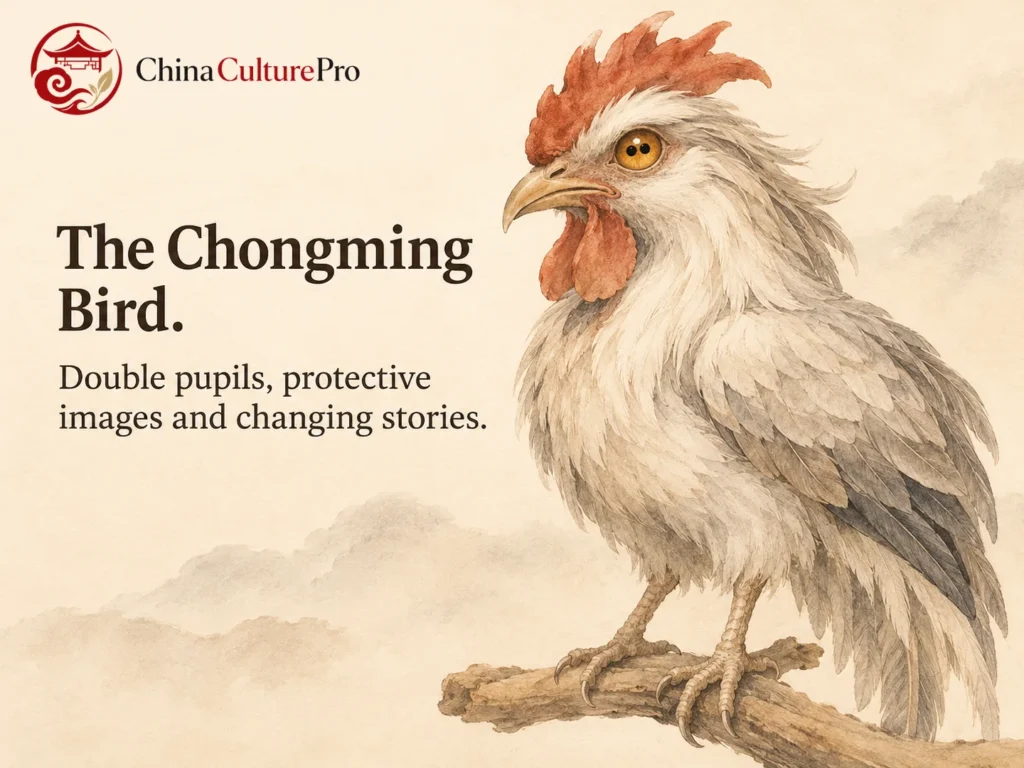
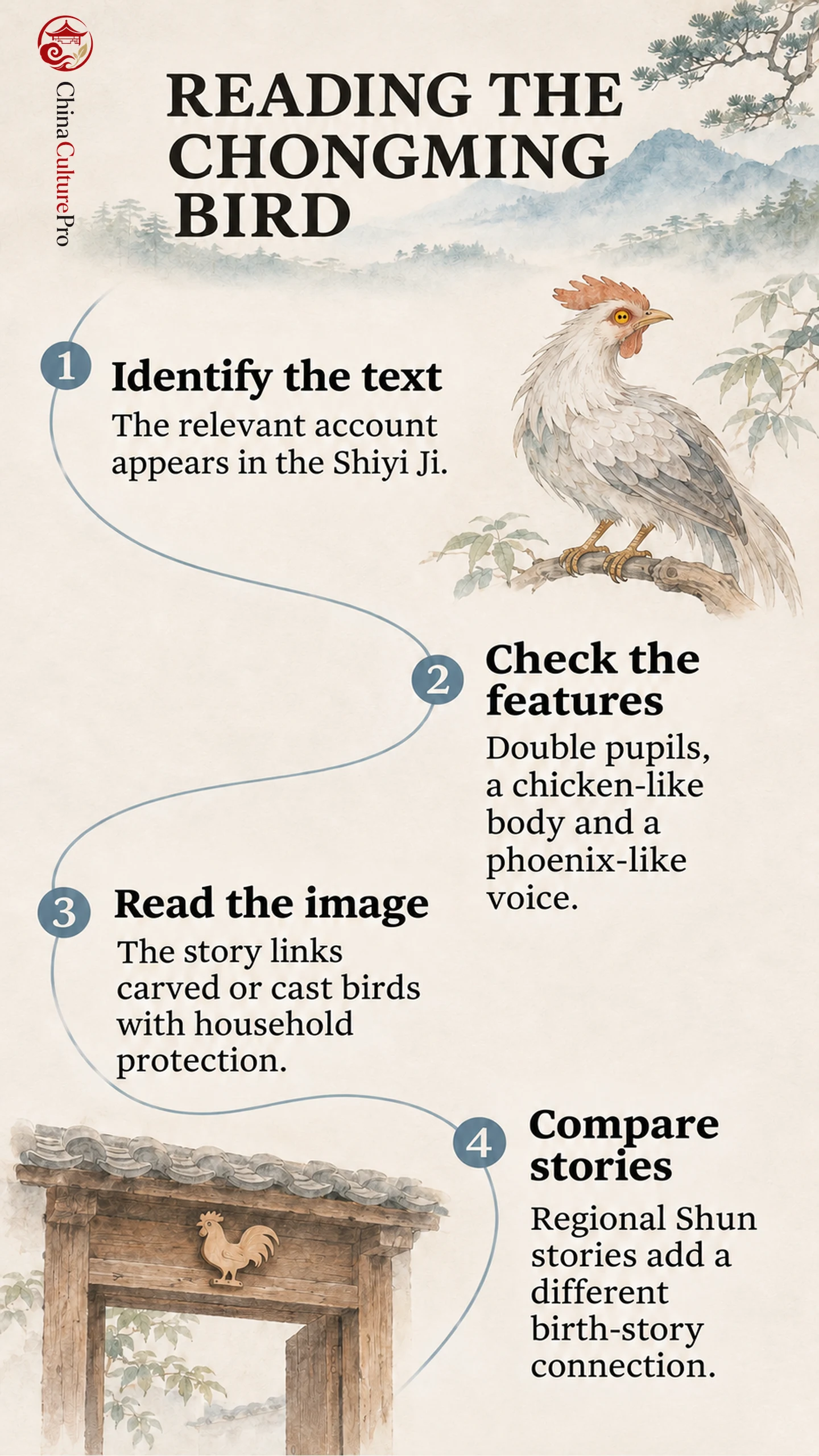
The Chongming bird(重明鸟,Chóngmíng niǎo)is a legendary protective bird described in the Shiyi Ji(拾遗记,Shíyí jì).[1]
- Appearance: Chicken-like, with doubled pupils rather than four separate eyes.
- Voice: Compared with the cry of a phoenix.
- Narrative role: Driving away dangerous creatures and inspiring protective doorway images.
The early literary account, ancient images and later regional stories provide different kinds of evidence; they do not all describe one fixed design.
A bird resembling a chicken can become extraordinary through a small change: a doubled pupil, an unexpected voice or wings that work after their feathers fall away. The Chongming story uses such details to turn a familiar household creature into a powerful visitor. Its movement from living bird to protective image gives it a distinctive place in Chinese mythology.
Reading the Shiyi Ji and Its Legendary Setting
The collection is associated with the Jin-period writer Wang Jia(王嘉,Wáng Jiā)and reached its transmitted form through later editing by Xiao Qi(萧绮,Xiāo Qǐ). It belongs to the literature of strange occurrences, not a contemporary record of remote antiquity.[2]
The first volume places the bird’s arrival in the seventieth year of Yao(尧,Yáo)’s legendary reign. The setting and the date of the written collection are different layers of the story.[1] Calling it a tale about Yao does not establish that an observer recorded the creature in Yao’s lifetime.
It is also frequently assigned to the wrong book. The Classic of Mountains and Seas(山海经,Shānhǎi jīng)is not the source of this account. A National Library of China study reports finding no Chongming entry when searching 92 editions of that work.[3] The two named texts should remain distinct.
A Chicken-Like Body, Double Pupils and a Phoenix-Like Voice
The bird’s alternative name is Shuangjing(双睛,Shuāngjīng), referring to its doubled pupils. The bodily comparison is with a chicken, while the voice is compared with a fenghuang(凤凰,fènghuáng).[1] These comparisons have separate jobs: a splendid cry does not automatically give the bird a phoenix’s body.
Another striking detail concerns flight. At times, the bird sheds its feathers but continues flying with its bare wings. This is an episode or capacity in the description, not a requirement that every picture show a permanently featherless creature.[1]
Its strength is expressed through action. It can fight or drive away fierce animals, including tigers and wolves, and prevent harmful supernatural beings from injuring people. Those are powers attributed within the narrative, not ordinary zoological features.[1]
The contrast explains much of the bird’s appeal. The starting point is recognisable and domestic, but the altered eyes, remarkable flight and protective activity take it beyond that familiar appearance. Elaborate modern plumage can be visually effective, yet it is not a substitute for these particular textual features.
From a Visiting Bird to a Doorway Image
The bird does not remain permanently available. In the story, it may visit several times in a year or stay away for years. People clean their entrances while awaiting its arrival. In its absence, they carve wooden or cast metal images and place them at the doorway; harmful beings retreat from those substitutes.[1]
That transition matters. The image stands in for a visitor who cannot be summoned on demand. The protective meaning therefore belongs not only to the bird’s strength but also to the act of representing it at a vulnerable boundary between household and outside world.
The passage ends by connecting the legend with chicken images carved, cast or drawn at windows for the first day of the year.[1] This is the text’s own explanation of a custom. It should not be expanded into proof that every later rooster decoration descended through one uninterrupted line from Yao’s court.
The connection provides one historical strand within New Year imagery. Set beside door-god traditions, it also shows how household boundaries could become important locations for protective symbols, with different figures and different stories.
Ancient Motifs and Later Shun Stories
Images require interpretation as well as recognition. Huo Hongwei(霍宏伟,Huò Hóngwěi)has proposed identifying bird motifs on a Han brick pillar in the British Museum with the Chongming bird, relating their spread-wing forms to the literary description.[4] This is a scholarly identification of an ancient motif, not an inscription on the object naming the bird. Nor does it make every rooster or spread-wing bird a certain Chongming image.
A different narrative appears in a study of stories collected in the Yuncheng region of Shanxi. In one birth-story pattern, a miraculous bird appears in the father’s dream and asks to become his son; Shun(舜,Shùn)is understood as a rebirth of that bird. The reported variants identify it as a phoenix or a Chongming bird.[5]
This differs from the visiting tribute bird in the Yao episode. Keeping the regional setting visible allows folk-story variation to enrich the subject without treating every version as the same ancient passage.
Moderno game adaptations can add costumes, abilities or new relationships. When reading such an image, distinguish what comes from a named text, what belongs to a recorded regional story and what the new work has invented.
FAQs About Chongming Bird
Does the Chongming bird come from the Shanhaijing?
No. The relevant account is in the Shiyi Ji.[1][3]
Does it have four separate eyes?
No. Doubled pupils are conventionally understood as two pupils in each eye.[1]
Is the Chongming bird the same as a fenghuang?
No. The text compares its voice with a phoenix but its body with a chicken.[1]
Fuentes
[1] Wang Jia, transmitted through Xiao Qi. Shiyi Ji, volume one: the Chongming passage in the Yao section
[2] Palace Museum. Shiyi Ji: genre and textual transmission
[3] Zhu Tingting, National Library of China. Translating Shanhaijing elements into games, relevant discussion on page 97
[4] Huo Hongwei. A Han brick pillar in the British Museum: the bird-motif interpretation on pages 81–82
[5] Mao Qiaohui and Han Na. Types of Shun legends in Yuncheng, Shanxi: the miraculous-birth variants