
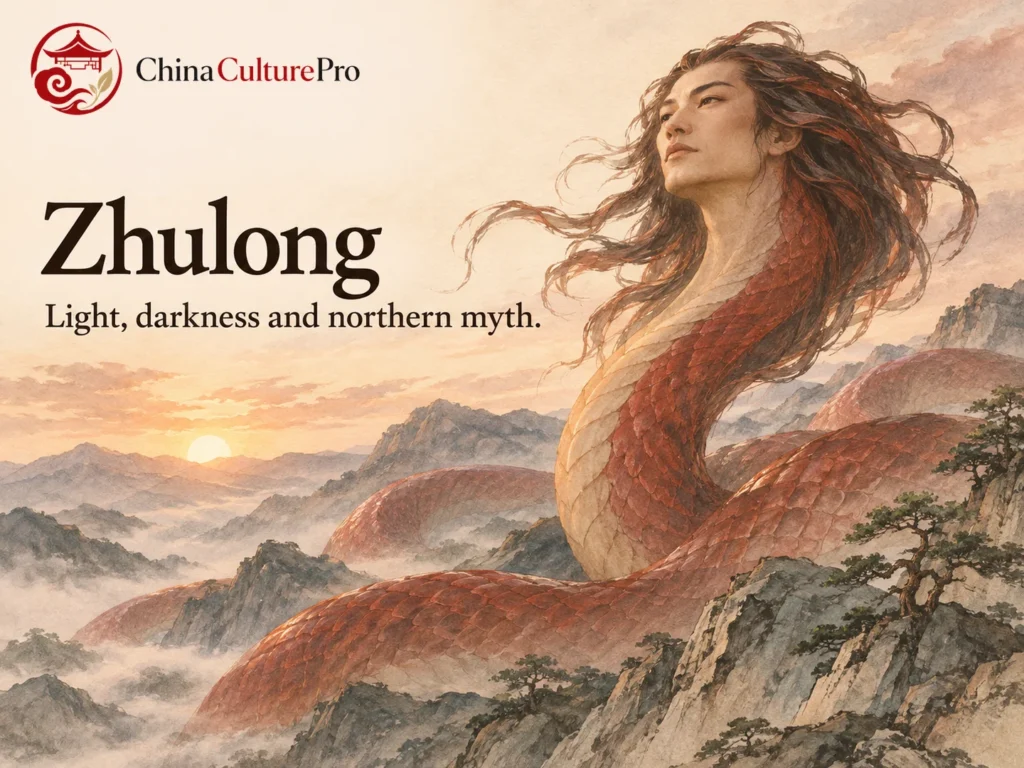

Quick Answer: Who Is Zhulong?
Zhulong(烛龙,Zhúlóng), often translated as the Torch Dragon, is a supernatural figure associated with light and darkness in ancient Chinese texts.
- Identity: A northern, human-faced serpentine deity, rather than an ordinary animal.
- Names: Related northern accounts use different names and settings.
- Interpretation: Ancient descriptions, later commentary and modern explanations belong to different layers of its story.
The familiar name is a useful starting point, but no single modern dragon illustration can stand for every textual version.
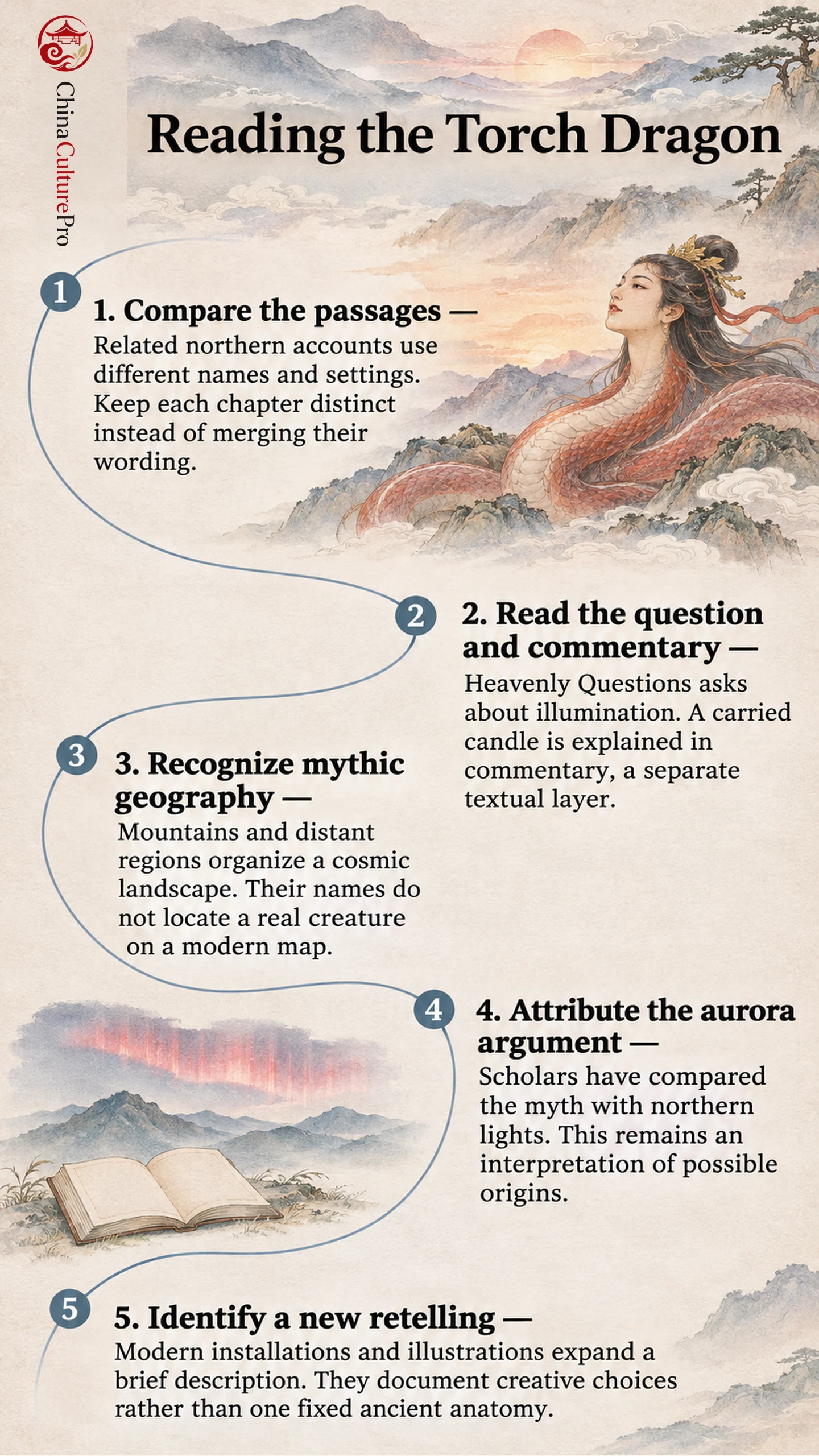
A red, human-faced serpent belongs to a landscape where light behaves differently from everyday experience. Zhulong is one of the striking figures readers encounter in Chinese mythology. Its story is brief rather than a long heroic adventure; much of its interest lies in comparing what different texts actually say.
Two Northern Passages in the Classic of Mountains and Seas
The Shanhaijing(山海经,Shānhǎijīng), or Classic of Mountains and Seas, contains two closely related northern descriptions. The Overseas North passage names Zhuyin(烛阴,Zhúyīn)at Zhong Mountain. It links seeing and closing the eyes with day and night, blowing and breathing with winter and summer, and describes a red, human-faced snake body. The Great Wilderness North passage names Zhulong at Zhangwei Mountain beyond the northwestern sea. Its wording is related but not identical.[1]
These are two passages to compare, not halves of one seamless quotation. When checking a retelling, keep its chapter name beside its description. This keeps differences visible even when ancient expressions remain difficult.
Why the Torch Dragon Is Connected with Light
Tianwen(天问,Tiānwèn), usually translated as Heavenly Questions, asks where sunlight does not reach and what Zhulong illuminates. The question appears among inquiries into the arrangement of the world. Read in context, it is a question about the world’s illumination, not a continuous adventure narrative.[2]
A candle carried in the mouth belongs to an explanatory layer. Scholar Tsai Che-Mao reproduces Wang Yi’s commentary describing a dragon illuminating a sunless northwestern land with a torch or candle. This helps explain why candle-bearing images are understandable, while also showing why the commentary should be distinguished from the wording of the question itself.[3]
In English, “Torch Dragon” can suggest a familiar fire-breathing fantasy monster. Reading the question and its commentary makes illumination a more useful starting point than flames used as a weapon.
The Northern Landscape in the Huainanzi
The Huainanzi(淮南子,Huáinánzǐ)places Zhulong north of Yanmen, screened by Weiyu Mountain from the sun. Its description gives the being a human face, a dragon body and no feet. The surrounding chapter orders an expansive world of mountains, waters, distant regions and extraordinary beings.[4]
Here, geography and cosmology sit together. A place-name in such a passage is part of the text’s imagined arrangement of the world; it does not by itself establish a modern location for a mythical creature. The account supplies a particular setting and bodily description, rather than a definition of every Chinese dragon.
Compare the wording first, then examine a commentator’s proposed identification of its mountains. A modern map pin adds a degree of certainty that a short ancient description may not supply.
Is Zhulong an Aurora? An Interpretation, Not a Discovery
Tsai Che-Mao’s study argues for an association with the northern lights, building on earlier proposals. It compares the myth’s northern setting, redness and elongated form with auroral appearances, while discussing other explanations of the figure. This is a scholarly interpretation of the story’s possible formation.[3]
The distinction matters: a text can be interpreted through natural phenomena without becoming a verified observation report. An argument about resemblance is not the same as evidence identifying the precise event that produced a myth. Nor does it establish that every later use of Zhulong’s name refers to an aurora.
Readers can appreciate the comparison while retaining the mythical figure’s literary setting. When a summary says simply “Zhulong was the northern lights,” look for the missing attribution and the argument behind it.
Reading Modern Zhulong Images
Contemporary artists can turn a compact description into an extensive visual world. A 2025 China Art Museum announcement for Amazing Zhulong described digital installations using eyes, breath and scales as imaginative exhibition themes. The announcement documents a modern reinterpretation.[5]
The same distinction helps when looking at illustrations, games or decorative objects. Ask whether you are seeing an ancient passage visualized, a later commentator’s candle-bearing dragon, or a new character inspired by the name. A useful image caption identifies that choice rather than presenting one invented anatomy as definitive.
For a wider comparison of dragon imagery, see Chinese and Western dragons. Zhulong is a particular figure within a much larger and varied field.
FAQs About Zhulong
Are Zhulong and Zhuyin the same figure?
They are closely connected names in related traditions, but the individual passages differ. Keep the source chapter visible when comparing them.
Does Zhulong carry a candle?
Some commentary explains the figure that way. A candle is not stated in every ancient passage about it.
Was Zhulong a real dragon?
Zhulong is a mythological being, not an identified animal species.
Is Zhulong definitely the northern lights?
No. That is an interpretation advanced by scholars, not an established identification of the myth’s origin.
Fuentes
[1] Chinese Text Project. Shanhaijing, Overseas North: Zhuyin Passage and Parallels
[2] Chinese Text Project. Chuci: Tianwen
[3] Tsai Che-Mao, Fudan University Research Center for Excavated Texts and Paleography. A Study of the Zhulong Myth through Modern Astronomy
[4] Wikisource, Primary Chinese Text. Huainanzi: Dixing Xun
[5] Shanghai Municipal Government, China Art Museum Announcement. Mythical 3D Art Display Set to Debut at China Art Museum, 2025