
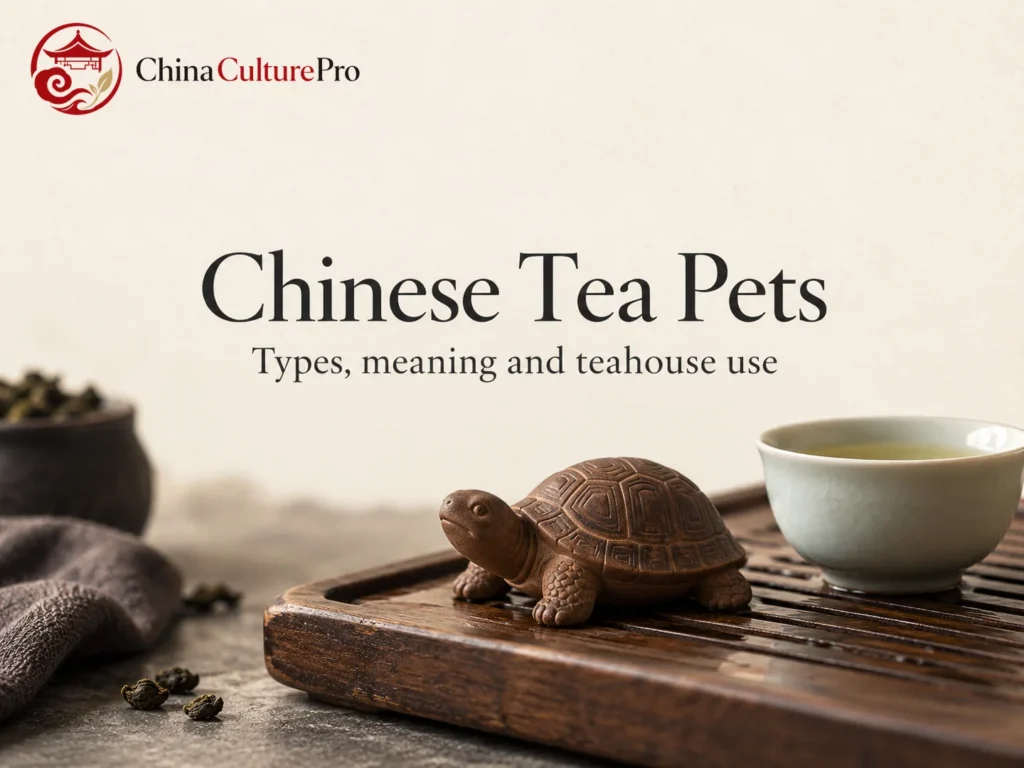

Quick Answer: What Is a Chinese Tea Pet?
A tea pet (茶宠, cháchǒng) is a decorative companion for a tea setting. It is commonly a small ceramic or clay figure placed on a tray, rather than a vessel that holds the drink.
- Forms: animals, auspicious creatures and human figures are all sold as tea pets.
- Use: some owners rinse the figure with tea during a session.
- Role: it adds pleasure or personal meaning; it is optional equipment.
The name describes its place in tea practice, not one material or one religious requirement. A plain brewing setup can serve tea perfectly well without a figure.[1]
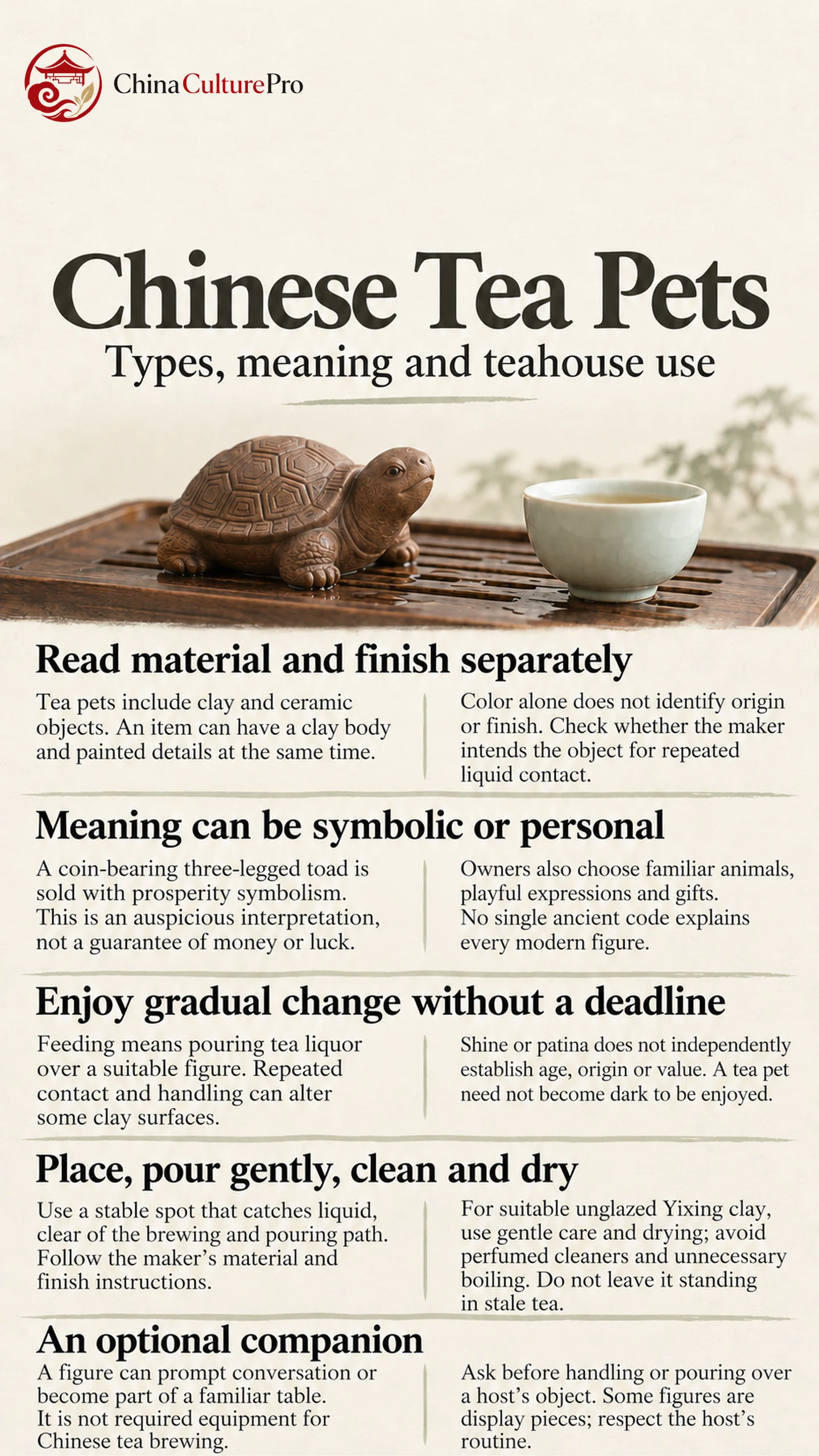
A Chinese tea pet (茶宠, cháchǒng) is a small figure that may sit beside the brewing vessels. Some drinkers pour tea over it and enjoy its changing surface; others simply like the company of an animal or symbolic object on the table.
Materials and Finishes Change How a Tea Pet Is Used
Zisha (紫砂, zǐshā) refers to the clay tradition associated with Yixing. Its historical record concerns a local ceramic tradition; that does not date every modern tea-pet design or prove that every brown figurine comes from Yixing.[2] The related tradition of Yixing teapots has its own forms and making methods.
Read the material and the finish separately. A figure may be unglazed clay, glazed ceramic or a clay object with painted details. One documented tortoise, for example, is described as both Yixing clay and hand-painted. A clay body can have a painted finish; the material name does not establish a bare surface.[4]
Check the maker’s intended use and care instructions before pouring hot liquid over a coated or decorative item. Color alone cannot identify clay, firing or finish. A figurine intended for display should not be assumed to have the same use conditions as a cup.
Animals, Auspicious Figures and Personal Meaning
A coin-bearing three-legged toad is a concrete example of prosperity symbolism. One original object description connects the figure with wealth and a traditional toad story. Read that as an auspicious interpretation and a story, rather than evidence that the object produces money or that its modern design can be dated to the tale.[5]
Other tea pets are chosen for less elaborate reasons: a familiar animal, a zodiac connection, an appealing expression or a gift from a friend. Modern catalogs include playful dogs, whales and piglets alongside mythical creatures. Their meanings need not come from one ancient symbolic code.[1]
Human or religious figures also deserve identification on their own terms. Do not assume every smiling figure represents the same person, or that one placement rule applies to every owner and setting. Ask the host about the particular object if its meaning is unclear.
What Feeding a Tea Pet Actually Means
Feeding a tea pet means pouring tea liquor over the figure. On suitable unglazed clay, repeated handling and tea contact can gradually alter the surface’s appearance and feel. A maker’s tortoise description presents a possible shiny patina as a change over time, not an instant result.[4]
A visible change is not an age certificate or evidence of improved monetary value. Nor must the figure become dark to have fulfilled its purpose. Some owners prefer a clean-looking object and others enjoy gradual changes. Display, handling and pouring are choices, rather than a test of whether someone drinks tea correctly.
How to Use and Care for a Tea Pet
- Place it securely: Choose a stable part of a draining tray or a surface that can catch liquid. Keep the figure clear of the pouring path and away from the rim of a hot vessel.
- Use liquid only when appropriate: Follow the maker’s instructions for the material and finish. If it is intended for tea contact, a small gentle pour is enough to include it in the session; do not force a painted ornament into the same routine.
- Rinse and dry after the session: Remove leftover liquid, clean gently as appropriate for the object and let it dry. For suitable unglazed Yixing clay, avoid perfumed cleaners and unnecessary boiling. Do not leave a figure standing in stale tea to accelerate its appearance.
The clay-care principles follow guidance for related Yixing ware: gentle rinsing and drying are more useful than elaborate boiling rituals. A painted or glazed object still needs its own maker’s care directions.[3]
Tea Pets at Home and in a Teahouse
A tea pet can become a conversation point, a small gift or a familiar part of a regular table. It is one possible feature of Chinese tea practice, which includes many ways of hosting and brewing. It does not turn every session into a fixed ceremony.
In a shared setting, ask before handling the host’s figure or pouring over it. Some objects are display pieces, and the host may prefer to manage the tray. The gaiwan brews tea; the figure accompanies the occasion. In teahouses, conversation, service and the tea itself remain central whether a tea pet is present or absent.
FAQs About Chinese Tea Pets
Do I need a tea pet for Chinese tea brewing?
No. It is an optional companion for the table, rather than equipment needed to make or serve the drink.
Are all tea pets made from Yixing clay?
No. Tea pets include different clay and ceramic objects, with bare, glazed or painted surfaces. Check the actual material and finish instead of inferring them from color.
Must I use only one type of tea?
Some owners prefer one tea as part of their personal routine. That preference is not a universal rule for all materials or a requirement for enjoying the object.
Does a shiny tea pet prove that it is old?
No. Surface appearance can change through use and handling, and does not independently establish age, origin or value. Provenance requires evidence beyond patina.
Fuentes
[1] Teasenz, original tea-pet catalog. Traditional Chinese Tea Pet Store
[2] China Intangible Cultural Heritage Network (Red del Patrimonio Cultural Inmaterial de China). 宜兴紫砂陶制作技艺
[3] Mud and Leaves, original clay-care guidance. Don’t Boil that Teapot!
[4] Teasenz, original object description. Ceramic Turtle Tea Pet
[5] Teasenz, original object description. Lucky Frog Tea Pet