


Quick Answer: What Is a Chinese Tangram?
A Chinese tangram, or qiqiaoban (七巧板, qīqiǎobǎn), is a flat seven-piece dissection puzzle. Its pieces fit into a square and can be rearranged to match silhouettes of animals, people, objects and geometric figures.
- The classic set contains five triangles, one square and one parallelogram.
- A conventional silhouette puzzle uses all seven pieces without overlap.
- Pieces may slide, rotate and turn over; the parallelogram’s reversed orientation is especially important.
- The familiar puzzle is documented in the early nineteenth century; older geometric traditions are background, not a secure invention date.
A tangram is usually a shape-making challenge rather than a contest with a single scoring system. Classroom exercises using fewer pieces are useful variations, provided their different task is clear.
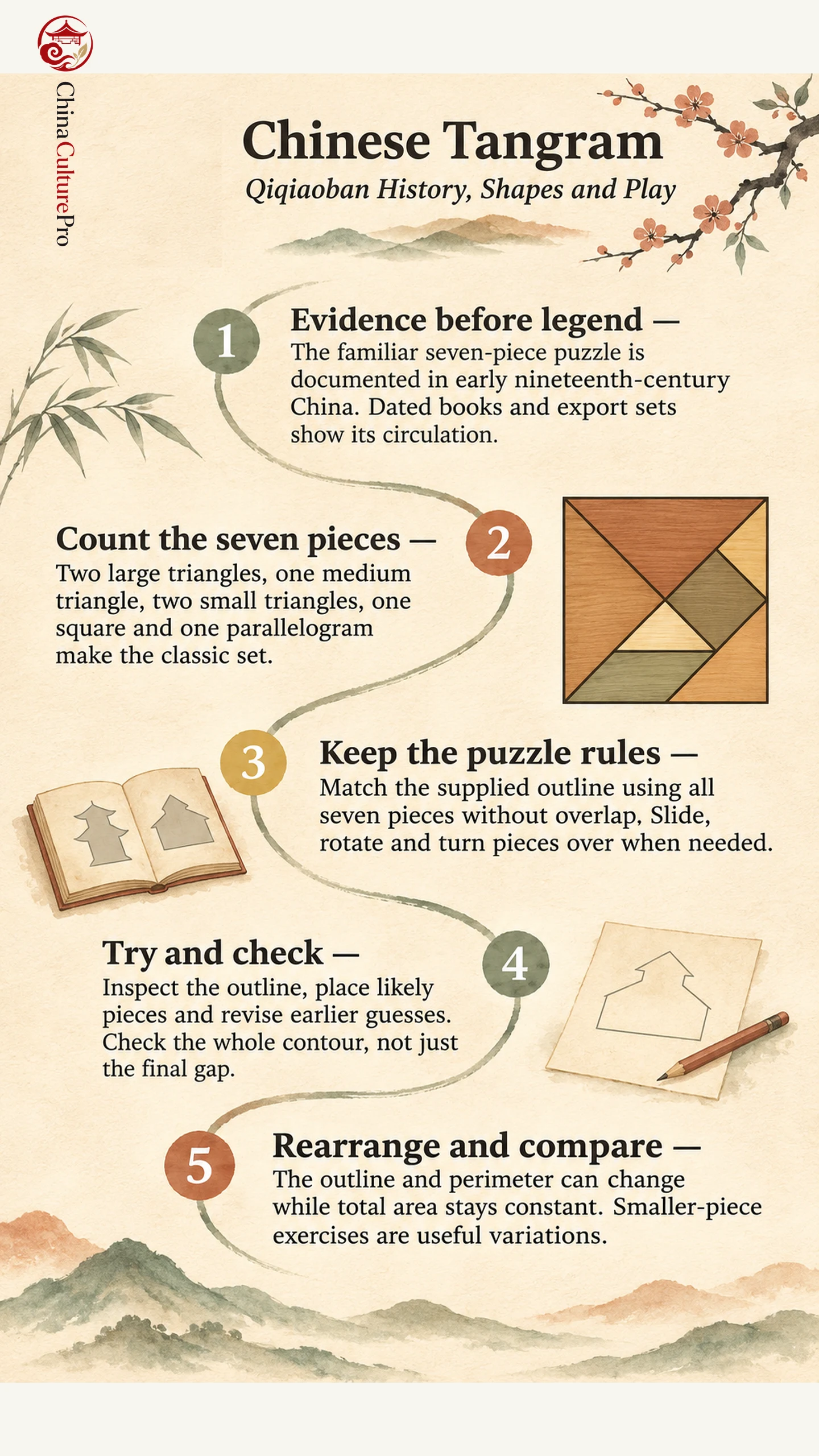
The appeal lies in a small fixed set producing very different outlines. Within traditional Chinese games, tangram belongs to the world of rearrangement puzzles: the pieces remain intact while their relationships change.
What the Historical Evidence Shows
Chinese mathematical dissection and arrangements of furniture provide an older context for the puzzle. They do not establish that today’s exact seven-piece set existed throughout that history. The present form is securely documented in early nineteenth-century China; its precise inventor remains uncertain.[1]
A surviving ivory set associated with the Canton trade has a box inscription dated April 4, 1802. A Chinese collection of tangram diagrams was published in 1813. These are useful dated witnesses, not proof that the puzzle was invented in either year. Books and export sets helped carry the pastime abroad, with publications spreading across Europe and America in 1817–1818.[2]
Printed puzzles also preserve how people played. An 1816 book, Qi qiao chu bian he bi, survives in the Library of Congress’s Chinese rare-book collection. A separate, undated volume in the Smithsonian contains 96 pages of woodblock prints on mulberry paper and entered the collection through a 1919 donation. The donation dates its collection history, not the printing of the undated book.[3][4]
Those objects make the history more tangible than a broken-tile origin story. They connect a Chinese pastime to printing, collecting and overseas exchange, while leaving room for uncertainty about its beginnings.
The Seven Pieces and Their Proportions
Count pieces, not just shape names. The five triangles come in three sizes, and every triangle is right-angled with two equal legs. A correct set needs both large triangles and both small ones; an equilateral triangle does not belong in the classic set.[2][5]
| Piece class | Quantity | Area of each piece relative to the whole square |
|---|---|---|
| Large right isosceles triangle | 2 | One quarter. |
| Medium right isosceles triangle | 1 | One eighth. |
| Small right isosceles triangle | 2 | One sixteenth. |
| Square | 1 | One eighth. |
| Parallelogram | 1 | One eighth. |
The pieces’ areas add to one complete square. You can treat a small triangle as one area unit: each large triangle has four units, and the medium triangle, square and parallelogram each have two. The whole set contains sixteen such units.[5]
These proportions matter more than colour. Different sets use different colours, and a monochrome silhouette normally hides the internal boundaries. Do not assume that a yellow or red region in one book identifies the same piece in another.
Rules for Making a Tangram Figure
For the standard outline challenge, use all seven pieces flat on the same surface, without overlap, to reproduce the target. The outer contour must match; simply making something recognizable as “a bird” is not enough when a particular bird silhouette is supplied.[1][2]
Translation means sliding a piece, rotation means turning it in the plane, and reflection means turning it over. Tangram learning activities use these transformations to explore how shapes fit together.[6] For the classic parallelogram, reflection changes its handedness: rotating alone cannot always put it into the required orientation. The square and right isosceles triangles can match their own reflected shapes by rotation.
If a physical set has a printed design on only one face, check whether the activity permits the blank face upwards. A product’s decorative restriction can make a standard silhouette impossible even when the geometry is correct. Do not bend or trim a piece to force a fit.
How to Approach Your First Outline
Start with a printed outline or a digital target whose solution uses a standard seven-piece set. A target showing the internal piece boundaries is a gentler first task than an unmarked silhouette; interactive exercises can also let you arrange pieces directly over the picture.[7]
- Check the set and target. Count all seven pieces and confirm that the physical outline is printed at the same scale as your set, or work beside it by comparing proportions.
- Inspect distinctive boundaries. Look for long straight edges, sharp corners and obvious triangular regions; try the large triangles where the outline gives them enough space.
- Adjust the remaining pieces. Slide and rotate them, and turn over the parallelogram when needed. If a piece will not fit, revisit an earlier placement rather than forcing the last gap.
- Verify the complete figure. Check that all seven pieces are used once, nothing overlaps and the contour matches the target, including any deliberately shown holes or separations.
This method organizes trial and error; it does not guarantee that the first large-triangle placement is right. Photograph or sketch a promising arrangement before dismantling it so you can compare alternatives.
What Rearranging the Pieces Reveals
A useful warm-up uses only the two small triangles. Join their longest sides, putting the triangles on opposite sides of that shared edge. The result is a square with the same area as the set’s square piece. This is a subset exercise, not a completed seven-piece silhouette. Such explorations of smaller squares are part of established tangram teaching activities.[8]
Area stays constant when pieces are rearranged. In an example set cut from a square with 16-centimetre sides, the total area is 256 square centimetres. Each small triangle has area 16; the square, medium triangle and parallelogram each have area 32; each large triangle has area 64. A new outline can change the contour and perimeter, but not that total area.[5][9]
That gives a practical diagnostic: an unexplained gap in a supposedly solid target means something about placement, scale or the supplied pattern needs checking. For another kind of spatial problem, Luban puzzle locks move the challenge into interlocking three-dimensional parts. Tangrams also sit alongside other traditional Chinese toys used for hands-on play.
FAQs About Chinese Tangram
Can you flip a tangram piece?
Yes, in the standard geometric puzzle. Turning over the parallelogram can be essential; a one-sided decorative set may impose an additional restriction.
Must every tangram use all seven pieces?
A conventional full-set silhouette does. An exercise asking for a square from two pieces has a different stated goal and can legitimately use a subset.
Why does my finished figure have a gap?
Check the scale, piece inventory and earlier placements. An unmarked gap in a solid silhouette is not a solution, but a hole intentionally included in the target may be correct.
Is tangram only a children’s toy?
No. It is accessible to children, but adults can tackle difficult silhouettes and mathematical questions. The challenge depends on the target and the information it reveals.[1]
Fuentes
[1] ETH Library. Tangram
[2] ChinesePuzzles.org. Tangram Puzzle
[3] Lora Taylor. Craft, Create, Calculate: Bring Geometry to Life with the Tangram
[4] Smithsonian National Anthropological Archives. Guide to MS 7177 Book of Tangrams or Puzzle Designs
[5] Mathigon. Polypad Teacher Guide
[6] University of Cambridge NRICH. World of Tan 1: Granma T
[7] University of Cambridge NRICH. Tangram Browser
[8] University of Cambridge NRICH. Tangrams
[9] University of Cambridge NRICH. Tangram Area