
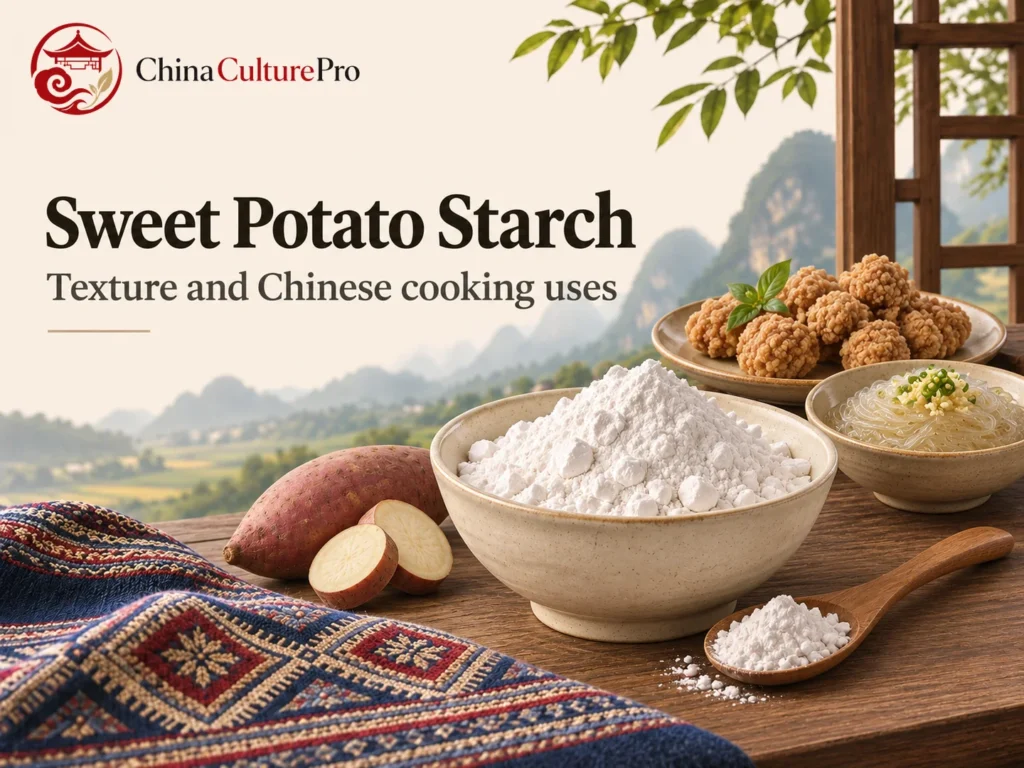

Quick Answer: What Is Sweet Potato Starch?
Sweet potato starch(红薯淀粉,hóngshǔ diànfěn)is starch separated from sweet potato roots. It is a cooking ingredient distinct from flour made by drying and grinding the root itself. Chinese foods use it for texture in coatings, batters and formed noodles. [1][2][4][5][6]
- Source: Check that the actual ingredient is sweet potato starch, not another root starch sold under a familiar market name. [3]
- Form: Some cooking preparations call for a visibly coarse product. [4]
- Function: A coating can become crisp, while a hydrated cooked batter or noodle has a different texture. [4][5][6]
- Identity: A packet of starch is not a packet of finished noodles. [6]
The recipe’s job matters: an ingredient chosen for a crisp exterior is being used differently from starch that forms the body of a noodle.

A rough coating on fried chicken and a translucent layer in an oyster omelet can both involve sweet potato starch. Their textures differ because the starch plays different roles. Before choosing a packet, separate three things: the plant source, the product’s physical form and the food it will become.
Extracted Starch Is Not Whole Sweet Potato Flour
Whole sweet potato flour is commonly made by drying root pieces and grinding them. Starch production separates a starch-rich fraction through processing that includes wet grinding, filtration and washing. These are different ingredients even when an English label uses “flour” loosely. [1][2]
That distinction also separates starch from a cooked or mashed root. Adding a purple sweet potato to a food is not the same ingredient choice as adding extracted starch. Look for the ingredient declaration rather than assuming that all powders named after a root contain the same material. [1]
Starch is selected here mainly for structure. The crispness of a coating or the body of a noodle is a more useful guide to its role than expecting it to reproduce the taste of a roasted sweet potato. [4][6]
Diguafen Labels and Coarse Granules
Diguafen(地瓜粉,dìguāfěn)is a name encountered when shopping for this type of ingredient. It needs a second check: one Taiwanese supplier explicitly describes a coarse tapioca-starch product as commonly called diguafen, while identifying its raw material as cassava root. The familiar market name alone therefore does not establish sweet potato as the source. [3]
Physical appearance is a separate question. A coarse starch called for in a fried-chicken preparation is chosen to produce a textured coating. The size of the visible pieces in the packet does not, by itself, identify the root used to make it. [3][4]
Read the label for the actual starch and inspect the form requested by the recipe. Neither “coarse” nor an informal root-based name is enough to settle both points. This is a practical buying distinction, not a reason to rank every root starch as better or worse. [3]
Three Different Jobs in Chinese Cooking
Different preparations make different use of the starch. These three jobs explain why one ingredient can appear in foods that do not feel alike. [4][5][6]
| Culinary job | What the starch does in the food |
|---|---|
| Dry coating | A coarse coating contributes a crisp, textured exterior to a fried food. |
| Wet batter | Starch mixed with liquid forms part of a cooked layer surrounding other ingredients. |
| Formed noodles | Processed starch becomes the noodle itself, rather than coating another food. |
Taiwanese popcorn chicken(盐酥鸡,yánsūjī)illustrates the first job. A documented preparation coats small marinated chicken pieces with a coarser sweet potato starch before frying. The coating supplies the crisp exterior, while the chicken and marinade contribute their own flavors. [4]
Taiwanese oyster omelet(蚵仔煎,é zǐ jiān in Mandarin)shows another approach. One version combines sweet potato starch with tapioca and water, then cooks that batter with oysters, egg and greens until the starch layer becomes translucent. The mixture belongs to that version, not a formula that every Taiwanese oyster omelet must follow. [5][7]
In starch noodles, including products described as fentiao(粉条,fěntiáo), the starch is processed into strands. A technical account of Sichuan sweet potato processing documents a route involving refined starch, forming and cooking, followed by cooling and drying. The packet sold as noodles has already undergone manufacturing that a bag of loose starch has not. [6]
For eating and shopping, this distinction is more useful than grouping every translucent noodle together. A comparison of mung-bean and sweet-potato noodles addresses the finished noodle ingredients, while this page concerns the starch used to make or coat food. [6]
Substitutions and Choosing the Right Packet
Start with the role. If a preparation depends on a coarse coating, a finely powdered substitute may change that exterior. If a batter depends on a particular starch mixture, replacing one component changes the mixture. A noodle-making ingredient needs to form the food’s structure. These are different substitution questions. [4][5][6]
Plant identity still matters. Sweet potato starch and potato starch are separately named ingredients. Likewise, cornstarch should not be assumed to reproduce the coarse coating described above simply because both products look pale in a bowl. [4]
Use the packet’s ingredients and preparation directions together with the recipe. Confirm whether you are buying starch, whole-root flour, a mixed coating product or finished noodles. Use the translated name to locate the product, then confirm its ingredient and intended preparation before substituting. [1][3][6]
In the completed meal, inspect the other ingredients too. The chicken preparation includes a marinade, while the oyster omelet contains oysters and egg. Identifying the starch alone does not identify everything in the finished dish. [4][5]
FAQs About Chinese Sweet Potato Starch
Is Diguafen Always Made from Sweet Potato?
No. A supplier may use that common name for coarse tapioca starch made from cassava. Read the stated starch ingredient to establish the plant source. [3]
Will Sweet Potato Starch Make Food Taste Like Sweet Potato?
Do not treat it as a substitute for cooked or mashed root. It is a separated starch, and the cooking uses described here depend mainly on the texture it provides. [1][4][6]
Is a Bag of Starch the Same as Sweet Potato Noodles?
No. Noodles are a formed food that has undergone further processing. Loose starch is an ingredient; it cannot simply be soaked as though it were a packet of dried strands. [6]
Fuentes
[1] COLEAD. Sweet Potato flour and starch, puree, and gari: market profile (2023), processing comparison
[2] P Vithu and colleagues. Optimization of starch isolation process for sweet potato and characterization of the prepared starch (2020)
[3] Chiun Fu. Coarse tapioca starch: original product description
[4] Judy Leung. Taiwanese Fried Chicken: original preparation
[5] Yu Tsai, Street to Kitchen Asia. Taiwanese Oyster Omelet: original televised preparation
[6] He-ning Liu, Sichuan Research and Design Institute of Agricultural Machinery. Post-harvest Processing Technology of Sweet Potatoes in Sichuan, China
[7] Taiwan Ministry of Education. Revised Mandarin Dictionary: oyster omelet