

Quick Answer: Is Human Nature Good or Bad in Confucian Thought?
Classical Confucian thinkers did not give one answer about human nature (性, xìng). Their differences concern what is present from birth, what counts as moral goodness and how people develop through learning.[1][2][3]
- Confucius (孔子, Kǒngzǐ): The Analects (论语, Lúnyǔ) connects relative closeness in nature with divergence through practice, without presenting the later debate in full.
- Mencius (孟子, Mèngzǐ): Humans have beginnings directed toward moral goodness; these need cultivation.
- Xunzi (荀子, Xúnzǐ): Untrained natural tendencies lead toward disorder, while learned effort makes good conduct possible.
- Shared concern: Education and formation matter; neither good nature nor bad nature means a person’s conduct is already settled.
These are three influential Confucian approaches, not an exhaustive account of every Chinese philosophical view.[2][3]

Why do people act badly if they can become good? Confucius, Mencius and Xunzi approach that question from different starting points. Their disagreement becomes clearer when nature, moral development and learned conduct are kept distinct.
What Counts as Human Nature?
Before deciding whether nature is good or bad, ask what a thinker includes within it. An initial tendency that can develop toward goodness is different from a fully formed moral character. An unlearned desire is different again from a practiced response to that desire.[2][3]
| Término | Working definition |
|---|---|
| Xing (性, xìng) | Nature: the inborn constitution, capacities or tendencies being discussed, with meanings that differ between thinkers. |
| Xingshan (性善, xìngshàn) | The Mencian claim that human nature has beginnings directed toward moral goodness. |
| Xing e (性恶, xìng’è) | The Xunzian claim that untrained natural tendencies lead toward harmful disorder. |
| Deliberate activity (偽, wěi) | Learned, purposeful effort that develops acquired abilities and moral conduct. |
The table offers an entry into the arguments rather than a complete dictionary. In particular, the English word “evil” can suggest ideas that are not intended by Xunzi’s account.[3]
The debate belongs within Confucianism, mientras que Chinese philosophy includes other traditions and questions. It is a mistake to turn one disagreement among Confucians into a single national belief about humanity.
Confucius: Shared Starting Points, Diverging Practice
Analects 17.2 presents people’s natures as close to one another and their practices as a source of divergence. This short remark draws attention to the importance of formation, but does not itself declare the full Mencian doctrine that nature is good.[1]
The Analects (论语, Lúnyǔ) contains many teachings about learning and conduct. It does not offer the same sustained argument about moral beginnings or the nature–effort distinction found in the later texts. Readers should resist filling that gap by assigning a successor’s theory to the earlier teacher.
Nor does “close” necessarily mean that all individuals are identical in every capacity. The immediate point is more limited: practice matters to how people come to differ.
The guide to Confucius supplies the broader ethical setting, and the Analects reading guide explains why short sayings need their textual context.
Mencius: Moral Beginnings That Need Cultivation
Mencius argues for more than a general ability to learn whatever a community teaches. He identifies incipient responses already directed toward moral goods. A beginning is not complete virtue, but it is not morally directionless either.[2]
His well-known example in 2A6 concerns suddenly seeing a child about to fall into a well. Alarm and concern arise before calculations about praise, reputation or favor from the parents. The example supports his claim that concern for others has a basis within people, rather than being merely a strategic performance.[4]
The four beginnings (四端, sìduān) connect compassion, shame at wrongdoing, deference and moral discernment with virtues that require development. Having a beginning does not establish that one will respond wisely or consistently in every later situation.[4]
This is why the image of growth matters. Cultivation nourishes an existing direction rather than manufacturing it from something wholly indifferent to goodness. Yet growth also needs suitable conditions and effort; the claim is not that neglect produces virtue automatically.[2]
The full guide to Mencius develops those examples and their political implications. Here, the crucial distinction is between a moral tendency and a completed moral life.
Xunzi: Goodness Through Deliberate Activity
Xunzi separates what is present without learning from what people acquire through purposeful effort. In chapter 23, desires for advantage, pleasing sights and sounds, comfort and satisfaction are not themselves a dependable guide to shared ethical life. Left unchecked, their pursuit leads to conflict.[5]
The second half of the argument is essential: goodness is achievable through deliberate activity. The written term 偽, simplified as 伪, should not here be read as a recommendation to deceive. It concerns acquired activity, habits and achievements, rather than goodness arising spontaneously from untrained desires.[3]
Teachers and ritual provide models for that transformation. Li (礼, lǐ), ritual propriety, and yi (义, yì), rightness, are learned and practiced; they are not simply ready-made moral principles contained within the original nature.[5]
Education accordingly does more than supply information. Practice can change what a learner notices, values and enjoys. A teacher should embody the conduct being taught, not merely recite statements about it.[6]
This account does not say that people enjoy wrongdoing for its own sake or can never improve. It places strong confidence in the possibility of transformation while recognizing that people may fail to undertake it.[3][6]
For the wider ethical vocabulary, see ren, li and yi. Xunzi’s commitment to formation belongs to a Confucian project, even where he disputes Mencius sharply.
Different Models of Growth, Shared Need for Learning
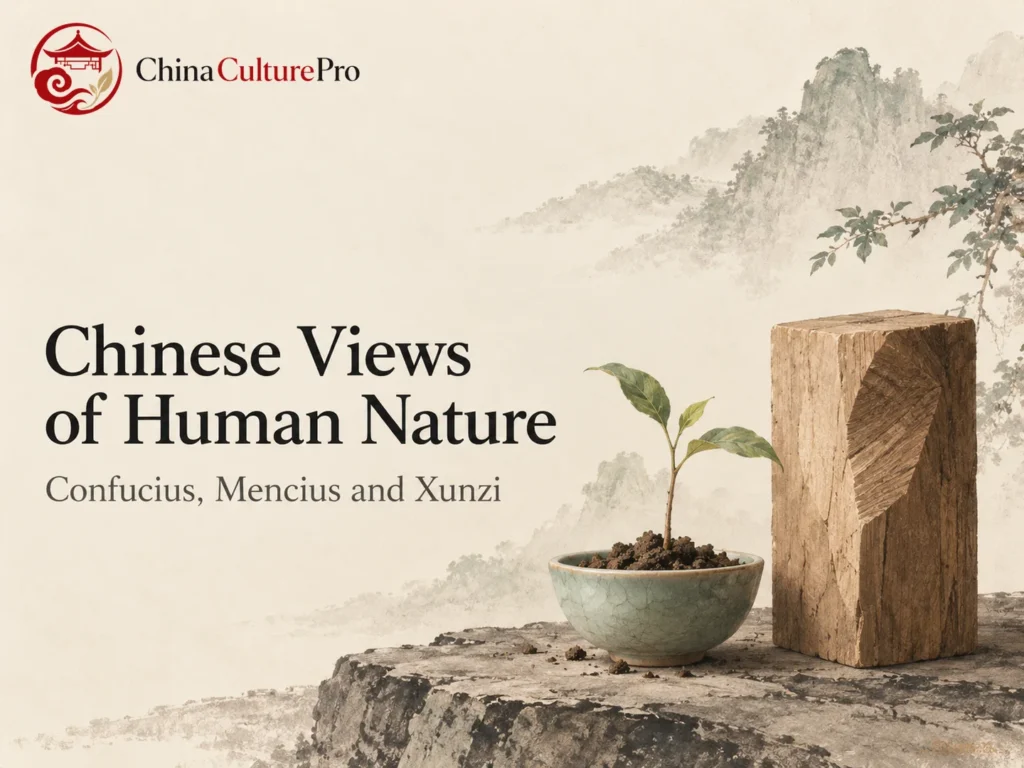
Two familiar images clarify the contrast. Mencian cultivation resembles supporting a sprout’s growth. Xunzian formation is compared with working material, such as straightening wood or shaping clay into a useful form.[2][6]
| Pregunta | Mencian emphasis | Xunzian emphasis |
|---|---|---|
| What does the starting point contain? | Incipient tendencies directed toward moral goodness. | Inborn capacities and desires, without already learned moral standards. |
| What does cultivation accomplish? | Develops and extends moral beginnings. | Forms cultivated dispositions through deliberate learning and practice. |
| Why can people act badly? | Beginnings can be neglected or fail to develop properly. | Unregulated desires and inadequate formation produce disorder. |
Different definitions of nature explain part of the disagreement, but do not make it disappear. The question whether people have an innate direction toward moral concern remains substantive. Both positions can allow learning while disagreeing about what learning develops.[2][3]
Xunzi’s learner exercises agency and effort; the material metaphor should not make the learner seem passive. Likewise, a sprout does not imply that a person becomes good by leaving every impulse untouched.
A Short Reading Route Through the Debate
The following passages are useful reference points rather than a required sequence:
- Analects 17.2: Compare closeness in nature with divergence through practice.
- Mencius 2A6: Examine the child-at-the-well argument for moral beginnings.
- Xunzi chapter 23: Read the distinction between nature and deliberate activity.
These references make it possible to compare the actual arguments rather than only their labels.[1][4][5]
For each passage, ask what “nature” includes and what must happen for good conduct to become dependable. That comparison reveals why the choice is more complex than optimism versus pessimism.
Later Neo-Confucian interpretations gave Mencius a particularly influential place, but later authority does not settle the philosophical argument by itself.[2]
These texts offer accounts of moral formation. They are not substitutes for modern empirical research, and this comparison does not claim that one ancient slogan has scientifically proved how every human being behaves.
FAQs About Chinese Views of Human Nature
Did Confucius say human nature is good?
Analects 17.2 says that natures are close and practices produce divergence. It does not itself state the developed Mencian argument for good nature. Later interpretations should be distinguished from that earlier wording.
Did Mencius think people are born morally perfect?
No. His account concerns beginnings directed toward goodness, which need development. Possessing them is different from consistently expressing mature virtues.
Did Xunzi think people could never become good?
No. Deliberate effort, teaching and practice make moral transformation possible. Omitting that part reverses the practical purpose of his account.
Was the disagreement only about the meaning of nature?
Different uses of the term matter, but a real ethical disagreement remains over innate moral direction and the role of cultivated standards. Shared commitment to education does not make their views identical.
Fuentes
[1] James Legge, translator. The Analects, Books 16–20
[2] Bryan Van Norden. Mencius
[3] Paul R. Goldin. Xunzi
[4] Asia for Educators. Selections from the Mencius: On Human Nature
[5] Asia for Educators. Selection from the Xunzi: Human Nature Is Evil
[6] David Elstein. Xunzi