

Quick Answer: What Was Chinese Legalism?
Chinese Legalism (法家, fǎjiā) is a later label for related approaches to strengthening government through standards, incentives and control of officials. It became influential during the competitive Warring States (战国, Zhànguó) era.[1]
- Main problem: How can a ruler obtain reliable service without depending on exceptional personal virtue?
- Ordinary conduct: Rewards and penalties direct people toward activities valued by the state.
- Administration: Defined duties and scrutiny of performance address the risk of self-serving officials.
- Political authority: The ruler’s position supplies power that personal talent alone cannot provide.
- Historical influence: These arguments helped shape Qin statecraft, while administrative practices outlasted the tradition’s declining reputation.
The label describes a diverse ancient political tradition. It does not identify one organized movement or a modern constitutional system.[1]
A government can announce strict rules and still fail if officials conceal information or turn public office into private power. The writings grouped under Chinese Legalism address that problem as well as the conduct of ordinary people.
Why the Name Legalism Needs Explaining
The word sounds as though the tradition concerned only courts and criminal codes. Its scope was wider: organizing work, allocating rewards, staffing offices and keeping ministers answerable to a sovereign. The category was developed retrospectively in early imperial classification, rather than adopted by all the thinkers it now includes.[1]
That distinction matters when reading a disagreement. Two writers can share an interest in strong government while offering different accounts of how it should work. Their differences need not be exceptions to an otherwise fixed party platform.
In the broader landscape of Chinese philosophy, these arguments belong to debates over political order. Confucianism emphasized moral formation and appropriate relationships; Mohism developed its own standards of beneficial conduct and government. Reading the alternatives makes the dispute over dependable political order clearer.
Four Thinkers and the Texts That Survive
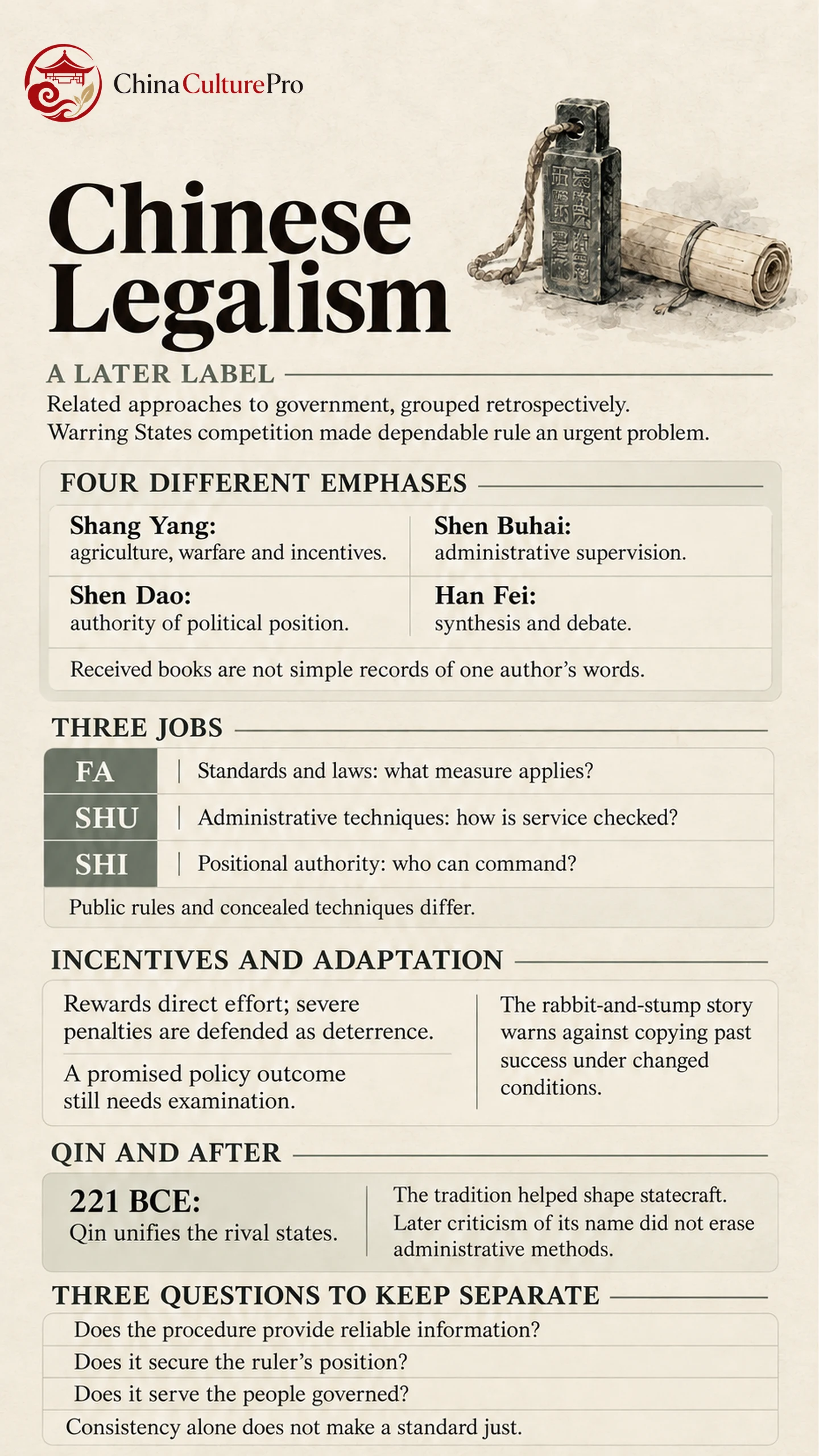
The following four figures are commonly grouped together, but each name points toward a different emphasis.[1]
| Thinker | Main contribution associated with the figure |
|---|---|
| Shang Yang (商鞅, Shāng Yāng; died 338 BCE) | Qin reformer associated with agriculture, warfare, rewards and punishments. |
| Shen Buhai (申不害, Shēn Bùhài; died 337 BCE) | Administrator associated with supervising officials and their responsibilities. |
| Shen Dao (慎到, Shèn Dào; fourth century BCE) | Thinker associated with authority arising from the ruler’s position. |
| Han Fei (韩非, Hán Fēi; died 233 BCE) | Thinker whose received text synthesizes and debates earlier approaches. |
The Book of Lord Shang (商君书, Shāngjūnshū) is associated with Shang Yang and his followers. Compiled across the fourth and third centuries BCE, it makes a forceful case for concentrating resources and human effort on state-building. Attribution to a named master should not be treated as proof that he personally wrote every chapter.[2]
The Han Feizi (韩非子, Hán Fēizǐ) survives in 55 chapters. Its relationship to Han Fei’s own writing remains a subject of scholarship. Shen Buhai’s and Shen Dao’s writings survive much less completely, which also makes the evidence uneven.[1]
This is one reason to distinguish a thinker’s traditional reputation from an argument in a particular passage. A surviving anthology can preserve several emphases even when its title names one person.
Fa, Shu and Shi: Three Different Jobs
These concepts explain why severe punishment alone is an incomplete summary of the tradition.[1][3]
| Concepto | Working meaning | Question it addresses |
|---|---|---|
| Fa (法, fǎ) | Standards, laws and models used to regulate conduct and administration. | What rule or measure should apply? |
| Shu (术, shù) | Administrative techniques for assigning duties and monitoring officials. | How can service and performance be checked? |
| Shi (势, shì) | Authority derived from political position rather than personal excellence alone. | Why can the officeholder command compliance? |
Han Feizi distinguishes clear public standards from techniques the ruler keeps concealed to prevent ministers from manipulating his assessment.[1]
A rule, a method of supervision and the authority to enforce a decision do different work. Imagine, as an explanatory example, an official responsible for a grain store. A standard can specify what must be recorded; a checking procedure can compare a report with the store; authority can empower someone to demand the account. Announcing the standard does not itself establish that the report is true.
The distinction also raises a difficult question: who checks the checker? Following the ruler’s chain of command is not equivalent to an independent public safeguard against misuse of power.
Rewards, Punishments and Changing Circumstances
In “Making Orders Strict,” the Book of Lord Shang argues that heavy penalties for minor offenses can prevent more serious wrongdoing. The logic is deterrence through severity. The same program channels effort toward farming and military service through public incentives.[4]
Describing this reasoning does not establish that its promised results follow. A policy’s stated aim, its means and its effects need separate examination. One can ask whether a punishment is proportionate even if its defender claims it will eventually reduce punishment overall.
Han Feizi chapter 49, “The Five Vermin,” presents a different problem. A state cannot fill all its offices by waiting for rare people of perfect integrity. The proposed answer is a dependable system rather than hope that every appointee will be exceptionally good.[5]
The chapter also tells of a farmer who obtains a rabbit when it accidentally strikes a stump. He abandons farming to wait for another such accident. The story attacks the expectation that copying an earlier success will work under changed conditions.[5]
Read together, these arguments reveal two tasks: make conduct predictable through institutions, but choose institutions appropriate to the circumstances. Predictability is not the same thing as preserving every inherited practice.
Qin and the Later Imperial Legacy
Shang Yang’s reforms helped strengthen Qin before it unified the rival states in 221 BCE. The Book of Lord Shang presents agricultural production and military capacity as foundations for a powerful, unifying state.[4][2]
That connection should not turn a broad historical transformation into the achievement of one book. A political text advocates a program; the history of an expanding state involves implementation, resources, leadership and conflict. Likewise, a dynasty’s eventual collapse cannot by itself demonstrate that every institutional idea associated with it was abandoned.
Under the succeeding Han dynasty, the tradition’s prestige declined, yet elements of its administrative thinking continued in imperial government.[1]
The useful distinction is between the tradition’s public reputation and the practices available to officials. Criticizing a name does not necessarily remove the procedures associated with it.
Order, Power and the Costs of the Program
The appeal of uniform standards is easy to recognize: the same act should not receive a different reward merely because a ruler likes one person better. But consistency leaves another question unanswered: is the standard itself defensible?
The primary excerpts make that tension concrete. State strength can be placed ahead of activities and loyalties that other thinkers value, while punishment becomes an instrument for securing obedience.[5][4]
When reading, keep three questions separate: does a procedure produce reliable information, does it protect the ruler, and does it serve the people subject to it? Success at one task does not settle the others. This distinction helps explain both the program’s administrative ambition and the objections it provokes.
FAQs About Chinese Legalism
Was Legalism a single organized school?
No. The category grouped related writings retrospectively. The thinkers shared important political concerns without all belonging to one self-declared organization.
Did Legalists believe everyone was evil?
Many arguments assume that people pursue advantage and that government should work with predictable incentives. That political assumption is different from a single, universally shared theory of moral evil. The broader debate about human nature includes other accounts of motives and cultivation.
Was Legalism the same as modern rule of law?
No. Public standards and consistent administration do not by themselves establish constitutional limits, independent courts or equal political rights. These ancient programs principally addressed the order and security of a ruler’s state.
Did Legalist ideas disappear after Qin?
No. Their reputation and explicit intellectual standing declined, but administrative methods and arguments about controlling officeholders continued to matter in later imperial government.
Fuentes
[1] Yuri Pines. Legalism in Chinese Philosophy
[2] Columbia University Press. The Book of Lord Shang, translated by Yuri Pines
[3] Russell Kirkland. Legalism
[4] Asia for Educators. Selection from the Book of Lord Shang: “Making Orders Strict”
[5] Asia for Educators. Selections from the Han Feizi: Chapter 49, “The Five Vermin”