
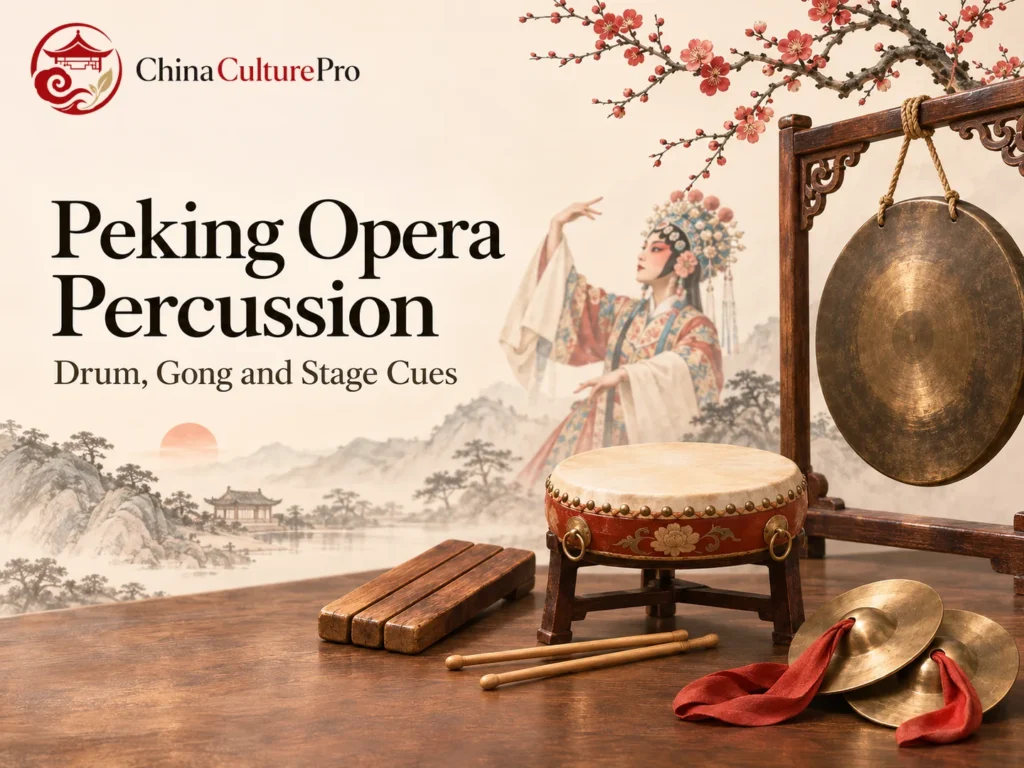

Quick Answer: What Does Peking Opera Percussion Do?
In Peking opera, the percussion section (武场, wǔchǎng) marks beats, cues entrances and punctuates movement. A drummer leads with a small drum, a clapper and sometimes hand gestures. Named percussion patterns called luogujing (锣鼓经, luógǔjīng) can be represented by syllables that correspond to sounds or combinations of instruments.[1][2][3][4]
- Drum and clapper: Short sounds help mark the moment of a cue.[1][2]
- Gongs and cymbals: Their ringing or crashing tones can emphasize an action.[1][3]
- Patterns: Different cues help shape movement, speech and singing.[1][3][4]
You can often hear a cue most clearly by watching what changes onstage as it sounds.[3][5]
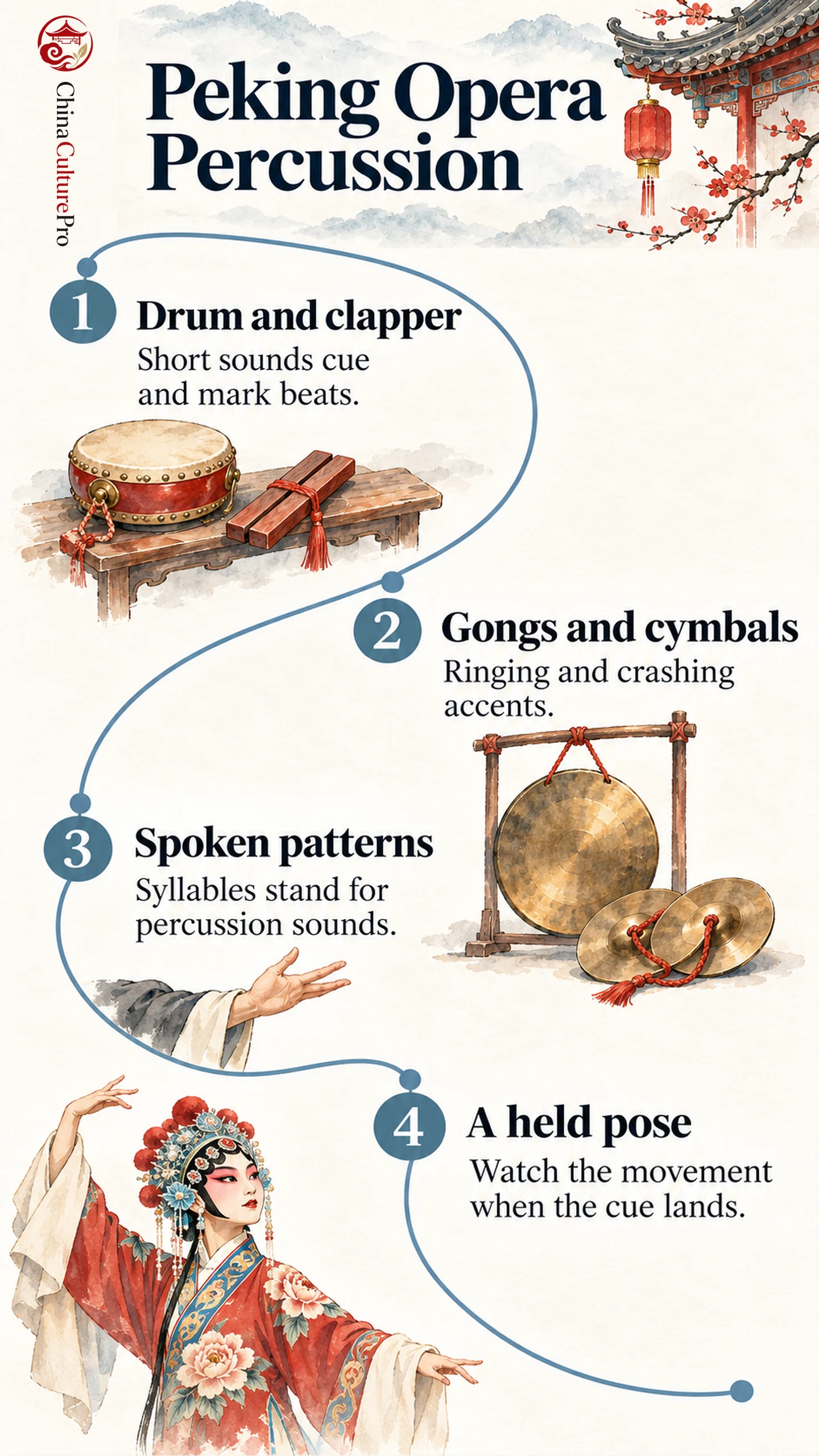
A performer can pause with one hand lifted while a gong continues to ring. In that moment, the sound and the position of the body form a single stage event. During a song, a much shorter clapper sound can mark a beat under a sustained voice.[1][3][5]
Which Instruments Make the Main Sounds?
The Palace Museum names the drum and clapper, large gong, cymbals and small gong as central to the section. The China National Peking Opera Company describes how players sound and damp the instruments.[1][2]
- Drum: The bangu has a dry tap that can cue the group or turn into a roll.[1]
- Clapper: The same player handles the paiban, using a short wooden click to mark time during singing.[1][2]
- Large and small gongs: The company describes the larger gong in dramatic entrances and abrupt turns, and the smaller gong in lighter actions or to punctuate a small gesture.[1]
- Cymbals: Two metal plates give a clear crash that can combine with the gong sound.[1]
The gongs do not always ring freely. The company describes damped strokes as part of both gong techniques. In a recording, a sharply cut-off metallic accent can be deliberate. When the sound ends may matter as much to a gesture as when it begins.[1]
How Spoken Patterns Become Stage Cues
A spoken percussion syllable can represent a single stroke or several instruments sounding together. In a study by composer Li Cheong, one syllable refers to the combination of a large gong, small cymbals and a small gong. The spoken sequence gives a learner both the order of events and which sounds happen at once.[4]
One named pattern is sijitou (四击头, sìjītóu), whose name refers to four strikes. A review of the opera Yao Qi describes the character mounting a horse in mime and saluting as this pattern accompanies a held pose, or liangxiang (亮相, liàngxiàng). The strikes and the actor’s saluting pose mark the farewell before the character exits.[4][5]
What to Listen for During a Scene
For a stage entrance, listen for the first dry percussion sound and watch for the next movement. Then see whether a gong or cymbal continues ringing while the performer holds a pose. During a sung passage, compare the clapper’s short click with the sustained bowed tone of the jinghu.[1][3][5]
UNESCO’s description of Peking opera distinguishes the greater emphasis on percussion in military plays from the emphasis on strings and winds in civilian plays. The balance can also change within a performance. A scene with limited scenery can rely on a sequence of footsteps, turns and percussion accents to suggest a journey. In the mounting scene from Yao Qi, there is no need to hear a realistic hoofbeat to understand the actor’s movement.[3][5]
FAQs About Peking Opera Percussion
Is percussion only used in battle scenes?
It is prominent in martial action and can also mark entrances, stage gestures and sung beats.[1][3][5]
Who leads the percussion players?
The drummer who plays the bangu and clapper can guide the group with strokes and gestures.[1][2]
Fuentes
[1] China National Peking Opera Company. The Instruments of Peking Opera
[2] The Palace Museum. Wuchang, the Percussion Section
[3] UNESCO Intangible Cultural Heritage. Peking Opera
[4] Li Cheong, White Rose eTheses Online. Portfolio of Compositions and Luogujing Analysis
[5] China National Peking Opera Company. Performance Review of Yao Qi