
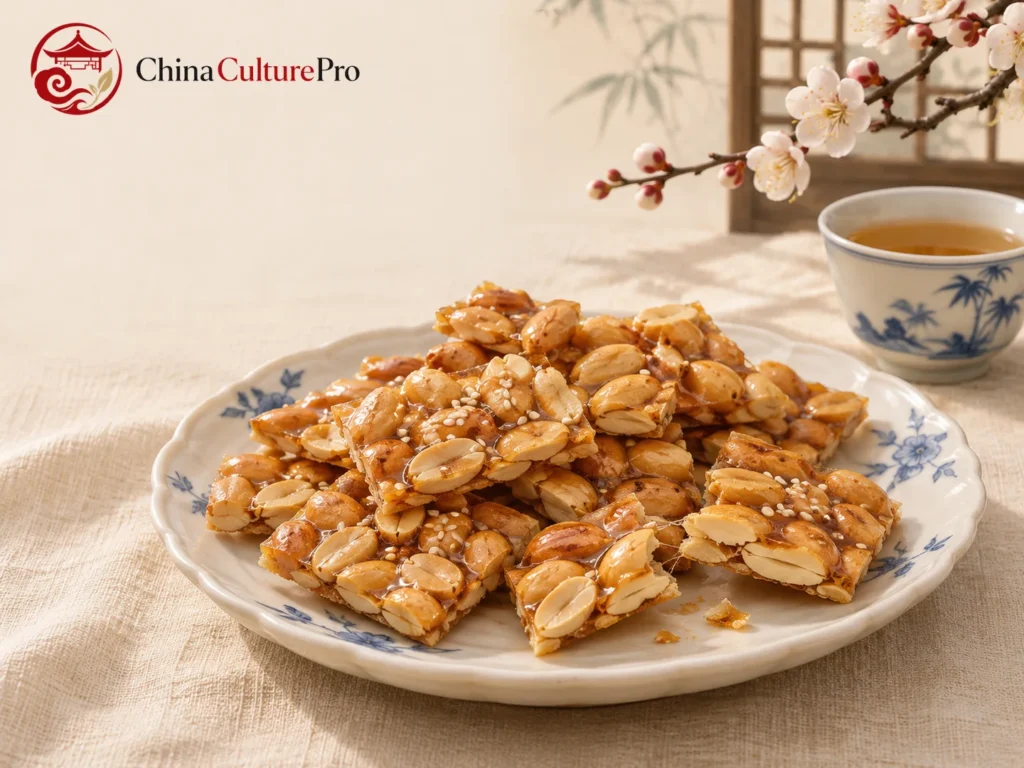

Quick Answer: What Is Chinese Peanut Brittle?
Chinese peanut brittle(花生糖,huāshēngtáng)combines peanuts with a sweet binder that sets into a crisp piece. The Chinese name also covers peanut candies with other textures.[1][6]
- Body: Peanuts provide the nutty taste and visible pieces.
- Binder: Cooked sugar syrup holds the nuts together.
- Additions: Sesame, different fats or sweeteners depend on the version.
- Serving: Small pieces are eaten as snacks or shared as gifts.
Brittle is the crisp style, not a guarantee that every candy called hua sheng tang will snap.

A broken edge shows the structure clearly: peanuts packed into a thin sweet layer. The balance between nut pieces and binder shapes the bite.
Peanuts, Sugar Binder and Optional Sesame
Peanuts supply the main roasted or cooked-nut character. Sugar forms the connecting layer, often alongside maltose syrup. White sesame can appear on the surface or within the mixture, adding a smaller seed crunch beside the larger peanut pieces.[1]
Other formulations use sugar with honey and butter. Some add sesame and puffed grains as a variation. These differences matter when identifying the flavor: a honey-and-butter brittle will not taste exactly like a simpler maltose-bound candy, even when both break crisply.[2]
The essential distinction is between the solid ingredients and what binds them. A large visible peanut content does not identify the syrup or added fats, and a sesame-speckled surface does not turn the whole piece into a purely sesame candy.
How Peanut Brittle Is Shaped
A familiar production sequence brings nuts and syrup together, then makes a slab that can be divided:[3]
- Prepare the peanuts so they have the intended nutty flavor and texture.
- Cook the sugar mixture into the binder.
- Mix the peanuts and any chosen additions through the syrup.
- Press or roll the mixture into a sheet or block.
- Divide it into pieces and allow it to finish setting.
The exact point at which makers cut varies between methods. What matters for recognition is the finished structure: nuts embedded in a set sweet layer, rather than loose nuts dusted with sugar. Slab thickness and peanut size can make two brittle pieces feel different without making either a different food family.[1][2]
Brittle, Crumbly Candy and Regional Names
Gongtang(贡糖,gòngtáng)is a regional peanut-candy name worth distinguishing from a clear, hard brittle. A documented Xiamen method pounds and folds peanut-and-sugar material, preparing fine particles for a center and a thin sugar layer to wrap around it. The result belongs to a crumbly, layered candy tradition.[4]
| Texture family | Pista para reconocerlo | Buying question |
|---|---|---|
| Crisp brittle | Distinct nuts held in a firm binder | Does it snap cleanly? |
| Crumbly peanut candy | Finer peanut material and a more powdery or layered bite | Is it flaky or crumbly? |
| Soft peanut candy | A yielding sweet binder rather than a brittle break | Is this the soft version? |
Commercial ranges in Taiwan include both crisp candy and soft peanut gongtang. A regional name therefore does not settle texture on its own. Ask how the particular product eats, rather than applying the English word “brittle” to every peanut sweet.[6]
For the wider family, see Chinese peanut and sesame candies. Sesame brittle shifts the emphasis toward seeds, while this page centers on peanut pieces and their binder.
Festive Sweets and Macao Craft Traditions
In Macao, peanut candy is both an everyday snack and a familiar festive gift, including at Lunar New Year. Small pieces make it easy to share, and the sweet food carries wishes for a happy, harmonious life in local festive interpretation.[3]
Macao added peanut-candy-making skills to its intangible cultural heritage inventory in August 2026. This is a local recognition of the craft; it does not establish one nationwide recipe or make every peanut brittle a designated heritage product.[5]
Choosing and Eating Peanut Brittle
Choose texture first: crisp, crumbly or soft. Then check plain peanuts versus sesame or other additions. If you want a delicate wafer crunch instead, sweet egg rolls offer a different structure.
Eat a small piece over a plate or wrapper to catch fragments. A thin slab and a thick nut-filled block need not break in the same way. “Crisp” describes the intended texture rather than a requirement that every piece be equally hard.
Peanuts are central, and sesame may be present. Check the actual fats and sweeteners too: butter and honey occur in published versions. A simple-looking peanut sweet is not automatically dairy-free or vegan, and any dietary restriction requires checking the complete product ingredients.[2]
FAQs About Chinese Peanut Brittle
Does Chinese Peanut Brittle Always Contain Sesame?
No. Sesame is a familiar addition, but peanuts can remain the main solid ingredient without it. Check the specific version.[2]
Is All Hua Sheng Tang Hard and Brittle?
No. The broader peanut-candy family includes crumbly and soft products. Ask about texture when the English translation is unclear.[6]
Is Peanut Brittle Automatically Vegan?
No. Some versions use butter or honey. Confirm the binder, fats and any additional ingredients instead of judging only by visible peanuts.[2]
Fuentes
[1] PY’s Kitchen. Chinese Peanut Brittle: Hua Sheng Tang
[2] Maggie Zhu. Chinese Peanut Brittle
[3] Macao Cultural Heritage. Peanut-Candy-Making Skills
[4] Ministry of Commerce Digital Museum / Xiamen Bailu Foods. Bailu: Gongtang Production Process
[5] Macao Cultural Affairs Bureau. New Additions to the Intangible Cultural Heritage Inventory
[6] Liang Handmade Peanut Candy. Peanut Candy: Craft and Product Variations