

Quick Answer: What Were Chinese Imperial Edicts?
Chinese imperial edicts were commands issued in an emperor’s name. The English label covers documents with different purposes, audiences and physical forms. [1][2]
- Purpose: Some proclaimed major events; others granted titles or addressed particular affairs.
- Materials: Surviving examples include paper documents and silk honorary patents.
- Preparation: Imperial authority did not mean every surviving text was personally handwritten by the ruler.
- Circulation: An original, a distributed copy and an archival transcription could serve different roles.
A yellow silk scroll is one recognizable form, not a template for every dynasty or every imperial command. Identifying the document’s function is more useful than judging by color alone. [2]
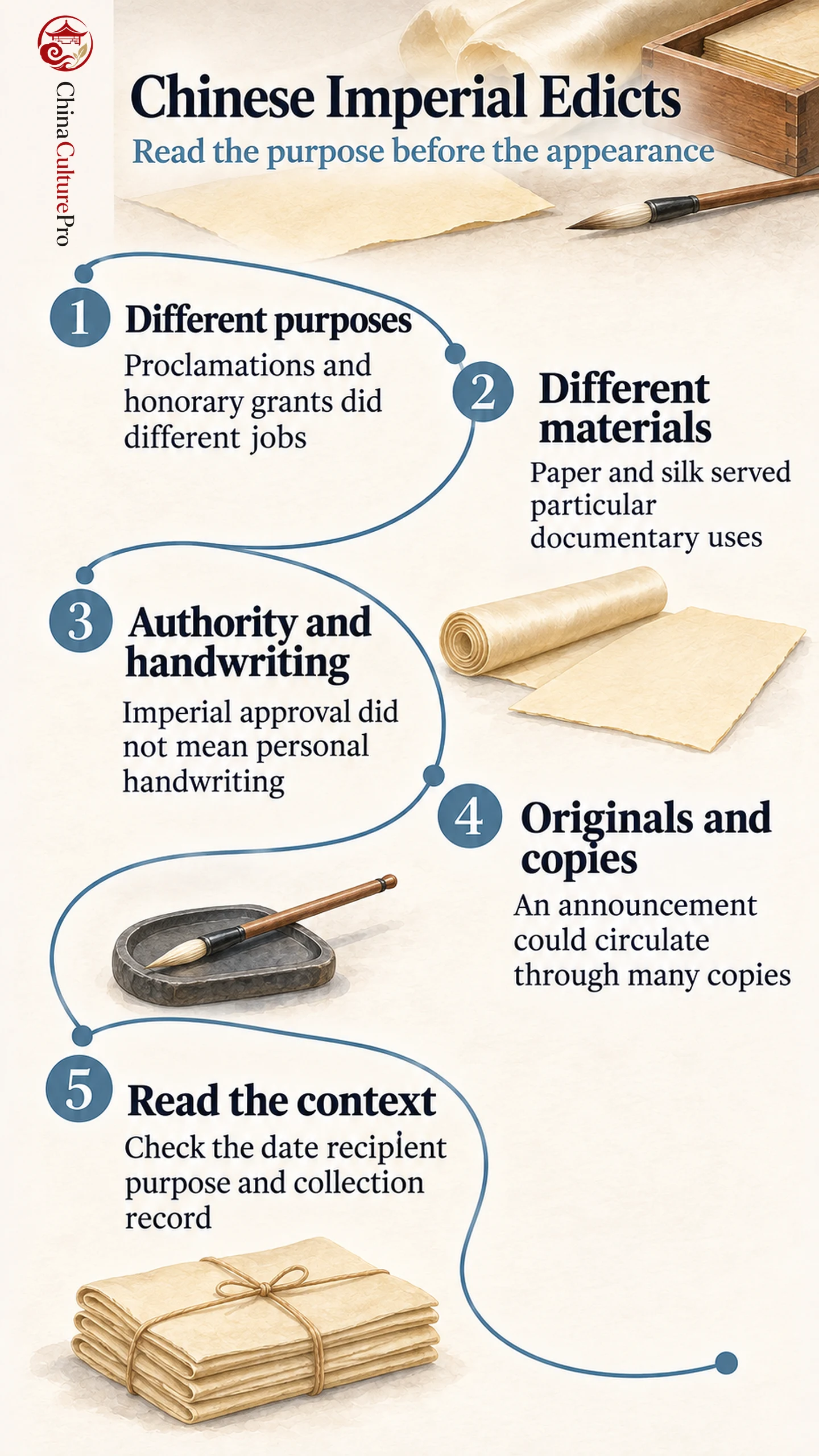
A museum case may hold a long silk scroll, a sheet of decorated paper or a bound archival copy. Each can illuminate imperial government. Reading these objects alongside Chinese history means asking who issued the order, whom it addressed and how it reached its readers.
One English Label, Several Chinese Document Types
Shengzhi(圣旨,shèngzhǐ)is a broad term for an emperor’s commands. Within that umbrella, zhaoshu(诏书,zhàoshū)often refers to a formal proclamation, while gaoming(诰命,gàomìng)and chiming(敕命,chìmìng)include honorary grants concerning officials and their families. In Ming and Qing honorary practice, the distinction between the latter two was associated with official rank. It should not become a universal glossary for all Chinese history. [1][2]
A chiyu(敕谕,chìyù)could address particular people or affairs. A surviving Ming directive protected Chengen Temple’s property: it was an instrument of protection and instruction, rather than an empire-wide accession announcement. English translations such as “edict,” “decree” and “patent” therefore need their historical context. [3]
Paper, Silk and the Shape of a Document
The 1513 Chengen Temple directive was written on decorated yellow paper. Its present hanging-scroll appearance also reflects later museum mounting. The distinction matters: the original writing support and the object’s current display format need not be identical. [3]
A different object, a 1737 honorary patent, was written on silk and concerned an official’s grandfather and grandmother. Its long, scroll-like format suits the image many readers associate with an imperial command, but its purpose was a family honor. [4]
These examples undermine the assumption that official dignity required one material. Paper did not by itself indicate lower status, and silk did not make a document a public proclamation. Ask what the support allowed the document to do and what its catalog actually identifies.
Who Wrote an Emperor’s Commands?
The ruler could approve a command without writing out the finished copy. The Qing proclamation system involved drafting officials, imperial approval and further preparation for distribution. Personal authority and physical handwriting were separate questions. [1]
The Ming temple document’s historical discussion likewise describes officials composing and writing imperial texts, while noting exceptions in the ruler’s own hand. “Issued by the emperor” is therefore not equivalent to “written personally by the emperor.” [3]
There are attributed examples of imperial handwriting. One surviving instruction by the Ming founder concerns land and revenue records in Yingtian and six counties; its collection record identifies paper and red-ink writing. That is evidence for this particular work, not proof that every red annotation or official document was an autograph. [5]
Seals, Languages and Official Authority
In the 1737 patent, Manchu and Chinese writing approach the central dating area from opposite sides, and a bilingual red seal identifies its official character. The languages, arrangement, date and seal belong to a particular documentary convention. [4]
Other instruments used different formulas and seals according to function. The Chengen Temple directive, for example, has its own opening, closing and seal placement. [3]
An imperial seal is thus one part of the evidence. Reading a seal alongside the text, material and provenance provides context; a visible red impression alone cannot settle authenticity. Likewise, the language of the Mandate of Heaven expresses a claim to legitimate rule, rather than proving how an individual decision was implemented.
From Palace Announcement to Provincial Copies
For major Qing proclamations, a capital announcement was followed by duplication and provincial circulation. The sealed original and the copies used to spread its message were not interchangeable physical objects, even when they transmitted the same command. [1]
A late Qing imperial wedding provides a vivid ceremonial example. Officials read the proclamation at Tiananmen, lowered it in a golden phoenix device and transferred it to the Ministry of Rites for printing and distribution. This was a ceremonial practice for a major state occasion, not the delivery method for every routine order. [6]
The longer journey depended on administration and communication. The related guide to Chinese postal stations explains another part of that infrastructure.
Edicts, Memorials and Imperial Replies
A palace memorial generally moved upward: an official reported information or submitted a matter to the emperor. An imperial rescript was the ruler’s response, sometimes written in vermilion on the submitted document. Topics ranged from military affairs and appointments to agriculture and local conditions. A command moving downward and a report moving upward are different parts of the exchange. [7]
The paperwork did not stop at the reply. Grand Council records include transcriptions, dispatch registers, collected orders and dossiers. A museum object may consequently be a preserved copy within an administrative series, rather than the first sheet that passed through imperial hands. [8]
How to Read an Imperial Document in a Museum
Start with the catalog’s document type and date, then identify the recipient and purpose. Compare the writing support with any later mounting. Separate an autograph attribution from an issuing authority, and an original from a copy.
Look beyond impressive brushwork. Chinese calligraphy helps explain the visual form, but administrative context explains the document’s job. Archival collections contain examination papers, memorials and other records alongside commands; imperial provenance does not turn every item into an edict. [9]
Finally, distinguish what a text ordered from evidence of what happened afterward. That distinction follows the same care needed when separating history from later storytelling.
FAQs About Chinese Imperial Edicts
Were All Imperial Edicts Yellow Silk Scrolls?
No. Surviving examples include paper directives and silk honorary patents. Material and format varied with the document’s purpose and historical setting. [3][4]
Did the Emperor Personally Write Every Edict?
No. Officials prepared many texts issued in the ruler’s name. An attribution to the emperor as author or authority does not automatically establish personal handwriting. [3][5]
Were Qing Imperial Documents Always Bilingual?
No. Many formal proclamations used Manchu and Chinese, but that convention should not be extended to every kind of Qing paperwork. Identify the particular document and its intended use. [1][7]
Does an Imperial Seal Prove a Document Is Genuine?
No. A seal impression needs to be considered with the wording, date, materials, provenance and documentary form. This overview cannot authenticate an individual object.
Fuentes
[1] Museum of the Institute of History and Philology. The First and the Last Mandate from the Emperors
[2] Chinese Museums Association. Exhibition of Imperial Edicts from the Xuzhou Museum Collection
[3] Beijing Municipal Cultural Heritage Bureau. The Ming Chengen Temple Imperial Directive Preserved at the Capital Museum
[4] National Museum of History. Qing Dynasty Patent by Command, Collection 105-00028
[5] National Palace Museum. Imperial Penmanship of Emperor Taizu: Edict on Yingtian and Six Counties
[6] Palace Museum. Qing Imperial Wedding Ceremonies
[7] National Palace Museum. Palace Memorials with Imperial Rescripts in Vermilion Ink
[8] National Palace Museum. Grand Council Archives
[9] Museum of the Institute of History and Philology. Archives of the Grand Secretariat