

Quick Answer: What Is a Chinese Folding Fan?
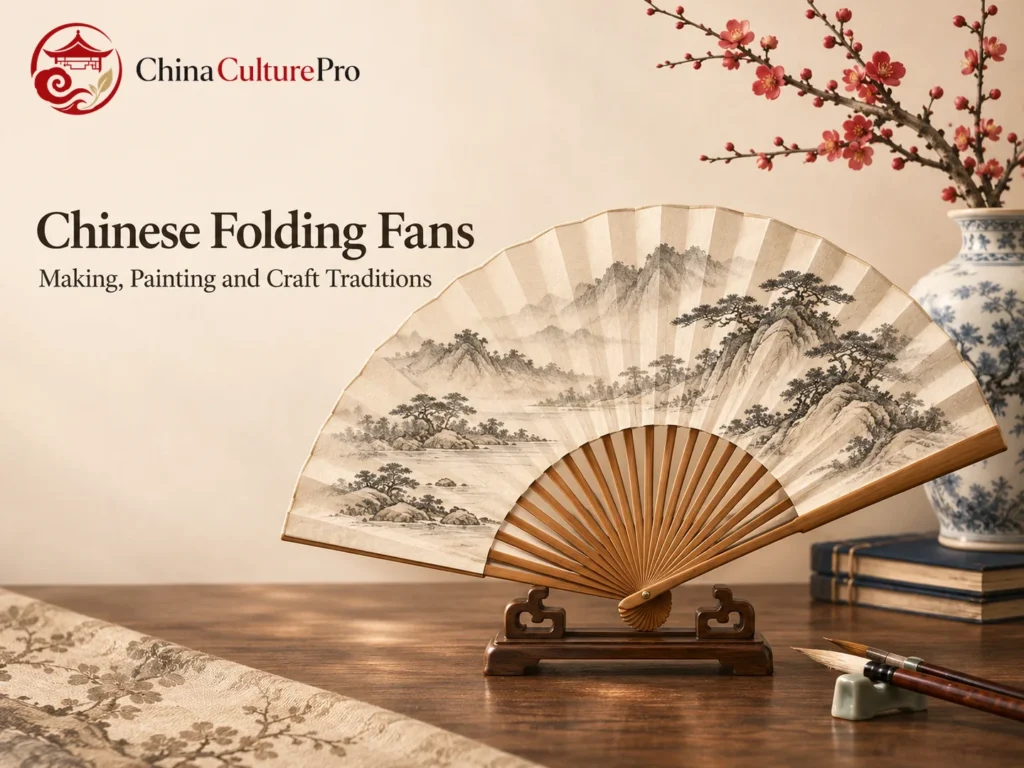
A Chinese folding fan (折扇, zhéshàn) opens around a pivot where its ribs meet. The ribs spread apart as the fan opens and carry the pleated leaf into an arc. The ribs and the leaf can also carry decoration, including carving, painting or writing.[1][2][4][6]
- Frame: The ribs support the leaf, and the outer ribs form its edges.
- Leaf: Paper or fabric provides the moving surface and can carry an image.
- Record: A museum may hold a complete fan or a leaf mounted separately.
Read the frame and the leaf separately before interpreting the complete object.
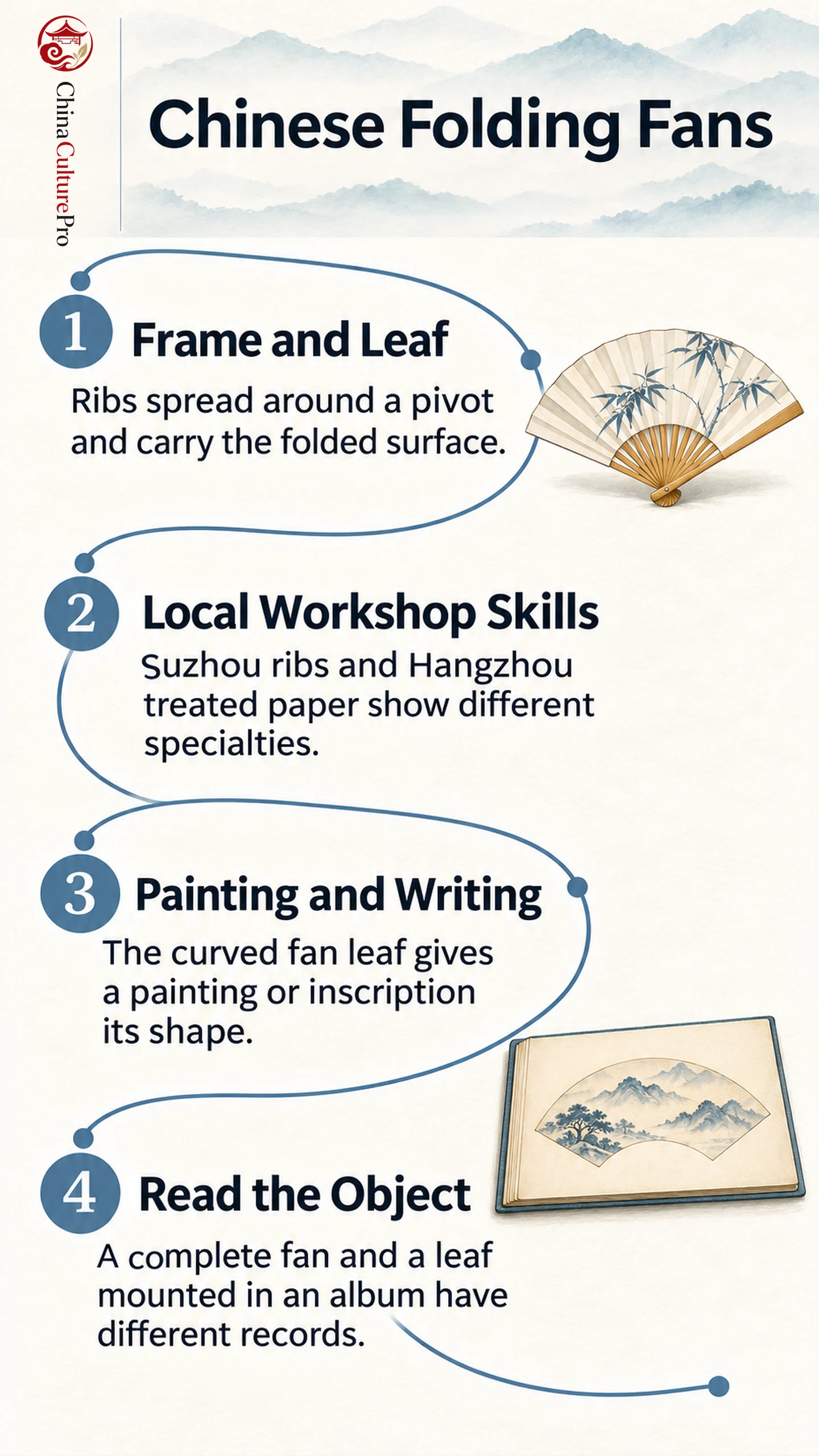
A painted landscape can open in the arc of a fan or sit flat on an album page. The paper may be the same. The frame and the way the leaf is mounted tell you how the object was used and viewed.
Ribs, Guards, Pivot and Fan Leaf
| Parte | What it does |
|---|---|
| Ribs | Narrow members support the leaf and spread from the base. |
| Guards | The outer ribs form the fan’s edges and can carry their own carving. |
| Pivot | A connection at the base lets the ribs rotate together. |
| Fan leaf (扇面, shànmiàn) | The folded surface spans the ribs and opens into an arc. |
The folds allow the surface to move between a narrow closed form and a broad open one. Looking from the side can show where the leaf meets a rib. Preparing the frame, attaching the leaf and decorating the surfaces are distinct jobs, as in many traditional crafts.[1][2][3]
Suzhou and Hangzhou Fan Making
Suzhou’s craft inventory includes folding fans alongside other fan types. Its description highlights the shaping and polishing of bamboo ribs. When a fan closes, more of the leaf disappears between the ribs. The guards can remain visible, giving their finish and shape a role in the closed object.[1]
Hangzhou’s Wangxingji (王星记, Wángxīngjì) tradition includes black paper fans. A heritage account describes paper treated with a persimmon-based coating and other forms of decoration. The dark paper describes the leaf and its surface treatment. The frame can still be read separately through the material and finish of its ribs.[2][3]
The two inventory entries record different workshop specialties. Suzhou’s entry covers several fan forms and calls attention to the finish of the ribs. The Hangzhou record and the black-paper example give a closer look at how the leaf itself can be treated. Treat each as a documented workshop example.[1][2][3]
Painting and Calligraphy on a Folding Surface
A painted fan leaf has an arcing top edge and a shorter inner edge. The painter can place a subject along the wider part of the arc or let a line of writing follow the available shape. Images and inscriptions can share the same surface, bringing Chinese painting and calligraphy into a format meant to open and close.[4][5]
A landscape dated 1699 by Shitao (石涛, Shítāo) in the Met collection uses ink and color on gold-flecked paper. The catalogue describes a folding fan mounted as an album leaf. The arc still shows the fan format. The current mounting places the painting on an album page.[5]
Shitao’s inscription discusses his idea of a single stroke. A close view can reveal the painted scene and the artist’s reflection on painting on the same leaf. The paper support gives them a shared shape.[5]
Complete Fans, Detached Leaves and Museum Records
Compare Shitao’s painted leaf with a complete folding fan in the same collection. The latter has plain paper and bamboo guards carved by Jin Xiya (金西厓, Jīn Xīyá) in 1960. His outer-rib decoration includes a spider and bamboo. The carved frame carries the image, and the paper is plain.[6]
In museum collection records, check whether the medium describes an assembled frame, a separate leaf or a later mounting. The artist credit may name a painter or a frame carver, depending on what the museum records. The material description and artist credit together help you find the work that is being attributed.[4][5][6]
The Palace Museum’s complete-fan catalogue includes folding fans and fixed round forms. It lists several paper and textile materials. A curved edge on a mounted painting can suggest the shape of an earlier fan leaf, while the record can establish how the museum classifies the object now.[7]
FAQs About Chinese Folding Fans
Is every Chinese fan a folding fan?
Chinese fan traditions include fixed forms as well as folding ones. The pivot and ribs distinguish the folding structure.
Are Chinese folding fans always made with paper?
Paper is a familiar leaf material. Some fans use fabric, and the ribs or guards can be made from other materials.
What is the difference between a fan and a fan leaf in a museum?
A complete folding fan includes a frame and leaf. A fan leaf can survive separately or be mounted on an album page.
Can the ribs be decorated when the leaf is plain?
Yes. Jin Xiya’s fan in the Met collection has plain paper and relief carving on the outer ribs.
Fuentes
[1] China Intangible Cultural Heritage Digital Museum. Fan-Making Techniques: Suzhou
[2] China Intangible Cultural Heritage Digital Museum. Fan-Making Techniques: Wangxingji
[3] China Intangible Cultural Heritage Digital Museum. Traditional Craftsmanship: Wangxingji Fans
[4] The Palace Museum. A Brief History of Complete Fans and Collecting Painted and Inscribed Folding Fans
[5] The Metropolitan Museum of Art. Shitao: Landscape, 1989.363.153
[6] The Metropolitan Museum of Art. Folding Fan with Bamboo Frame Carved with Spider and Bamboos, 2020.346
[7] The Palace Museum. Illustrated Catalogue of Complete Fans in the Qing Palace