


Quick Answer: How Should You Approach Cultural Taboos?
Common Chinese taboos connect certain objects, sounds or actions with unwanted meanings. Understanding the association helps you make a considerate choice; it does not establish what every person believes.
- Know the association: A clock, pear or green hat can carry a meaning beyond its practical use.
- Check the occasion: Celebration, mourning and an ordinary visit call for different choices.
- Notice the household: Personal preference matters when applying a general cultural guide.
- Respond calmly: A small misunderstanding usually calls for a courteous adjustment, not an elaborate performance.
These are cultural associations and social expectations, not evidence that an object or number causes good or bad fortune.
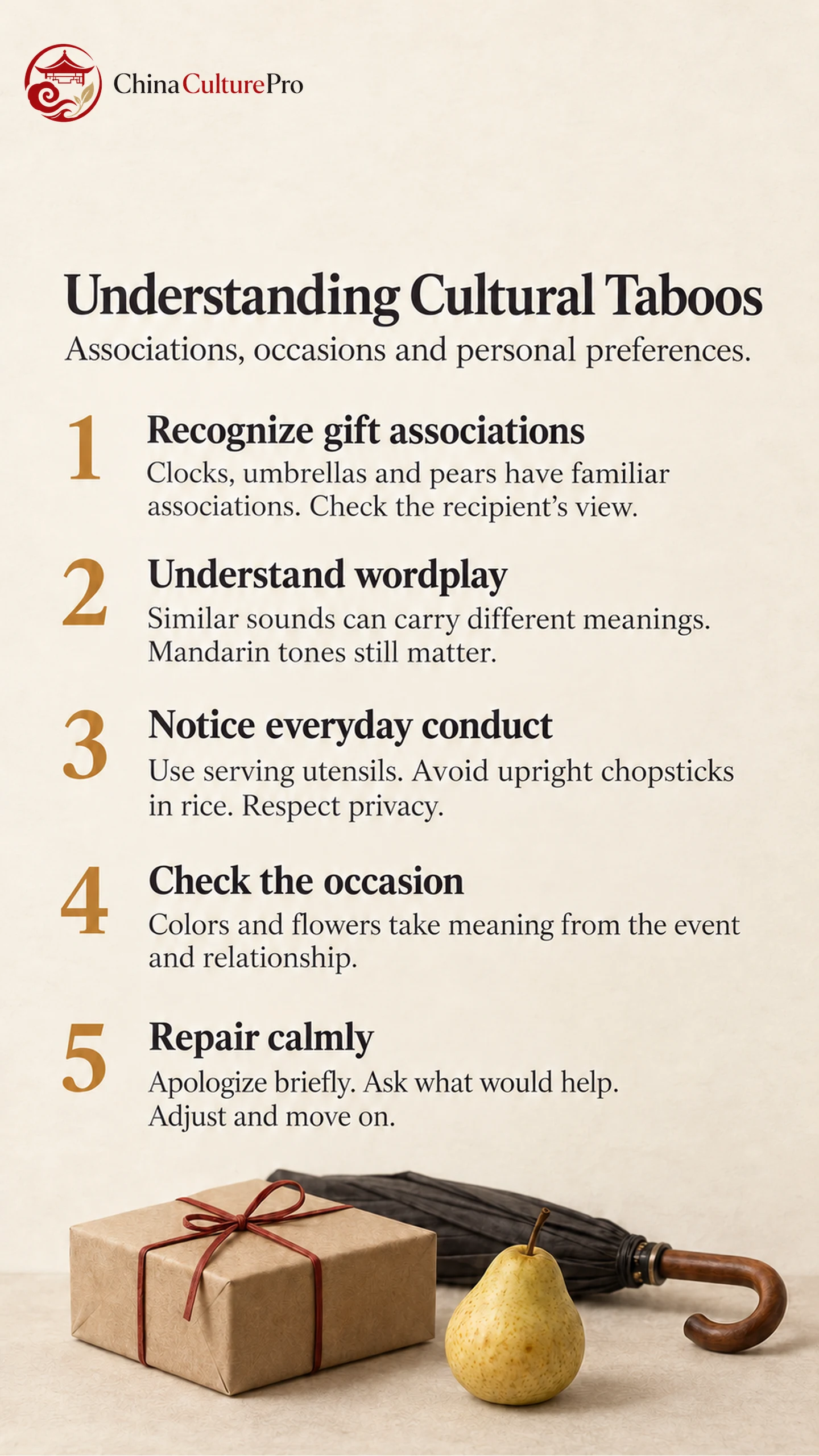
A list of forbidden gifts can make everyday life look more precarious than it is. The useful question is what an action may communicate in a particular relationship: a wish for celebration, an association with separation or a reminder of mourning.
This guide explains common examples and the distinctions behind them. Chinese superstitions covers the wider belief context; gift-giving etiquette focuses on selecting and presenting a gift.
Gift Choices and Their Associations
The following are familiar cautions to recognize when choosing a symbolic or formal gift. They are not statements that the objects themselves are unusable.
| Gift or action | Association you may encounter |
|---|---|
| Giving a clock | A sound association with attending someone at the end of life |
| Giving an umbrella | A sound association with parting or dispersing |
| Giving or sharing a pear | A sound association with leaving or separation |
| Giving shoes | Associations with an unwelcome sound or someone walking away |
| Giving a green hat | An idiom suggesting a man’s partner is unfaithful |
| Giving chrysanthemums | A possible reminder of mourning, alongside other cultural meanings |
These are documented associations, and some people attach little importance to the customs.[1] They are useful questions to check rather than assumptions about a recipient.
In New Year gift customs, knives or scissors can symbolize cutting a relationship, while funeral-associated items can feel unsuitable for a festive exchange.[3] A requested kitchen tool and a symbolic New Year present are different situations. Ask what the person wants before assuming a useful object must be rejected.
For a first home visit, something modest that the household can enjoy often solves the problem more simply than an elaborate symbolic gift.
Why Wordplay Matters
Xieyin (谐音, xiéyīn) means sound-based association or wordplay. The association can involve the same pronunciation or merely a similar sound. Keeping the Chinese words and tones visible prevents an explanation from turning into a false translation.
| Ejemplo | Mandarin sound connection | Distinction |
|---|---|---|
| Giving a clock | 送钟 (sòng zhōng) and 送终 (sòng zhōng), attending someone at the end of life | The phrases share a pronunciation |
| Pear and leaving | 梨 (lí) and 离 (lí) | The words share a pronunciation but have different meanings |
| Umbrella and dispersing | 伞 (sǎn) and 散 (sàn), dispersing or parting | These readings differ in tone |
Four, 四 (sì), is associated with death, 死 (sǐ), through a similar sound; the Mandarin tones are different.[2] An umbrella does not literally mean separation, just as four does not literally mean death. The cultural association depends on hearing one expression through another.
Do not treat an English object label as the explanation. The well-known clock example concerns a Chinese phrase, so it cannot by itself prove that every timepiece is viewed identically. A recipient’s preferences still need checking. The Chinese homophones guide explains wordplay; the guides to unlucky numbers and the number four explore numerical associations.
Meals, Conversation and Everyday Boundaries
Some cautions concern conduct rather than a gift’s symbolism. At a shared meal, use serving utensils when provided and avoid searching through the communal dish with your own chopsticks. Do not leave chopsticks standing upright in a bowl of rice; place them on a rest or a suitable edge instead.[4]
These concrete actions are easier to follow than an abstract instruction to “be respectful.” The table manners guide and chopstick etiquette guide provide the dining context, including how to respond to the host’s arrangements.
In conversation, give a new acquaintance room to decide how much personal information to share. If a question about age, marriage or income feels too personal, a brief answer or change of subject can preserve your boundary. You do not need to answer in detail to demonstrate cultural understanding.
Treat a private home, a workplace and a ceremonial setting as different spaces. Ask before photographing people or entering an area that is not clearly open to guests. When uncertain, a question about the particular action is more useful than asking whether something is “forbidden in China.”
Match Colors and Customs to the Occasion
Colors acquire meaning through their use. Red has familiar celebratory associations, while white can evoke mourning.[2] That does not make every white object a funeral message or every red object suitable for every gathering. Clothing, flowers, wrapping and a ritual object need to be considered separately.
Chrysanthemums illustrate the same point: they can carry associations of elegance and resilience as well as remembrance of the dead.[1] A plant’s meaning in painting need not dictate how a bouquet will be received at a celebration.
Consult the specific occasion rather than combining every caution into one list. New Year taboos, wedding expectations and funeral guest etiquette address different situations.
The pages on white, red and green explore their wider contexts. In particular, the green-hat idiom is about a specific object and expression; it is not a prohibition on green clothing generally.
If You Make an Awkward Mistake
If someone explains that a gift or action is uncomfortable, respond to that person’s preference. There is no need to announce the supposed meaning to everyone present or insist that the recipient must share a traditional belief.
- Acknowledge the moment: Offer a brief apology without turning the incident into a spectacle.
- Ask what would help: Let the host or recipient explain what they would prefer.
- Adjust the action: Change the gift or behavior if requested, then allow the conversation to move on.
A simple “I didn’t realize that association; thank you for explaining” can be enough. The guide to Chinese apologies and politeness covers repair expressions in more detail.
If the recipient is comfortable with the gift, accept that answer too. Cultural knowledge should help you understand another person, rather than override what they have just told you.
FAQs About Chinese Cultural Taboos
Is an umbrella always an unacceptable gift?
No. The parting association is useful to recognize, especially for a symbolic couple’s gift. A practical request from someone who wants an umbrella is a different context.
Must every number containing four be avoided?
No. Some people avoid it in symbolic choices, but the sound association does not create a universal rule for every date, address or number.
Does white always mean mourning?
No. Meaning depends on the object, occasion and person using it. Check specific event guidance rather than applying one color rule to all clothing, flowers and gifts.
What if I have already given an awkward gift?
Listen to the recipient. If they are uncomfortable, apologize briefly and offer to change it. If they are happy with it, you do not need to manufacture a problem.
Fuentes
[1] Confucius Institute at the University of Adelaide. Taboo Gifts in China, Chinese Conversation Corner teaching handout
[2] Cheng & Tsui. 10 Dos and Don’ts of Gift-Giving in Chinese Culture
[3] Chinaculture.org. Do’s and don’ts during Chinese New Year: Select gifts carefully
[4] Ministry of Culture and Tourism, Travel China. Dining Etiquette for Visiting Relatives and Friends