
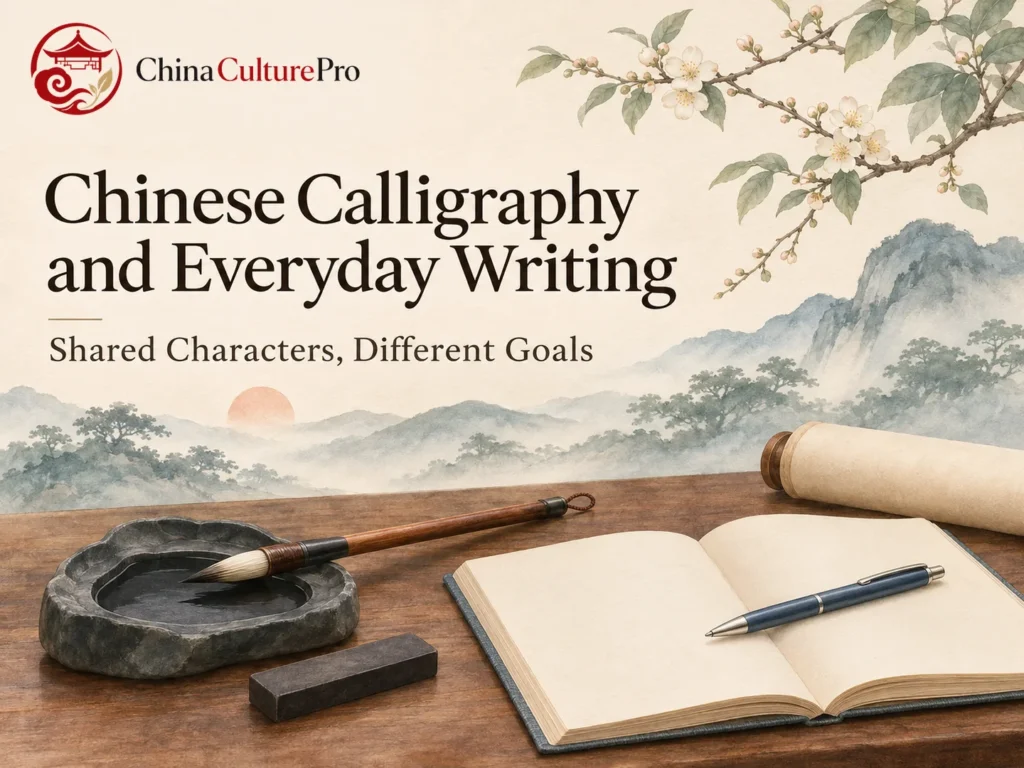

Quick Answer: How Is Calligraphy Different from Everyday Chinese Writing?
Chinese calligraphy (书法, shūfǎ) is an artistic practice using Chinese characters (汉字, hànzì). Everyday writing (写字, xiězì) mainly serves practical communication. They share a writing system and learned conventions, but calligraphy gives particular attention to the expressive qualities of strokes, character structure and the whole composition.[1][2]
- Shared foundation: The words and characters remain part of a writing tradition, not a separate calligraphy alphabet.
- Different emphasis: Practical clarity and artistic expression can overlap in the same work.
- Script choices: Several script types can serve both ordinary and artistic purposes.
- Viewing: Understanding the text helps, but visual rhythm and ink handling also deserve attention.
This comparison describes useful emphases, not a rigid border. A letter can communicate information and also be valued as calligraphy.[2][7]

A clear handwritten note and a museum handscroll can use related character forms while asking different things of a reader. One needs to deliver its message efficiently; the other may also invite attention to movement, balance and the handling of ink. Both sit within the wider world of Chinese writing.
Shared Characters, Different Emphases
Calligraphy is an art of writing. Its distinction lies in what a writer cultivates and what a viewer attends to, not in replacing Chinese with an unrelated code. The broader calligraphy guide introduces its cultural history.[1]
| Pregunta | Everyday writing often emphasizes | Calligraphic practice also emphasizes |
|---|---|---|
| What must the marks do? | Convey the intended words clearly | Give written form an expressive visual presence |
| How is a character judged? | Recognizable structure and useful legibility | Relationships among strokes, weight and movement |
| How does the page work? | Convenient organization for the task | Rhythm, spacing and the balance of the whole work |
| What is the setting? | Notes, forms, letters and other practical tasks | Study, exchange, display and artistic interpretation |
A carefully written letter can have artistic value, and a calligraphic work still contains words. UNESCO’s description of the practice includes letters, scrolls and fan coverings among its surfaces.[7]
Script Type Is Not the Same as Personal Style
A script type supplies construction conventions; an individual style reflects choices within or across them. Artists using the same type can produce different visual results.[2]
| Script type | Useful description |
|---|---|
| Regular script (楷书, kǎishū) | Distinctly articulated strokes and clearly organized character structures. |
| Running script (行书, xíngshū) | Abbreviated or linked movements with relatively readable forms. |
| Cursive script (草书, cǎoshū) | Conventional abbreviations and connections that require special training to read. |
These three types are examples, not a complete catalogue. Other calligraphic script traditions include additional historical forms. The history of character evolution helps place them without treating each as a style that completely replaced its predecessor.[3][4][5]
Running forms have a close relationship with convenient freehand writing. Cursive abbreviations, however, need learned conventions; writing a regular character carelessly or rapidly does not automatically produce a recognized cursive form.[4][5]
What Brush, Ink and Composition Add
Brush movement, stroke thickness and ink density contribute to calligraphic expression. Character size, spacing, and contrasts between wetter and drier ink can establish rhythm across a work.[2]
The tools matter because they make particular marks possible. The Four Treasures of the Study (文房四宝, wénfáng sìbǎo) comprise the brush, inkstick, paper and inkstone.[8] Owning them does not by itself settle the artistic quality of what is written; control and considered practice remain central.
Calligraphy and painting have shared materials, but they organize them around different tasks. The calligraphy–painting comparison explains that connection. Here, the important point is that the text and its written form work together.[1]
One Text Can Also Be an Artwork
An identified example makes the overlap concrete. Mi Fu (米芾, Mǐ Fú) wrote Poem Written in a Boat on the Wu River (吴江舟中诗, Wújiāng zhōu zhōng shī), a handscroll dated about 1095 and now in the Metropolitan Museum of Art. Its medium is ink on paper.[6]
The museum’s account emphasizes expressive brush movement and character distortion, rather than the production of uniformly perfect forms. That makes it a useful counterexample to judging every work by the standard of a tidy notebook.[6]
It is also a poem. Its literary content and visual execution are both part of the encounter; one does not replace the other. The wider guide to Chinese poetry supplies context for the words, while calligraphic study concerns how those words take material form.
The example does not mean that all calligraphy should look distorted or that visible irregularity proves mastery. It shows why an artwork’s identified script, format and artistic setting matter when choosing how to assess it.
Looking at Calligraphy When You Cannot Read It
Begin with visible relationships: stroke density, changing sizes, ink variation and the balance between written and blank areas. Appreciating these qualities does not require pretending to translate the text.[2]
Then add textual context. Look for the artist’s name, the script type, a transcription or translation, and an explanation of the format. A handscroll, a fan and a hanging work organize a viewer’s experience differently. Reading direction is another question to establish before following individual lines.
Keep text identification and visual judgment connected. The guide to reading Chinese calligraphy develops that approach. An unfamiliar character shape can reflect a historical convention rather than an artist inventing a new word.[5]
Choosing Practice for Your Actual Goal
For useful everyday handwriting, prioritize recognizable characters, stable structure and writing that suits the task. Stroke-order principles help explain the construction of individual forms.
For calligraphic study, choose a particular script and a suitable model, then examine how its strokes and structures work. Beginning calligraphy and copybook traditions address that more specific task. Switching randomly between unrelated-looking forms makes comparisons harder.
Practice is also part of cultural transmission. Chinese calligraphy was inscribed on UNESCO’s Representative List in 2009, and its description includes teaching through both apprenticeship and schools. The heritage is a learned practice, not just a set of images to reproduce.[7]
FAQs About Chinese Calligraphy and Writing
Does neat handwriting automatically count as accomplished calligraphy?
Neatness can be useful, but it is only one quality. Calligraphic appreciation also considers stroke relationships, rhythm, ink handling and composition in a particular tradition.[2]
Is cursive calligraphy just writing very quickly?
No. Cursive forms use conventional abbreviations and connections that require study. Speed alone does not produce those conventions.[5]
Do traditional characters or vertical layout make a text calligraphy?
No. Character-form conventions and page layout do not establish artistic accomplishment. Consider the writing’s purpose, execution, script tradition and context.
Fuentes
[1] Delbanco, Metropolitan Museum of Art. Caligrafía china
[2] Asian Art Museum. An Introduction to Chinese Calligraphy
[3] Smithsonian National Museum of Asian Art. Standard Script
[4] Smithsonian National Museum of Asian Art. Running Script
[5] Smithsonian National Museum of Asian Art. Cursive Script
[6] Metropolitan Museum of Art. Mi Fu: Poem Written in a Boat on the Wu River
[7] UNESCO. Caligrafía china
[8] Smithsonian National Museum of Asian Art. Four Treasures of a Scholar’s Studio